Published on 6/20/2026
When we look at the clock, time appears to be a clear thing. We may notice a hand moving, or a number changing, expressing the passage of seconds, but physics, as usual, does not let obvious matters pass peacefully. The deep question here revolves around the origin of time itself, and whether it is something that exists in itself, like a hidden river running in the background of the universe, or does it only appear when things change.
In other words, if we assume that everything in the universe is completely frozen, without the slightest movement, even at the level of electrons and quarks, will there still be time that passes?
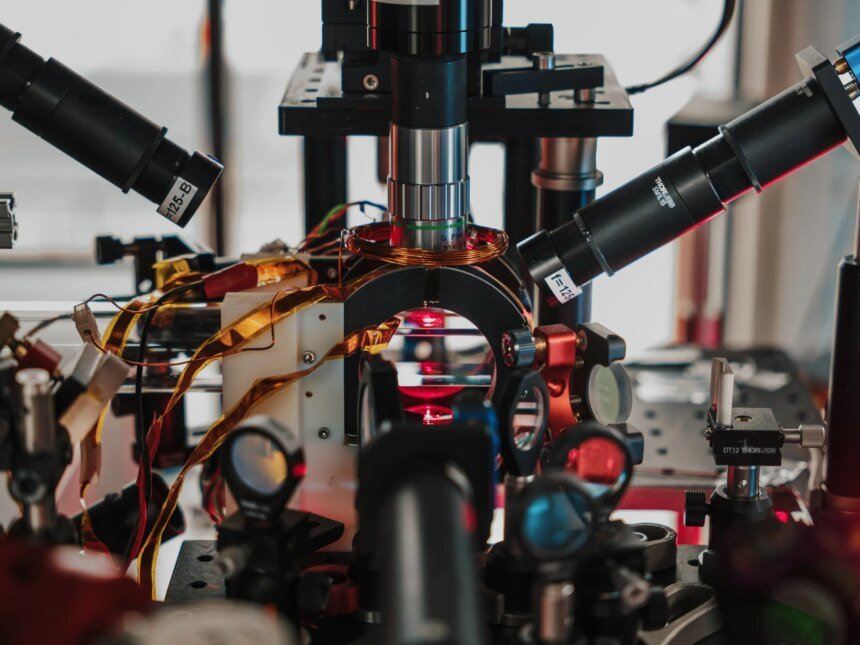
This old question has returned to the forefront after a recent experiment by a physicist from the University of Birmingham, Giovanni Barontini, in which he created a “small universe” inside the laboratory. Of course, the researcher did not create a universe of galaxies and stars, but he built a highly isolated quantum system of ultra-cold atoms, which can be used as a simplified model to test this strange idea, according to the study recently published in the journal Physical Review Research.

The problem of time
To understand the importance of experience, we must start from our daily lives. Time is clear because we compare it to regular changes, for example in the rotation of the Earth, or the vibration of an atom in an atomic clock, or the movement of a scorpion, or the change of telephone numbers.
But what if we are talking about the entire universe? There is no clock outside the universe, no observer standing outside it and saying that the beginning happened now, and then in a minute the next thing happened, and so on.
Here one of the most difficult problems in theoretical physics appears, sometimes called the “time problem” in quantum gravity. When physicists try to combine general relativity, which describes gravity and space-time, and quantum mechanics, which describes atoms and particles, strange equations appear in which time is not clear as we know it.
One of the most famous of these equations is the Wheeler-DeWitt equation, which deals with the universe as a single quantum state, with no external time moving from the past to the future.
But we live in time, we feel before and after, and we remember yesterday but not tomorrow, so where does this feeling that time is moving forward come from? Barontini’s experiment does not solve the final mystery, but it does open a small window into it.

A universe of atoms
The researcher used a cloud of about 24,000 ultra-cold atoms, in a precise quantum state, and placed them in a conservative trap, isolated as much as possible from the outside world. The cloud was then divided by a thin light barrier into two regions, the first of which can be observed and its development measured, and the second of which is not directly observed.
In this system, the atoms were moving and distributed between the two regions. The observed part was expanding and contracting periodically, so the researchers used a cosmic analogy. This system is like the universe, expanding and contracting.
What the researcher did was that he used these experiments to try to define a kind of “internal time” based on the change in entropy within the system itself. Entropy is a measure of disorder. For example, if you leave your organized room for months, you will return to find it less organized. Here we say that the entropy has risen (the example is intended for approximation).
In experiments, when the distribution of atoms changes between the observed and unobserved region, there is a meaning to the passage of time within this microcosm, and when the distribution does not change, internal time, by this definition, becomes as if it has stopped.
Here the researcher concluded that the external clock is not what tells the system what is happening, but rather the internal changes that create the order of events. This idea is sometimes called “relational time,” meaning that time is not a ready-made background over which events move, but rather emerges from the relationship between the parts of the system.
For example, we do not feel time in a complete vacuum in which nothing happens. For us, time is read from the change of light, the beating of the heart, the movement of people, the growth of hair, the aging of the body, and the rotation of the planets.
In this context, without change, the question of the passage of time becomes impractical. Of course, this remains one experiment, and scientists still need more confirmation of it, but the beauty of the experiment is that the researcher did not limit himself to a philosophical idea, but rather tried to put it to a physical test.