Published on 6/20/2026
|
Last update: 16:32 (Mecca time)
What happens when the school loses its ability to impose order, when the teacher is powerless to protect his students, the students are powerless to protect themselves, and the laws are too slow to prevent tragedy? From this perception begins the series “Teach You a Lesson,” one of the latest Korean works that takes school as an arena to ask questions that go beyond education, and touch on authority, justice, and punishment.
The series began showing on the Netflix platform in June 2026, and consists of 10 episodes. It is adapted from the famous webtoon/comic story (True Education), starring Kim Mo Yeol, Lee Seung Min, Jin Ki Joo, and Byo Ji Hoon, under the direction of director Hong Jong Chan, and a script by Lee Nam Gyu.
Justice with an iron fist
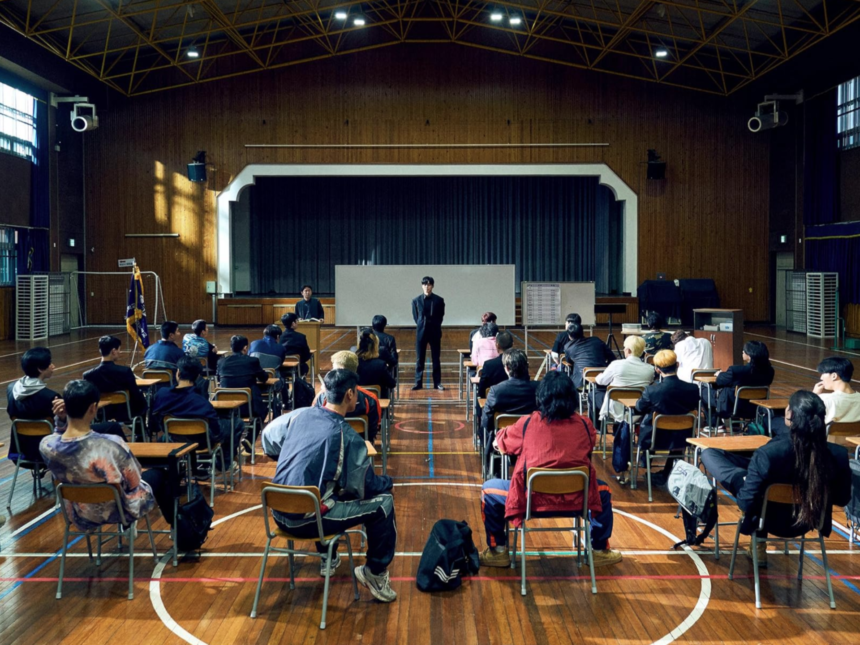
Since the first episode of the series “We Will Teach You a Lesson,” it treats school bullying as a crime that requires exceptional intervention. In the world that the series builds, schools are no longer able to protect students, nor are teachers able to impose any authority in the classroom, while laws stand helpless in the face of students, some of whom rely on family influence, or laws that prohibit corporal punishment of students. From this perception emerges the “Education Rights Protection” Authority, which is a fictional government institution granted by the Minister of Education broad powers to intervene in schools when traditional means fail to contain crises.
Here we meet Inspector Na Hwa-jin, played by Kim Moo-yeol, a man who is not a teacher or a social reformer, but rather a man who came to impose order by force, and through the various issues that the work addresses, from school bullying to student gangs, electronic defamation, and drugs, this inspector and his colleagues repeatedly resort to intimidation, physical confrontation, and psychological pressure, as legitimate tools within the work, and celebrated as well, to regain control.
This begins from the first episode, when the student inspector confronts the bully Ryu Joon-hyung, the son of an influential politician, and then is repeated with other cases in which the members of the authority deal with the students as opponents who must be subjugated, before they are young people in need of correction and reform.
Here the major paradox of the series appears. It declares its complete bias towards the victims, students and teachers, but it does so by adopting the same logic of power that condemns its use among bullies. While it presents bullies as people who exploit their physical and social influence to impose their will on others, the authority comes to do almost the same thing, but under a legal cover.
While the work can be viewed as a fantasy of justice that achieves for the spectator what reality cannot achieve, it is also a reproduction of the idea of violence itself in a more acceptable form.
From the controversial webtoon hero to the Netflix hero.. Who is Na Hwa Jin?
The controversy over “We Will Teach You a Lesson” did not begin with the series’ showing on Netflix, but rather preceded its television appearance by years. The work was adapted from electronic comic books or the famous Korean webtoon “True Education,” a webtoon that has achieved widespread popularity since its launch thanks to its treatment of school violence and bullying through an approach based on decisive and direct intervention.
However, this popularity was accompanied by sharp criticism, as the webtoon was accused on more than one occasion of glorifying corporal punishment and providing authoritarian solutions to complex social problems, which led to the work being withdrawn from some international platforms, and opened a discussion about the boundaries between criticizing violence and justifying it.
At the heart of this controversy stands the character of Na Hwa Jin, the hero of the work and its most prominent face, an employee of the Education Rights Protection Authority, a former soldier, who works in the authority as an investigator and an enforcement officer at the same time. He enters schools and confronts crises by means ranging from threats to physical confrontations, becoming the embodiment of the idea of absolute authority that places itself above the law.
The television version tried to mitigate some of the most controversial aspects of the original material, by giving the characters more clear motivations, such as the loss of the hero, the Minister of Education, the first’s fiancée, and the second’s daughter, who was a school teacher killed by her student, in addition to focusing on the failure of educational and social institutions as a cause of the crises that the work addresses. However, the series does not completely abandon the philosophy that made the webtoon famous, but rather mitigated it and re-presented it in a more globally marketable form.
Comedy in the face of tragedy… Why doesn’t “We’ll Teach You a Lesson” sink into darkness?
Although “We Will Teach You a Lesson” deals with heavy issues such as school bullying, suicide, delinquency, drug abuse, and violence against teachers, it does not present them in the dark style that many similar works are accustomed to. From its first episodes, the work attempts to balance tragedy and comedy, benefiting from a well-established tradition in Korean drama that works to mix different tones within one work, so that the viewer can move from a scene that deals with a human tragedy, to another that carries a degree of wit or sarcasm without feeling complete separation. Between them.
This trend is particularly evident in the secondary characters who accompany Na Hwa Jin and the members of the Education Rights Commission. While the hero bears the bulk of the action confrontations, some other characters relieve tension through sarcastic dialogues. The series also sometimes relies on intentional exaggeration, whether in the way the heroes enter schools, or the confrontations with bullies, which gives the events a character close to superhero stories, more than a realistic social drama.
Here, the work clearly differs from other series, such as the Korean “The Glory,” which dealt with bullying as a long-term psychological wound, and built its atmosphere on a constant feeling of pain and the desire for revenge, while in “We Will Teach You a Lesson,” the spectator does not remain inside the victim’s suffering for long, but rather quickly moves to the stage of confrontation and regaining control, which gives the narrative a more lively and less depressing rhythm.
The difference becomes clearer when compared to the famous American series “13 Reasons Why,” which built its entire story around Hannah Baker’s suicide, and chose to make the viewer live the consequences of the tragedy and its psychological and social details over the course of seasons. The result was a very dark work, which in turn sparked widespread discussions about the impact of depicting suicide and psychological violence on the audience. As for “We’ll Teach You a Lesson,” it takes almost the opposite path, as it does not focus on pain, but rather on responding to it, and does not give the tragedy the same space it gives. To the idea of punishment and restoration of justice.
Overall evaluation
- Output: 3
- Acting: 4
- Visual effects: 3
- Family friend: 3.5