Published on 6/21/2026
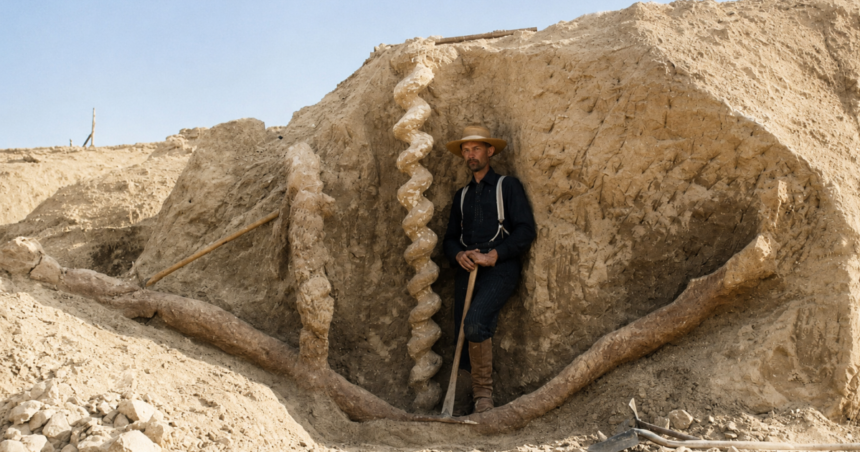
135 years ago, geologists discovered 23 million-year-old spiral stone structures in the US state of Nebraska, and they called them the “Devil’s Spiral” at the time, due to their strangeness and their inability to explain their causes.
When examining these formations discovered in 1891, scientists found that they resembled a “spiral nail” embedded in the ground, extending to a great depth beneath the surface, and that they were composed of a solid material, originating from fossilized sediments or mineral membranes such as agate.

Since the beginning of the discovery, researchers have been divided between those who considered them to be deposits of ancient marine environments, and those who believed they were traces of the behavior of living organisms. The American paleontologist Irwin Barbour strongly rejected the hypothesis of animal burrows, adhering to their interpretation as geological deposits, while other researchers such as Olaf Peterson supported the idea that they belong to extinct rodent animals, especially after finding bone remains inside some formations.
After decades of scientific controversy, subsequent studies in the 1970s, led by Larry Martin and Deb Bennett from the University of Kansas, reopened the file using careful field and laboratory analysis. The results showed that the tooth marks in the rocks matched the incisors of the extinct animal “Paleocastor”, which lived in the Miocene era, which provided direct evidence that these formations are in fact complex spiral burrows dug by these animals underground.
Why spiral design?
“Paleocastor” is a genus of ancient, extinct beavers that lived in North America during the Miocene era, approximately 20-30 million years ago. It was smaller than modern beavers, and was similar in size and shape to small wild rodents such as prairie animals, but it was distinguished by its special ability to dig deep into the soil using strong, flat front incisors.
A team of scientists believes that these animals dug spiral tunnels in the soil, before they were later filled with sediments and minerals and transformed over millions of years into fossilized rocks that have maintained their strange shape until today.
Scientists believe that the spiral design of these burrows was not a coincidence, but rather a behavioral adaptation that helps enhance stability within the soil, regulate heat, and protect against predators.
They explained that this discovery confirms how traces of ancient animal behavior can turn into amazing rock fossils that redraw the picture of life on Earth millions of years ago.