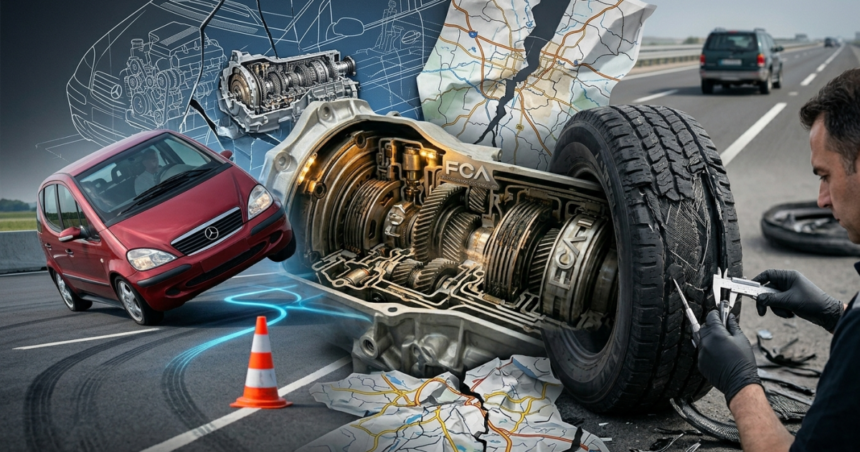
Imagine that you are driving your car today on a highway, and suddenly an unexpected obstacle appears in front of you. I hit the brakes and swerved the steering wheel hard to avoid being hit. The car responded smoothly, maintained its balance and stability on the ground, and you and those with you escaped safely.
You may think that this calm and safety that you enjoy now is just a normal and normal development of the automobile industry, but have you ever asked yourself what is the real reason that made your car develop to become this smart and stable?
The astonishing truth is that you owe your safety today to horrific engineering disasters and blunders that occurred in the past! Every safety system that protects you now, and every piece of engineering that works efficiently in your vehicle, was born out of crises that cost companies millions of dollars and shook the confidence of markets.
Just as the automobile industry has witnessed throughout its history a great series of successes and innovations, it has also witnessed many failures resulting from engineering errors and disasters. These mistakes were not just passing mistakes, but rather represented radical turning points that reshaped the laws and standards that regulate vehicle safety and protect road users.
Engineering errors are design, manufacturing, or operational failures or decisions that lead to unsafe or unreliable vehicle performance. Certainly, they are unintended defects that appear during the design stage, during manufacturing, during testing, or even after the car is put on the market.
What are these disasters? How did you turn failure into a starting point?

Engineering mistakes changed the automobile industry
- Mercedes-Benz… when the A-Class overturned in the “stag test”
German Mercedes-Benz, which is considered one of the most prestigious car companies in the world, did not expect that a small car like the A-Class, which was designed to open a new door in the world of compact cars, would put the company’s name in the heart of an unprecedented crisis.
In 1997, the car was introduced to the world with a modern appearance and a smart idea, a small size on the outside, and a large space on the inside. But behind this success, there was a question that was not asked seriously enough: How could a relatively high design with a narrow base maintain its balance during sharp maneuvers or sudden turns?
The answer came in a simple test known as the “stag test,” when the driver tried to avoid a sudden obstacle on the road, at a speed not exceeding 60 km/h, and the car lost its balance and flipped onto its roof in front of the testers’ eyes.
Immediately, the company decided to suspend sales of this model and recall the sold cars, beginning an engineering modification journey that changed the future of the car, and perhaps the future of safety systems in the entire industry.

- Firestone and Ford… engineering errors that toppled a partnership that lasted more than a century
At the turn of the new millennium, the automobile industry was rocked by one of the largest safety crises in its history. While Ford Explorer cars were confidently roaming the roads, disturbing reports began to emerge of similar and recurring accidents.
Attention quickly turned to Firestone tires, a historical partner of Ford, after it was discovered that some tires were subjected to sudden outer layer separation while driving at high speeds, causing the driver to lose control of the vehicle.
As the number of accidents and victims increased, the crisis emerged from its technical context into a global shock that shook the reputation of both companies, as the two parties exchanged accusations amid a campaign to recall and replace millions of tires.
Investigations revealed manufacturing and design defects in the tires, in addition to observations on the design of the Explorer car that contributed to the aggravation of the disaster. The shocking result was the collapse of a historic partnership that was once considered one of the strongest alliances in the automobile industry.

- Fiat Chrysler’s “confusing” transmission…a confusing puzzle on the road
With a 9-speed automatic transmission, Fiat Chrysler Automobiles introduced a new technology in 2014 that represents an advanced step towards improving performance and reducing fuel consumption, but it quickly became the focus of widespread controversy among drivers and experts.
During the first road tests, complaints began about hesitant gear shifting in Fiat Chrysler, Jeep, and Dodge models, unexpected delays when starting off, and at other moments gears were suddenly changed that confuses the driver while driving, as well as the car slipping and moving in stationary mode, so that more than a million cars around the world were recalled to fix this defect.
As complaints mounted and controversy increased, the company implemented a series of corrective measures to try to address the malfunction. It relied mainly on software updates to improve the timing of gear shifting and reduce cases of hesitation or delay in response.
Although these measures contributed to gradually improving performance for many users, the experience did not always reach the level of expectations in all circumstances, which prompted the company to abandon this design in subsequent models.

- Porsche…the engineering error that almost caused complete damage to the engine
In the late 1990s, Porsche was experiencing a bold expansion phase as it entered the mid-engine car segment. The idea seemed ideal and a driving experience closer to racing than to regular roads. But behind this there was an engineering detail that did not attract attention at first, but it began to impose itself later.
Inside some Porsche engines, especially the Boxster model, there is an internal bearing design called the “center shaft bearing”, a small but very important part of the engine’s operating cycle. With use, sporadic cases of sudden failure of this bearing began to appear, which could lead to major damage to the engine and sometimes complete damage.
Porsche did not make an immediate comprehensive recall, but rather dealt with the problem through design changes in new generations and gradual improvements in production.

- Ford and the dry transmission…a new technology that turns into an engineering nightmare
In 2011, Ford entered a new phase of technological bet, introducing the dual-clutch transmission, in an attempt to offer a combination of fuel efficiency and smoother performance compared to a conventional transmission.
At first, it seemed like a step into the future with faster shifts and lower fuel consumption. But with daily use, the picture began to change rapidly, and frequent complaints appeared from drivers about abnormal vibrations when starting, interruptions in shifting gears, and a sudden delay in response, especially within cities and crowded roads.
With the increase in reports and lawsuits, widespread controversy escalated over the reliability of the idea itself, and questions increased: Is the problem in the software and system or in the nature of the design of the transmission itself?
Investigations proved that the transmission had engineering defects, so Ford gradually began to stop using it in most of its models after this crisis, and moved towards more reliable solutions instead of this design.
How are engineering errors generated in production lines?
Engineering errors result from a number of factors, the most prominent of which are:
- Design flaws: Engineers may rely on inaccurate assumptions or incomplete analyzes when designing a vehicle, leading to defects that were not apparent during the early development stages.
- Reduce cost and speed up production: Some companies sometimes seek to reduce costs and expenses while speeding up production lines, which may increase the possibility of unexpected defects appearing after actual use.
- Inadequate tests: Tests may not cover all real-life daily use conditions, resulting in defects not being detected at an early stage, but rather appearing after the vehicle reaches consumers on the market.
- Poor control and quality: Even if the design is sound, poor control over production processes can cause malfunctions, and financial pressure forces some companies to use substandard or lower-quality materials.
- Use of complex technology: Modern cars rely on complex technological systems that include dozens of sensors and electronic control units, which increases the possibility of technical defects and errors that are difficult to detect early.

How are manufacturing defects detected?
After cars are put on the market, engineering errors are not discovered by one party only, but rather through an integrated system that includes users who notice faults during daily use and file complaints, as well as maintenance workshops that monitor the recurrence of abnormal problems during repair.
Car companies also track the performance of their vehicles through after-sales monitoring and data analysis systems to detect any recurring defect. Government regulatory agencies also participate in following up on accidents and investigating potential defects that threaten public safety, in addition to insurance companies that analyze accident data to discover abnormal patterns.
Research centers and independent bodies also contribute to analyzing complex incidents and identifying technical causes of malfunctions.
The cooperation of these parties forms an interconnected system to quickly discover engineering errors, as the efforts of users, maintenance workshops, companies, regulatory bodies, and experts combine to monitor and analyze the defect, allowing appropriate corrective measures such as recall or repair to be taken before its effects worsen.

Lessons from the cruelty of experiences
One of the most important lessons learned from engineering errors in the automotive industry is that safety is not a negotiable item in the face of cost reduction, because the price of the error may be measured in human lives and enormous economic losses. These disasters also prompted countries to reformulate their laws and legislation, to impose more stringent standards in vehicle design and testing, and to obligate companies to implement precise regulatory systems and immediate recalls when any defect appears that affects the safety of users.
The change did not stop at the borders of legislation, but rather extended deep into the industry itself. Car testing is no longer left to the manufacturer alone, but is subject to the oversight of independent bodies that ensure impartiality. The harsh experiences also imposed a new reality regarding supply chain management, as relying on a single supplier is no longer a safe option, after mistakes proved that a single defect could paralyze an entire industry extending across the world.
How do failures create the future?
The automobile industry did not evolve voluntarily in all aspects of safety. Rather, much of this development came in response to major engineering errors and disasters that exposed weaknesses in design and manufacturing. Each major accident raised new questions and prompted engineers and lawmakers to reconsider prevailing safety standards.
The philosophy of change lies in the fact that mistakes, no matter how costly they are, turn into a source of knowledge when their causes are understood and their lessons are learned. Thus, history is not written by successes alone, but is also shaped by failures that push a person to develop what he has created and go beyond the limits of what he thought was sufficient and safe, and here failure becomes a starting point, not an end.