Published On 4/26/2026
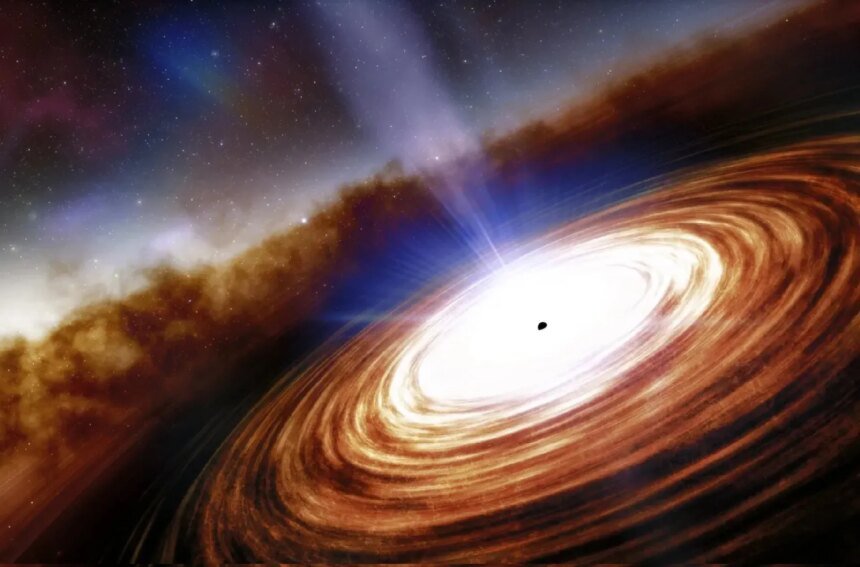
Scientists have discovered a supermassive black hole at the heart of the quasar ULAS J1120+0641, which formed only about 670 million years after the Big Bang, approximately 13 billion light-years from the Sun. The scientific dilemma is that its mass is equivalent to billions of times the mass of the sun, a size that is difficult to explain how it formed so quickly according to current theories.
A quasar is a galaxy that appears to be so bright – due to the presence of a giant black hole – a star, and that is why it is called a “quasar”.
Read also
list of 2 itemsend of list
This accelerated growth made the black hole more massive than the host galaxy could gravitationally support, indicating an “out of control” and unstable cosmic system.
Astronomers have long believed that there is a precise harmony governing the relationship between galaxies and their central black holes, as they grow together in relative balance, but this revelation about the quasar (ULAS J1120+0641) has turned these balances upside down.

We are facing a discovery that not only monitors a deep celestial body, but also provides evidence of the existence of an “imbalance” in the balance of universal gravity in the beginning of time, as it appears that black holes were able to “rebellion” and grow at a speed exceeding the ability of their host galaxies to accommodate them.
Evidence from data… How does a black hole devour the future of its galaxy?
The results, published in The Astrophysical Journal and based on precise observations from the XMM-Newton Ultra-X-ray Observatory, show that the gravitational dominance of this black hole may hinder the birth of stars.
By heating up the surrounding gas or expelling it away, the black hole deprives the galaxy of the “fuel” needed for its normal evolution. Professor Neil Brandt of Pennsylvania State University points out that the rate at which black holes consume matter has slowed significantly as the universe has aged, making this object a unique window into an era when cosmic feeding was at its peak.
Rewriting the scenario of cosmic evolution
This discovery challenges traditional models that assume simultaneous evolution between the galaxy and its center. If black holes are able to overtake their galaxies by such a huge gap, we need to reconsider the “feedback mechanisms” that regulate the formation of cosmic structures.

Were these holes formed from unusually large “seeds”? Or did it go through periods of accumulation of super-efficient matter? These questions open the door to alternative theories about how the universe formed from its earliest moments to its current structure.
What’s next? Future monitoring prospects
Confirming these subtle imbalances requires more sensitive observational techniques, as this discovery sets a roadmap for upcoming space missions, which will attempt to measure mass and motion with higher precision to understand how gravity and dark energy control large cosmic scales.
“Ulas J” remains not just a distant object, but rather a scientific challenge that pushes scientists to deepen their understanding of the origin of existence.