With renewed controversy over navigation traffic in the Strait of Hormuz following an Iranian announcement of its closure in exchange for American assurances of continued crossing, recent satellite images showed the resumption of activity of giant oil tankers at export facilities on Khark Island, which is the main center for loading and exporting Iranian crude oil.
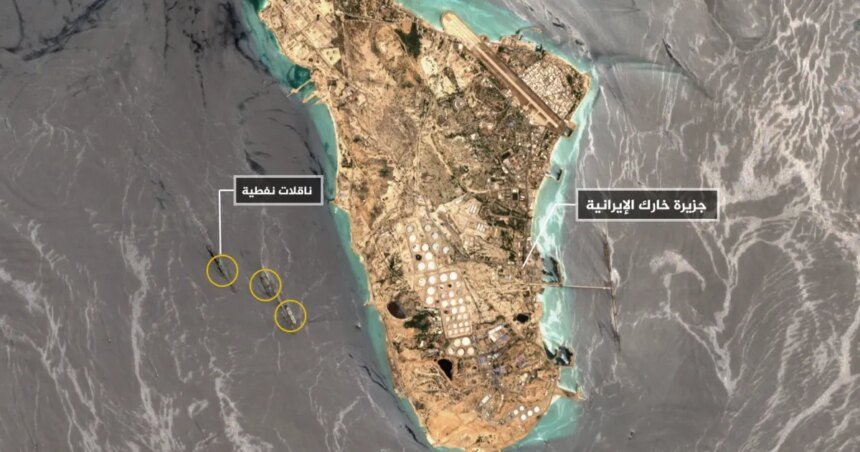
Satellite images analyzed by the Al Jazeera Network’s open source unit revealed the appearance of 3 giant oil tankers in the vicinity of the loading facilities on Khark Island on June 20, after the docks were empty of ships in images taken on June 17.
Read also
list of 2 itemsend of list
The visual comparison shows two ships anchored at the loading facilities, and a third tanker in the vicinity of the port, likely waiting to enter or complete docking procedures. The lengths of the tankers shown in the pictures range between about 320 and 350 meters, which are measurements consistent with giant crude oil tankers.
Khark.. Iranian oil gateway
Khark Island, located in the Gulf about 32 kilometers west of the Iranian coast, is the most important center for Iranian crude oil exports.
The island is of particular importance because it includes deep-water loading facilities that allow receiving giant oil tankers, while most of the shallow Iranian coasts do not allow this type of ships to be received easily.
Khark is often described as the backbone of Iranian oil exports, as the largest proportion of crude destined for foreign markets passes through it. Therefore, monitoring giant tankers near their loading facilities represents an important indicator of the level of return of Iranian oil activity after a phase of escalation and naval blockade.
The island was subjected to strikes during the military escalation last March, at a time when American and Israeli operations targeted a number of Iranian military sites. However, new images show that Khark’s export facilities are back to receiving large oil tankers after the latest agreement.
Limited transit and absence of energy carriers
The return of activity in Khark comes as navigational data monitored by the Al Jazeera Network’s open source unit via the “Marine Traffic” platform shows that transit traffic in the Strait of Hormuz did not stop completely after the Iranian announcement of its closure, but it declined to a very limited level.
Since the morning of June 21, only 5 ships have crossed the strait, all of them cargo ships or bulk goods, without recording the crossing of oil or gas tankers as part of the monitored movement until the time of preparing the article.
This monitoring gains its importance from comparison with the previous day’s movement. On June 20, the Open Sources Unit monitored 18 ships crossing the Strait of Hormuz, including 8 oil tankers, a liquefied gas tanker, 6 cargo ships, and 3 bulk cargo ships.
Thus, the data reveals a striking paradox: while satellite images show the return of giant oil tankers to loading facilities on Khark Island, the exit movement of energy tankers through the Strait of Hormuz remains limited or almost halted within the available monitoring.
Return of activity after agreement
The previous months, from February to June 2026, witnessed a widespread escalation between the United States and Israel on the one hand and Iran on the other, which included strikes inside Iran and a naval blockade of Iranian ports, before the two parties announced in mid-June that they had reached a memorandum of understanding to stop the war and lift maritime restrictions.
The announced understandings included opening a 60-day negotiating window to reach a broader agreement, in addition to measures related to lifting restrictions on Iranian navigation and exports, including oil exports.
But subsequent field developments, especially the continued tension in southern Lebanon, returned ambiguity to the future of the agreement and its implementation mechanisms, and opened the door to messages exchanged between Washington and Tehran regarding control of the Strait of Hormuz and freedom of navigation in it.
Satellite images reveal that Khark facilities did not remain outside of post-agreement traffic; In just 3 days, the port’s image went from a clear absence of loading docks to the presence of giant tankers around the island.
However, according to navigational monitoring, the return of ships to Khark is still separate from a complete return to the movement of energy tankers through Hormuz. The Iranian port receives ships, but the strait is still operating with extreme caution, amid a clear decline in the number of passing ships and the absence of oil and gas tankers from the transit traffic observed since the morning of June 21.
Between Khark’s limited activity and the declining Hormuz movement, Iranian oil exports appear to be facing a new testing phase: Will loading indicators turn into actual flows through the strait, or will they remain hostage to security tensions and transit conditions that have not yet been clarified?