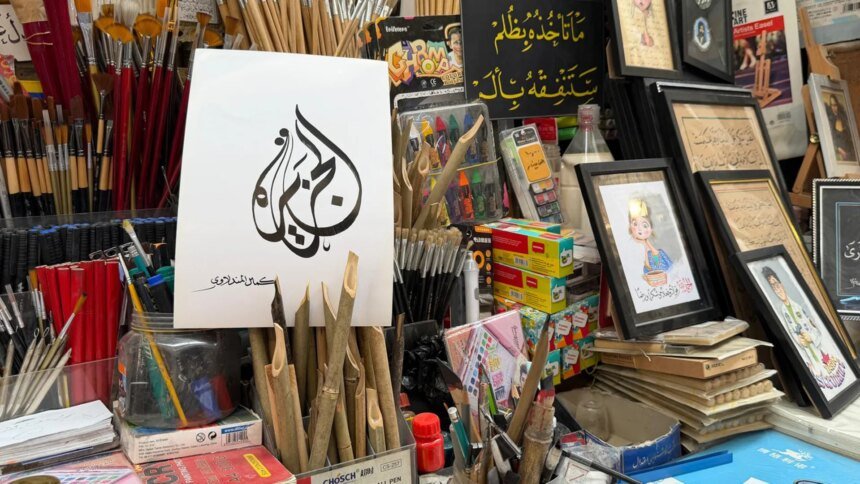
In an alley branching off from the historic Al-Mutanabbi Street towards Al-Saray Market in central Baghdad, a small shop attracts attention, the walls of which are covered with hanging and accumulated used pens in different colors and shapes. At the shop’s door, visitors stop to take pictures or admire the place, which looks more like a popular museum than a stationery shop.
Ali Al-Mandalawi sits on an old sofa that can accommodate two people inside a store where one can barely stand. He begins his loving talk about his journey that began in 1985 when he was working in a small stall in Baghdad.
Read also
list of 2 itemsend of list
Al-Mandalawi tells Al-Jazeera Net how his relationship with the pen began as a simple source of livelihood, but over the years it turned into a passion and then into a part of his personal identity, until many market-goers began to know him as “the father of a million pens,” and although the number exceeded a million, he does not want to count his pens. He aspires for more and this habit will not stop with him.

The pen is not just a writing tool, but rather a message and life, and the pencil in particular represents the first link between man and the world
He adds that for him the pen is not just a tool for writing, but rather “a message and a life,” explaining that the pencil in particular represents the first link between man and the world, because it is the tool through which the child begins learning, drawing, and discovering life, pointing out that the pen accompanied man in all his stages, from school to work, and through it people became doctors, engineers, teachers, and writers.
“All with love”
While Al-Mandalawi points to shelves crowded with old and rare pens, he emphasizes that his relationship with customers was not based on trade only, but on love and the human connections that he created within the market. He says that many people come here to talk and sit more than to buy, because for them the place holds memories.
As he continued his conversation, he clearly regretted the outcome of the new generations’ relationship with the pen, pointing out that technology had greatly influenced this relationship, after most of the details of daily life moved to phones and smart devices, so handwriting declined in favor of quick and ready writing on screens, which was reflected in the students’ calligraphy skill and the quality of written expression.
He points out that many students today have a weak relationship with handwriting as a result of excessive reliance on technology, which has made writing lose some of its presence and skill, calling for the revival of calligraphy and writing lessons within the school curriculum. Despite this, he asserts that the pen has not completely lost its value, because the real human being and the real handwriting cannot be replaced by ready-made programs.

The pen is a tool of human expression
In the corner of the store, Umm Razan, Ali Al-Mandalawi’s wife, stood and spoke to Al Jazeera Net about the impact of this passion on the details of their daily lives, stressing that the place for her goes beyond being a store, to become a space that carries a special moral and heritage value.
She explains that the pen, in the eyes of the family, is not just a tool for writing, but rather a means that expands the expression of feelings, ideas, drawing, and imagination, as if it is an extension of what words cannot say directly, as it tells what is inside a person, and through it he expresses himself in words and drawing.
She pointed out that her husband’s passion for pens was passed on to her, as they keep a larger number of what is in the store in their home, while their daughters, Razan and Ilan, tend toward drawing and the arts, influenced by this world in which they grew up between ink, paper, and imagination.
The place deserves to be included in human heritage
One of the visitors to the place, the diplomat Abdul Karim Al-Basri, entered and looked at the walls full of old pens, before describing the place as a “cultural focal point” in Baghdad.
Al-Basri told Al-Jazeera Net that Al-Mandalawi’s shop does not just represent a space for selling pens, but rather a living museum that documents an aspect of the city’s cultural memory, considering that the place deserves to be included in UNESCO’s documentation plans.
Technology, despite its development, cannot compensate for the feeling associated with the pen and writing on paper, as the work of the hand cannot be compensated by programs
He adds that the value of the place also lies in the human atmosphere it creates. The place brings together calligraphers, painters, poets, students, and even ordinary visitors who are dazzled by what they see. Its visitors leave smiling and carrying a different feeling, far from material things, because every pen here has a story.
In his speech, Al-Basri pointed to the changes that occurred on Al-Mutanabbi Street and Al-Saray Market with the technological development and the decline of some traditional crafts, but places like these still preserve part of Baghdad’s cultural memory.

Technology versus hand work
In the same alley, calligrapher Kamal Al-Mandalawi stood holding a papyrus reed dipped in black ink, while he was writing the Al Jazeera logo on a white sheet of paper, in a scene that seemed like an attempt to prove the presence of the pen in the face of the dominance of screens.
Kamal told Al Jazeera Net that technology, despite its great development, cannot compensate for the feeling associated with the pen and writing on paper, and he adds that Arabic calligraphy originally started from handwriting tools, before its forms moved to digital design and modern programs. He believes that the demand for calligraphers has clearly declined with the spread of printing and technology, considering that manual labor cannot be compensated for by programs.
The journey of the pen in Iraq extends since the Sumerian civilization, when man recorded the first signs of writing on clay tablets using reeds, which marked the beginning of the shift from oral memory to written recording. That moment was the first spark for the idea of the pen as a tool for preserving knowledge and documenting life.
From those early beginnings, some small spaces in Baghdad still maintain a living connection to that legacy, including the “Ali Al-Mandalawi” shop, which reminded us that the tool that began with a cane on Sumerian clay is still present today in various forms, despite all the changes that technology has brought about in the ways of human communication.