On the western coast of Yemen, the city of Mokha stands at a cultural moment that has re-introduced its name into the public space after decades of retreat from its historical center.
The city, whose name was linked globally to the path of the coffee trade, found itself in recent years outside the scene that made its first fame, while its name “Mocha” continued to travel in international cafes and markets as a brand rather than a geographical place.
The cultural festival that was recently held in the city came as an event that goes beyond a celebratory nature, to represent a serious attempt to reinstall memory in geography. In the events arena near the Red Sea, Mokha has emerged as a space that is regaining its voice through art, music, and local products, in a context that reconnects the city with its centuries-old commercial and cultural history.

Director of the Mokha Directorate, Sultan Mahmoud, told Al Jazeera Net, “Mocha does not suffer from the absence of history, but rather from the absence of the narrative that keeps this history alive in the public consciousness. What we are doing today is an attempt to restore this narrative within the space itself; to highlight the presence of the city’s history and restore its memory as a place linked to heritage and Yemeni coffee, as an extension of its economic memory.”
Mokha was never just a transit port. Rather, it was a central point in the coffee trade during the centuries of flourishing sea routes between Asia, Africa, and Europe, which gave its name a global spread that exceeded its geographical borders.
Mokha is an open theatre
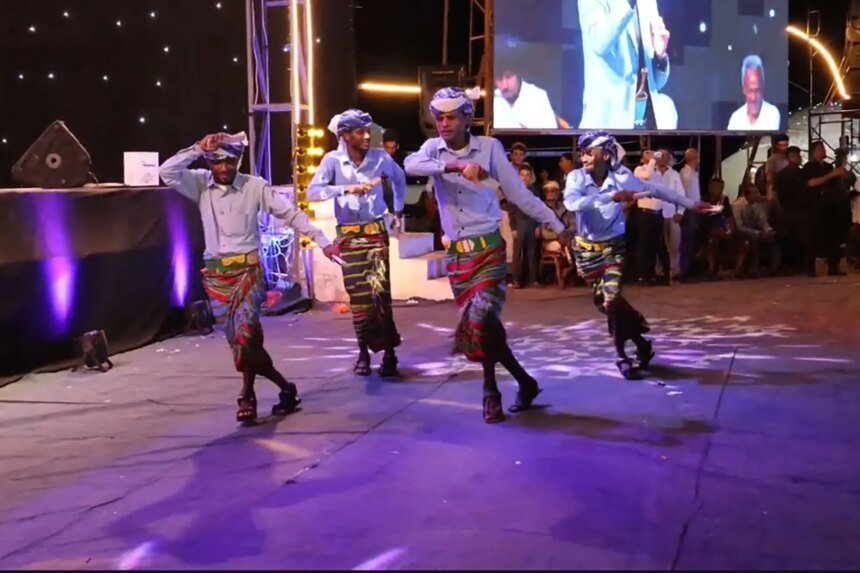
In the festival square in the center of the city, crowds of residents and visitors gather around a singing stage set up in an open space, which has temporarily reshaped the city’s cultural presence. The lighting extending over the stage reflects unusual human movement, while the audience spreads out around the arena to follow the performances, which vary between traditional singing and modern singing performances.
The singing voices extend throughout the place and overlap with continuous applause from the audience interacting with the successive paragraphs, in a scene that revives the image of public gatherings inside a coastal city that has been absent from major events for long periods. Mobile phones rise from time to time to document moments that seem completely different from the monotonous rhythm of daily life.
Singing artist Soha Al-Masry tells Al Jazeera Net: “The festival gives artists an opportunity to appear in front of their audience within their city itself, and reconnects the singing voice with the place from which this culture emerged, instead of remaining far from its natural environment.”
On the outskirts of the square, visitor Ahmed Salem (from the city of Taiz) expresses: “We have not witnessed such a gathering in the city for a long time. There is a feeling that people are experiencing a single moment united by music and place, and as the performances continue, the public space turns into a space for direct social interaction.”

A port whose fame has spread around the world
Over the past centuries, Mocha was not just a sleepy port city, but a central transit point on one of the most important ancient world trade routes. From this small port, Yemeni coffee beans headed towards the markets of Asia, Africa and Europe, at a time when sea convoys were the arteries of the global economy, and the quality of coffee coming from the Yemeni highlands gave it an exceptional status internationally.
Economic researcher Salem Ali told Al Jazeera Net, “Mocha was not just an export port, but rather it was an early global brand, whose name was linked to quality until (Mocha) became synonymous with luxury coffee in the world.”
As European trade expanded in the 17th and 18th centuries, Yemeni coffee seeds began to be transported to new colonies in Asia and Latin America, gradually breaking up the Yemeni monopoly on production. This transformation not only changed the map of trade, but also reshaped the location of Mocha itself. From a vibrant international port to a less central station on modern shipping routes.
Despite this decline in the field, the name remained alive in the global commercial memory, repeated on the menus of cafes around the world as a sign of coffee mixed with chocolate or luxury coffee, while the presence of the original city in the public consciousness declined.
Mocha lives on the edges of her memory
Nowadays, Mocha seems more like a space where memory intersects with a limited economic reality. The old port, which used to receive ships from distant continents, has today turned into activity limited to fishing boats and some small commercial movements, which reflects the change in the city’s location within the economic geography of the region.
Features of the current reality:
Infrastructure and urbanismSome old neighborhoods still maintain their inherited architectural character (eroded walls and narrow alleys), but they live in a state of relative neglect amid individual attempts to preserve their original features.
Local economyA large portion of the population depends on marine fishing and simple commercial activities, amid the absence of investments and weak infrastructure that limit the city’s ability to regain its role.
“The port is no longer what it was, the movement is little and the capabilities are limited, yet the sea remains the primary source of livelihood for many families here. We live on what the sea offers and on what remains of simple movement in the market, but the people here do not forget that Mocha was once a name known to the whole world,” says one of the coastal residents, Mahmoud Salah.
Despite this reality, the city’s symbolic presence remains larger than its current size. A harsh paradox between a city that is declining in reality, and a name that is advancing and dominating global memory.
Is music enough to restore the city?
With the conclusion of the festival activities in Mokha, the scene does not appear to be just the end of a cultural event, but rather the beginning of a broader question about the ability of art to reshape a city’s relationship with its history and its place in public consciousness. Today, the city returns through music and singing to present itself as a living space seeking to regain its symbolic presence.
The Director of the Directorate, Sultan Mahmoud, confirms that “what is happening here is not a temporary activity, but an attempt to rebuild the collective memory around Mocha, and reinsert it into the cultural narrative from which it once emerged.”
The festival opens a deeper discussion about the relationship between culture and development. While music alone cannot rebuild the economy or operate the port, it undoubtedly contributes to reshaping the mental image. It is a first and essential step in any urban or cultural restoration process.
As one of the city’s residents, Abdo Qadri, sums up this feeling: “Today we felt that Mokha is not just a place for practicing life and living, as much as it is a name that can be heard again.”
As the lights gradually go out and the square empties, the question remains open to the city and its residents: Can a city regain its position through art alone, or does what began here require a longer path of development and work to become a real transformation in reality?