Published on 6/22/2026
|
Last update: 14:25 (Mecca time)
Tomorrow, Tuesday, a new round of negotiations between the Lebanese government and Israel will begin, under American auspices, the fifth, in light of a fragile truce and official Israeli statements confirming Tel Aviv’s refusal to withdraw from southern Lebanon.
The negotiating round, which was announced by the US State Department on Friday, comes after four previous rounds that began last April, as part of a negotiating process aimed at reaching an agreement between the two sides that would put an end to the war.
It also comes a day after negotiations in Switzerland between Tehran and Washington, in which the war file in Lebanon was the top priority.
So what do we know about the Washington negotiations tomorrow? Who will participate in it? What is expected from it after the American-Iranian rapprochement and the dispute that has surfaced between Washington and Tel Aviv against the backdrop of the Israeli escalation in Lebanon?
When are negotiations held and who participates?
According to the US State Department statement, the negotiations will be held in Washington, DC – similar to the previous rounds – between Tuesday and Thursday, June 23 to 25.
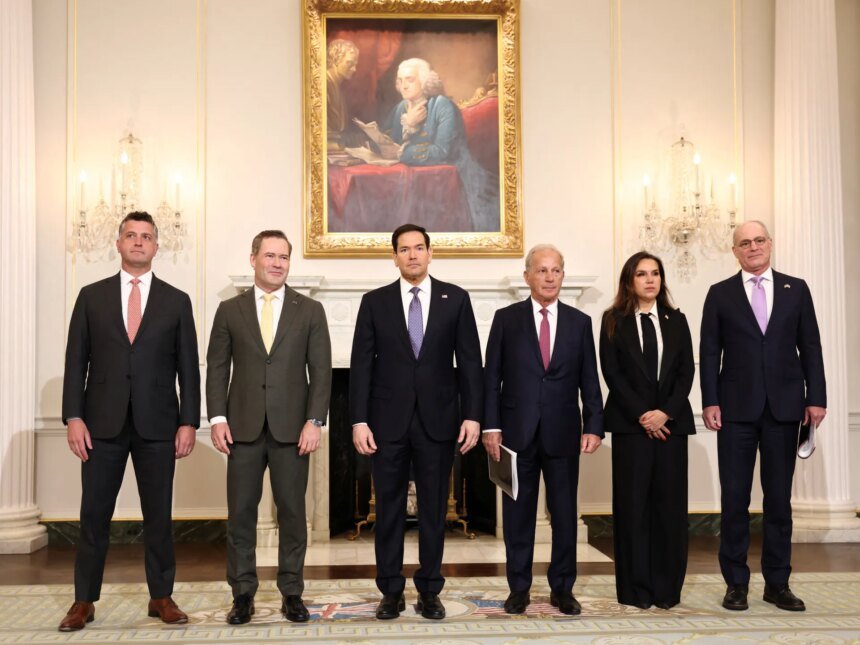
Lebanese and Israeli officials are participating in the negotiations, under the auspices and supervision of an American mediator and the direct intervention of Secretary of State Marco Rubio.
The Lebanese side is represented by a security delegation and a political delegation, and the Lebanese Ambassador to Washington, Nada Moawad, is responsible for signing.
The Israeli side will also be represented by a security delegation and a political delegation, signed by the Israeli Ambassador to Washington, Yehiel Leiter, and followed up by Prime Minister Benjamin Netanyahu and Defense Minister Israel Katz.
What are the two parties negotiating?
The negotiations include two separate tracks: political and security. According to reports, the talks will be conducted through two parallel and separate tracks, where the two security delegations will hold sessions to discuss an independent security working paper, while the two political delegations will hold parallel sessions to discuss a political working paper proposed by Washington.
The main points of what is being negotiated are as follows:
Security aspect:
- Establishing a ceasefire: It is the first clause and the basic condition that precedes the implementation of any subsequent field steps or understandings.
- Experimental areas: Develop an executive plan according to which the Israeli army will withdraw from the Zawtar area and hand it over to the Lebanese army, with the latter assuming responsibility for security, preventing the entry of militants, and ensuring that it is free of weapons.
- Complete withdrawal: Lebanon seeks that this security operation ultimately lead to a complete Israeli withdrawal from its occupied territories in the south, with the Lebanese military delegation possibly stipulating that the scope of the Zawtar region be expanded to accelerate implementation and prevent the occupation from continuing for years.
Outstanding security points of contention:
- Supervisory body: There was no agreement on a mediator to supervise the field, as Lebanon adheres to the role of the monitoring mechanism (mechanism) led by an American general or UNIFIL forces, while Israel rejects this and demands the establishment of a joint security committee for direct coordination, which Lebanon rejects, insisting on coordination through an intermediary.
- Geographical boundaries of the occupation: Israel insists on keeping the “yellow line” as a security zone and rejects a comprehensive withdrawal, and demands that Lebanon prevent Hezbollah members from entering the experimental areas.
As for the political aspect of the negotiation process, it focuses on the nature and description of the future relationship between the two countries, and Washington seeks to come up with a “joint declaration of political intentions” that stipulates the establishment of a ceasefire as a first and basic clause, each country respecting the sovereignty and borders of the other country, and refraining from endangering the other party’s security or threatening its territory.
This round comes after a fourth round held at the beginning of the same month in Washington, which witnessed an initial agreement on a ceasefire and the establishment of what Israel calls “experimental areas” in southern Lebanon.
What’s new in this tour?
The negotiations come against the backdrop of the establishment of a ceasefire in Lebanon and the launch of a parallel regional negotiating track, in addition to the presence of an American draft ready for a “declaration of political intentions” between the two sides, and the start of discussing the executive terms of what Israel calls “experimental areas.”
Haaretz newspaper confirmed that the Israeli and Lebanese teams will determine the experimental areas whose responsibility will be transferred to the Lebanese army, noting that the Israeli army will be forced to partially withdraw from the Yellow Line.
Perhaps the most important feature of this round is the different context from the previous rounds, as it comes amid escalating tension between the administration of US President Donald Trump and the government of Israeli Prime Minister Benjamin Netanyahu against the backdrop of the memorandum of understanding between Washington and Tehran, which Tel Aviv opposes.
The Washington negotiations will be held a day after the end of negotiations between Tehran and Washington, mediated by Qatar and Pakistan, in Switzerland, during which progress was announced today between the two parties.
How do the Swiss negotiations affect the Washington discussions?
The Lebanese file is currently moving between two negotiating tables that reflect a mixture of integration and competition, according to observers: the Swiss negotiations, which concluded their first round yesterday, Sunday, and the Washington negotiations expected tomorrow, Tuesday, between Lebanese and Israeli officials.
The ceasefire in Lebanon was a priority in the Swiss negotiations, as an emergency session on Israel and Hezbollah was included in the negotiating agenda.
Ibrahim Freihat, professor of international conflicts at the Doha Institute for Graduate Studies, believes that stopping the Israeli war on Lebanon is an essential issue for Tehran, because it is related to Iran’s credibility, as Hezbollah entered the war in support of it.
Fraihat also believes that the US-Iranian agreement produced a huge security vacuum, which is that Israel was defeated strategically, as it was unable to achieve its goals of redrawing the map of the region, and it retreated backwards, and now “is struggling with America to regain and maintain control in southern Lebanon.”
Freihat confirms that the desire of Tehran and Washington converge at the point of ending the Israeli war on Lebanon. The United States is not willing to get involved in the problems of the Middle East, and for this reason it is not interested in continuing the war. As for Iran, its priority now will be reconstruction.
Despite the two negotiating tracks to end the war on Lebanon, the major obstacle to the solution remains the Israeli insistence on not completely withdrawing from the areas it occupies in southern Lebanon, and what the media reported about the United States’ understanding of Tel Aviv’s position.