The file of incitement against Muslims in Japan did not end with the protests that accompanied the project to build a mosque in the city of Fujisawa, Kanagawa Prefecture, last April. After weeks of decline in local controversy, the file returned to the forefront with a new digital campaign, this time taking a broader and more complex path.
The new campaign is no longer limited to a mosque project, building permits, or local objections. The narrative has moved to a broader area, in which Japanese and foreign accounts used pictures, clips, and claims about praying in public places, an alleged picture inside an anime store, another of fires inside churches and temples, and an unproven deportation decision, to present Muslims in Japan as a cultural and social threat.
Read also
list of 2 itemsend of list
The Al Jazeera Network’s Open Source Unit tracked the most prominent materials circulating in this campaign, and reviewed the path of their spread and the comments accompanying them. The analysis revealed that much of the content that reignited the incitement was either fabricated, taken out of context, or linked to allegations not supported by official data or sources.
Mosque project
The new campaign did not start in a vacuum. The protests that took place in the city of Fujisawa, rejecting the project to build a mosque, provided a ready background for recycling old rhetoric against Muslims in Japan.
But the new wave is no longer limited to the mosque, building permits, or local objections. The narrative has turned into a broader file, in which various scenes are presented as evidence of “Islamic expansion,” a “cultural threat,” or a “danger to Japanese identity.”
A new spark
In several posts, Muslims in Japan seemed to be the target of a narrative that went beyond specific facts. Accounts linked prayer in public places to “changing the face of cities,” and other comments considered that any visible religious presence of Muslims represents a “test” of Japan’s ability to protect its identity.
These publications did not provide evidence of a specific legal violation or security threat, but they relied on the impact of the image or clip, then added political commentary to it, turning it into incitement material.
Comments accompanying some clips show strong language describing the presence of Muslims as an “invasion” or “imposition of presence,” and in other posts, Muslims were portrayed as a group moving within an organized cultural or religious project, without providing evidence to prove this.
This pattern is what made the campaign scalable; It does not need one central incident, but rather collects scattered materials and places them in one context, so that it appears to the reader as a broad and escalating phenomenon.
Prayer as an excuse
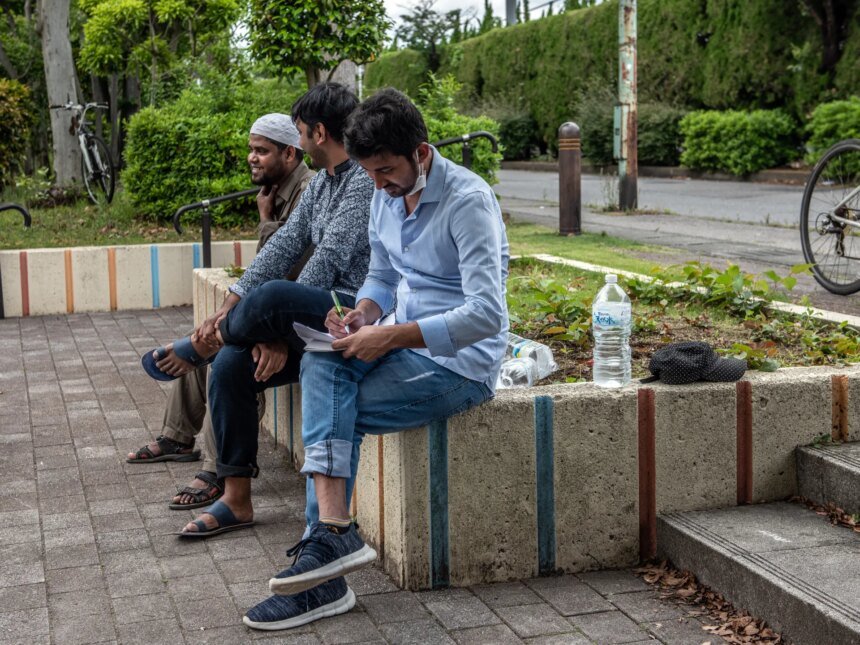
Attending prayer was one of the most prominent themes of the new campaign. Accounts circulated pictures and clips of Muslims performing prayer in public or open places, then linked them with warning comments about “invasion,” “threatening public order,” and “changing Japan.”
Instead of treating prayer as a religious practice, these accounts presented it as a political act or a collective show, and publishers wrote that the goal of this prayer was to “demonstrate power” or “normalize Islamic existence,” while others called for such scenes to be banned completely.
However, the materials circulated, according to what was reviewed by the Open Sources Unit, do not provide evidence of a security threat or a specific legal violation, and the prayer was not the first time, as Muslims held Eid al-Fitr prayers in the same place without posing any security risk or imposing designated places for them, as the allegations claimed.
This mechanism reveals how an ordinary religious scene can be transformed into an accusation, where the image is removed from its context, accompanied by an inflammatory comment, and then pushed to an audience ready to read it as evidence of a broader danger.
Prayer in anime store
The most controversial material was a photo that allegedly showed Muslims praying inside an anime store in Japan, and the photo spread with angry comments saying that Muslims had “entered stores” and “enforced prayer” inside Japanese commercial spaces.
The image gave the campaign a strong impetus because it combined two contradictory symbols in the mind of the target audience: an anime store as a Japanese cultural space, and prayer as an Islamic religious aspect. Therefore, the image was not treated as an individual incident, but rather was presented in the comments as evidence of “Japan has changed.”
However, examination of the image revealed that it had been fabricated by artificial intelligence, while users shared posts in which they said that they had communicated with the store owner shown in the image, and that he denied that any prayer had taken place inside his store.
Based on these indicators, fabricated or digitally generated content appeared to be a pretext used to produce rapid anger against Muslims, before the refutations reached the audience that first received them.
Netherlands fire
The campaign did not remain within Japan, as accounts circulated a clip of a church fire in the Netherlands, with the claim that a Muslim immigrant was behind it, and the clip was linked to a narrative saying that Japan may face the same fate if it does not stop Islamic immigration.
But reviewing the context reveals a different story. The fire referred to occurred at the beginning of this year during New Year’s celebrations. Local media said at the time that the cause of the fire was not known, and no documented evidence has emerged proving that the fire was committed for a religious motive, or that its perpetrator was a Muslim immigrant.
However, the clip was reused in the new campaign as a “warning” to Japan, and in this way, an incident was imported from a European country, then transplanted into a different Japanese context, to expand fear of Muslims and immigration.
Temple fires
The campaign then moved to the file of Shinto and Buddhist temples in Japan. It published accounts claiming between the presence of Muslims or Islamic immigration and fires in Japanese temples, and presented the matter as if there was a recurring pattern of targeting.
This narrative is based on collecting scattered facts in one frame, showing a picture of a temple or news about a fire, then comments about Muslims and immigration are placed next to it, without direct evidence linking the two sides.
But the available data and reports do not support this claim. Official statistics on fires in Japan do not prove a relationship between Muslims and temple fires, and there is no documented evidence of convictions against Muslim immigrants in this context.
Thus, the campaign does not work to prove a causal relationship, but rather to create an illusion. It is enough for the user to see a burning temple, then read a comment about Muslims, until a relationship is formed in his mind that is not supported by evidence.
Deportation claim
In a parallel vein, a claim circulated in English saying that a new head of the Japanese government announced the deportation of “culturally incompatible” foreigners, with reference to Muslims who appeared in prayer scenes near Japanese landmarks.
The allegation was formulated in a way that suggested formality and credibility, as it included a reference to an announcement attributed to the Prime Minister, the text of a deportation decision, and a warning of a threat to the cultural norm, specifying the target group. However, these allegations were not mentioned in any Japanese government source, and no official statements were issued supporting this formulation.
Despite the absence of evidence, the claim received widespread interaction because it addresses an international audience looking for a tough political model against immigration, and thus Japan was transformed in these publications into an imagined symbol of a country that “expels non-compliant people,” not into a documented political reality.
This case reveals how a claim without an official source can become part of a broader campaign, if it is formulated to suit the political mood of an anti-immigration public.
World Cup
The World Cup also entered the new campaign in terms of identity and immigration. Japanese and foreign accounts used talk about teams of multiple origins, such as France, to warn of “cultural changes” linked to immigration.
What was meant here was not sports, but rather presenting teams of diverse backgrounds as evidence of the loss of national identity, and from this perspective, Japan was linked to European and American concerns about immigration, despite the difference in political and social contexts between these countries.
External amplification
The campaign initially remained within the Japanese space, but English-speaking accounts later picked it up and republished it to a wider audience.
This track featured the “DR Maalouf” account, which republished claims about Muslim prayer in Japan, linking them to a broader discourse on Sharia and immigration. Anti-immigration European and American accounts also participated in recycling the narrative, including accounts using slogans such as “Make Europe Great Again,” and accounts linked to the “MAGA” movement in the United States.
Other accounts with different political orientations also appeared, participating in reposting the same content, and linking it to calls for restricting immigration or preventing manifestations of the Islamic presence in the public sphere.
These accounts did not convey the story as it appeared in Japan, but rather reformulated it to suit their audience. In the Japanese version, the speech was about “protecting Japan.” In the European version, it was about “preventing the repetition of what happened in Europe.” In the American version, it entered into a broader conflict over immigration, borders, and identity.
In mid-April, the city of Fujisawa in Kanagawa Prefecture, Japan, witnessed a massive demonstration that was considered one of the most prominent anti-Muslim gatherings in Japan in recent years, as demonstrators came out to reject the project to build a mosque in the city.
During the protests, banners were raised that included phrases such as “Islamic occupation” and “Halal food is annoying,” along with demands to stop the project immediately, and others calling for banning Islamic cemeteries and imposing cremation as the only option for dealing with the dead.