Published on 6/20/2026
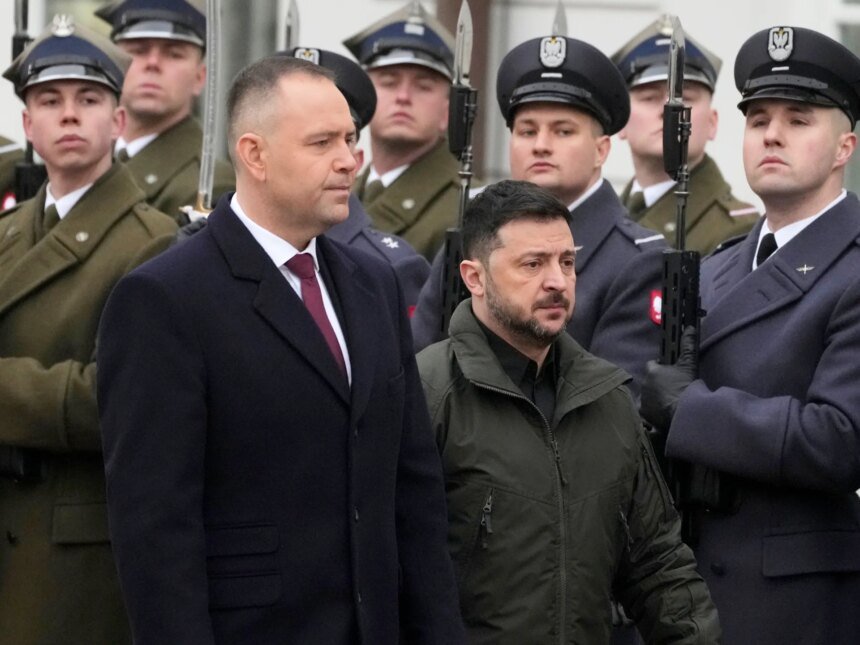
Polish President Karol Navrotsky decided to strip his Ukrainian counterpart, Volodymyr Zelensky, of the “Order of the White Eagle,” the country’s highest honor, against the backdrop of Zelensky naming a military unit the “Ukrainian Insurgent Army,” a nationalist organization that committed massacres against Poles during World War II. This step sparked new tension between the two countries, and Kiev denounced the decision and considered it a “strategic mistake” and an “insult.”
Navrotsky’s decision – which is opposed by his Prime Minister Donald Tusk – is likely to lead to a diplomatic crisis between the two neighboring countries, days before a conference on the reconstruction of Ukraine is held in the Polish city of Gdańsk overlooking the Baltic Sea, but it is not yet clear whether Zelensky will attend the conference.
The Polish President said – in a statement announcing the decision – that “historical truth is not and will never be a bargaining chip.”
He stressed that Poland “repeatedly” called on Ukraine to withdraw from naming the unit the “Ukrainian Insurgent Army,” but “the position of the Ukrainian side has not changed.”
The “Ukrainian Insurgent Army” is part of a nationalist movement that fought Soviet forces during World War II, but it was also involved – according to the Polish account – in massacres of Polish civilians, especially in the Volhynia region, as well as accusations of cooperation with Nazi Germany at some stages.
A series of killings took place in the Volhynia region between 1943 and 1945, in which Poland indicates that approximately 100,000 Poles were killed at the hands of Ukrainian nationalists. Thousands of Ukrainians also died in revenge killings.
On the other hand, a sector of Ukrainians sees this organization as a symbol of national resistance against Soviet hegemony, which makes its historical legacy a subject of sharp disagreement between the two countries.

Ukrainian response
In response to Poland’s decision, Kiev responded with strong criticism, as Ukrainian Foreign Minister Andriy Sepha said that the decision, which he described as “reckless,” only serves Moscow.
“The decision to strip the President of Ukraine of the Order of the White Eagle is a strategic mistake on the part of the President of Poland that is not in the interests of anyone but Moscow,” he wrote on Facebook.
The Ukrainian minister added that he would also return a medal he had received from Poland in 2022.
Although Poland – a member of the European Union and the North Atlantic Treaty Organization (NATO) – is considered one of the most prominent supporters of Ukraine since the outbreak of war with Russia more than four years ago, as it received hundreds of thousands of refugees and formed a major center for the delivery of Western aid; Historical differences continued to cast a shadow on the relationship between the two sides.
With the return of Polish Prime Minister Donald Tusk to power, the intensity of these differences decreased relatively, but they did not disappear completely, and today they have returned to the forefront in light of the sensitivity associated with the memory of World War II.