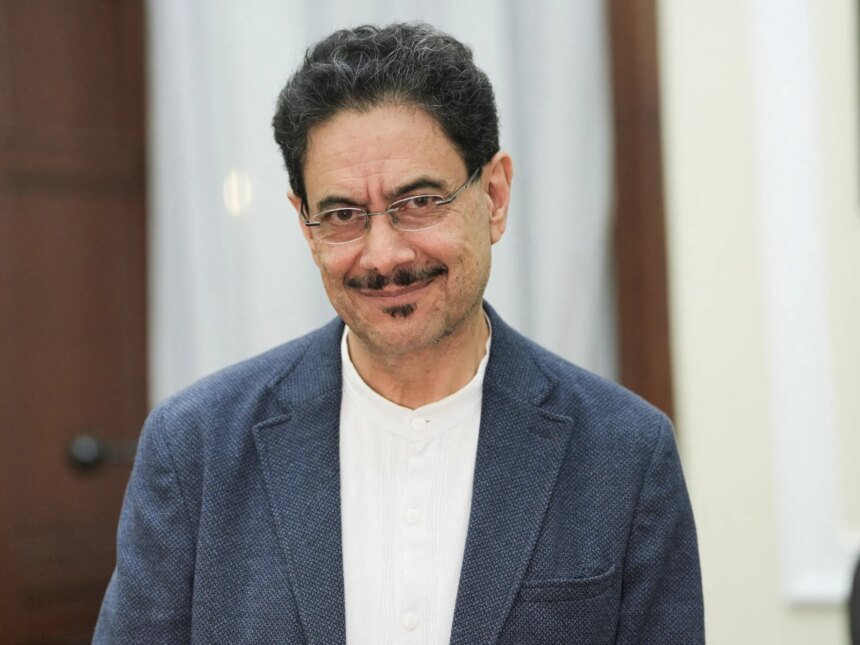
A Colombian democratic politician and member of the Senate, who belongs to the Historic Pact coalition, and is considered one of the most prominent voices defending transitional justice and national reconciliation. He was known for his defense of human rights and the issues of victims of armed conflict, and his name was also associated with opposing paramilitary groups and supporting peace efforts in Colombia.
He began his parliamentary career as a member of the House of Representatives in 2010, before being elected to the Senate in 2014. During his years in Congress, he focused on human rights issues, victims, and the peace process, which made him one of the most prominent political figures associated with these issues in Colombia.
After years of parliamentary and human rights activity, and his name being associated with issues of peace and victims, he emerged as a candidate for the ruling leftist movement in the 2026 Colombian presidential elections, and qualified for the run-off, in which he will face right-wing lawyer Abelardo de la Espriilla, who presents himself as a candidate from outside the political establishment.
Birth and upbringing
Iván Cepeda Castro was born in Bogotá on October 24, 1962, and grew up in a family involved in politics; His father, Manuel Cepeda Vargas, was one of the most prominent leaders of the Colombian left and a member of the Senate for the National Union Party.
His father was assassinated on August 9, 1994 in a crime that was later classified as crimes against humanity. As for his mother, Yira Castro Chadid, she is a journalist and political leader from the Sucre province, and served as a member of the Bogotá Municipal Council.
Because of the threats against his father, the family lived for a period of time in exile in Prague, Czechoslovakia, and Cepeda also spent part of his growing up years in Cuba, before returning to Colombia.

Study and training
Ivan Cepeda received his university education in Bulgaria, where he received a BA in Philosophy in 1987 from Saint Klement of Ochridian University in Sofia.
After the conviction of two non-commissioned officers in 2000 in the case of his father’s assassination, he left for exile in France, where he continued his academic career, specializing in international humanitarian law, and in 2002 he obtained a master’s degree from the Catholic University of Lyon.
Political experience
Cepeda devoted a large part of his public activity to defending human rights, preserving historical memory, and accompanying the victims of the armed conflict in Colombia. He was one of the founders and spokespersons of the “National Movement for Victims of State Crimes” (MOVIS), which made recognizing the rights of victims and holding those responsible for violations accountable one of the most prominent focuses of its work.
His name emerged in the public sphere through his human rights activism and efforts to achieve peace. Between 2009 and 2010, he participated in the “Colombians for Peace” movement, which contributed to mediating the release of a number of kidnappers.
In late 2009, he decided to enter politics through the Alternative Democratic Pole Party with the support of the “Movis” movement, and was elected as a member of the House of Representatives for Bogota for the period 2010-2014, before moving to the Senate and being re-elected from the Alternative Democratic Pole Party in subsequent sessions. He then retained his seat since 2022 within the “Historic Pact” coalition, to which President Gustavo Petro belongs.

In parallel with his parliamentary work, he played prominent roles in Colombian peace processes, participating between 2012 and 2016 as a facilitator of peace talks between the government and the Revolutionary Armed Forces of Colombia (FARC).
Since 2015, he has also participated in peace dialogues with the National Liberation Army (ELN), and has served as a mediator in the process of handing over the “Clan del Golfo” to justice.
He also assumed the co-chairmanship of the peace committees in the House of Representatives and the Senate, and contributed to supporting the implementation of legislation related to the peace agreement signed in 2016.
In Congress, he was known for running dozens of political oversight sessions that addressed issues of human rights, land, sexual violence, the conditions of victims, and paramilitary groups, and his efforts contributed to opening investigations against more than 220 officials.
He is also the author of Law No. 1719 of 2014 on combating impunity for crimes of sexual violence related to armed conflict.
The quest to uncover the truth about the crimes committed against members of the National Union Party was one of the most prominent files of his activity, as in 2010 he obtained a ruling from the American Court of Human Rights holding the Colombian state responsible for the assassination of his father, Manuel Cepeda, in collusion with paramilitary groups.

Due to his human rights activism and association with victims and peace files, Cepeda was subjected to repeated death threats, and he lived in exile between 1998 and 2004, which made him subject to protection measures ordered by the American Court of Human Rights.
His name was also linked to a prominent judicial case with former President Alvaro Uribe, which began by accusing him of witness tampering. However, in 2018, the Colombian Supreme Court decided not to investigate Cepeda and instead opened an investigation into Uribe on suspicions related to bribery of witnesses and procedural fraud.
After Uribe’s acquittal in October 2025, Cepeda announced his appeal to the Supreme Court as one of the parties to the case.
After years of parliamentary and human rights activity and his name being associated with issues of peace and victims, he emerged as a candidate for the ruling leftist movement in the Colombian presidential elections of 2026. In June, he qualified for the run-off round that Colombians are heading to decide to choose a new president of the country to succeed Petro.
Cepeda is running in the presidential race as a representative of the ruling “Historic Pact” coalition, pledging to continue Petro’s policies, especially in the areas of combating poverty and negotiating with armed groups.
On the other hand, he faces right-wing lawyer Abelardo de la Espriilla, who calls for ending negotiation processes with armed groups and adopting a more stringent security and military approach to confronting crime and violence.
Cepeda carries the banner of the leftist movement that came to power for the first time in Colombia’s modern history with the election of Petro in 2022.

Awards and honors
Ivan Cepeda has received a number of awards and honors in recognition of his work in the field of human rights, including the Roger Baldwin Medal of Freedom awarded to him by Human Rights First in 2007, and the special honor of the Franco-German Antonio Nariño Human Rights Prize in 2015.
Year after year, he was ranked among the best members of Congress, according to polls of opinion leaders conducted by the Colombian Sefras and Concepts Foundation.
In 2012, Semana magazine chose him among the top 5 parliamentarians in the 2010-2014 legislative session, in recognition of his work on human rights, peace, victims, and political oversight discussions.
Compositions
Cepeda co-authored my book with lawyer and politician Alirio UribeAt the gates of Obirimo“(A las Puertas del Ubérrimo) and”In the effects of Obirimo(A las Señas del Ubérrimo), which dealt with the emergence and expansion of paramilitary groups in the 1990s, and the relationships that some of these groups were said to have with local political circles.