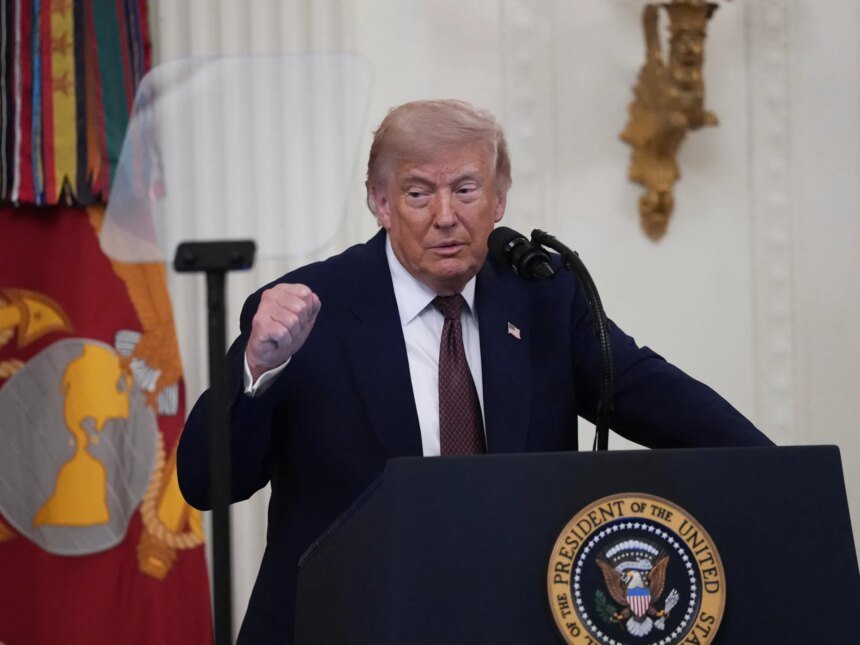
A thirst for revenge, an absence of restrictions, an obsession with interior decoration, and a drive to leave permanent marks in his office. With this suggestive phrase, writer Tim Balk began his report in the New York Times.
The writer considered these descriptions to be the image that emerges of President Trump in his second term, as reflected in a new book entitled “Regime Change: Inside the Imperial Presidency of Donald Trump,” written by two New York Times reporters, Maggie Haberman and Jonathan Swan.
Read also
list of 2 itemsend of list
According to the newspaper’s report, the book presented a detailed account of a president who sees himself as more powerful and influential than ever before, and who is working systematically to reshape the American state according to his own vision.
In his report, Tim Balk reviewed the highlights of the new book, which will be published next week, and is based on dozens of interviews with officials and those close to the current US administration.
The book paints a picture of a president whom the authors describe as “the most powerful president in our lives” who leads the country driven by personal grievances and political intuitions more than any other considerations, to the point that he was once seen redecorating the White House himself, using a tube of quick glue to attach the gilded decorations above the Oval Office’s marble fireplace, in a scene that did not surprise anyone from his close circle who were accustomed to his penchant for imposing his own aesthetic touch.

Flattery of the highest order
Within the report presented by Balk, the book confirms that Trump was enjoying seeing the leaders of giant technology companies trying to court him and regain their favor with him after he won the 2024 elections.
The book highlights Trump’s boasting to his visitors at his private resort in Mar-a-Lago, Florida, about how those who had previously boycotted and banned him turned to wooing him in every possible way, especially Jeff Bezos, founder of Amazon, and Mark Zuckerberg, CEO of Meta, who had banned him from the Facebook and Instagram platforms after his supporters stormed the Congressional Building (the Capitol) on January 6, 2021.
Trump even went so far as to show his guests a letter from one of Zuckerberg’s children expressing his aspiration for a “golden age of America” with Trump’s return to power.
The novel conveys Trump’s admiration for what he considered a radical shift in their positions, as he presented to his guests messages he received from leaders of technology companies.
Trump’s relationship with the Amazon founder has been closely monitored. The book states that over a dinner party, they shared frustration with media coverage of Bezos’s newspaper, The Washington Post, with Bezos complaining that the newspaper was his worst business investment ever, unlike the rest of his successful companies that obeyed his orders.
This scene of rapprochement and sudden shift in the positions of technology moguls was commented on by Trump in a conversation between him and billionaire Elon Musk, saying: “They hated me,” referring to Zuckerberg and Bezos, before the latter responded sarcastically: “It is flattery of the first degree.”
One of the striking aspects of the book is Trump’s continued interest in the question of who will carry the banner of the Trump movement after him. The book reveals that the president repeatedly asked his allies a direct question: Who is better, Vice President J.D. Vance or Secretary of State Marco Rubio?
Behind the scenes of operating rooms
The excitement was not limited to the scenes of the technology sector, but rather extended to include what goes on inside the White House Situations Room, which is the exclusive place usually reserved for managing major and dangerous national security crises.
The book devotes almost an entire chapter to the controversy related to the sexual crimes committed by convicted businessman Jeffrey Epstein, revealing that senior administration officials held a series of lengthy meetings inside the White House Situation Room to discuss the political ramifications of the case.
The novel describes those meetings as exceptional, given that the operations room is usually used to manage major military and security crises. But officials, according to the book, were busy assessing the extent of the issue’s impact on Trump’s electoral base, and discussed ways to deal with Congress’ demands to publish additional documents related to Epstein.
Some old and unconfirmed allegations related to Trump also alarmed officials, who feared that including them in government databases would give them greater credibility.
The book quotes one of the participants as describing those meetings as “surreal,” because he found himself inside the most important security crisis management center in the United States discussing personal issues related to the president.
One of the striking aspects of the book, which the New York Times also highlights, is Trump’s continued interest in the issue of who will carry the banner of the Trump movement after him. The book reveals that the president repeatedly asked his allies a direct question: Who is better, Vice President J.D. Vance or Secretary of State Marco Rubio?
According to the story, this question reached media kingpin Rupert Murdoch during a dinner that brought together the two parties at the White House. When Trump asked him about his opinion, Murdoch responded “diplomatically,” considering that Vance had “the potential to be great,” but he was more decisive when he spoke about Rubio, saying: “Marco is great.”

vindictiveness
The desire for revenge and settling scores was the main driver of Trump’s actions in the halls of power, even if the names were sometimes absent from his memory due to the large number of opponents.
In this regard, Haberman and Swan recount in their book an incident that occurred in the spring of 2025, when Trump was struggling to remember the name of a lawyer in his first administration who publicly stated that the 2020 presidential elections were fair and free of fraud.
Here the roles of his pivotal advisors emerge. The report referred to the name of Stephen Miller, White House Deputy Chief of Staff and Homeland Security Advisor, as one of the most powerful figures in Trump’s second term.
After being one of the prominent faces in the first term, Miller transformed during the second term into a real center of gravity within the government system, as he supervised the drafting of executive orders, led immigration and mass deportation policies, and his influence extended to most federal agencies.
The story narrates from officials that Miller repeatedly reprimanded employees, and in one meeting even threatened to fire the entire leadership of the Immigration and Customs Enforcement agency if deportations did not accelerate.
One of the most controversial passages in the book is Trump himself talking about power and strength. During an interview the authors conducted with him during the war on Iran, the president began to compare his influence to the influence of a number of historical leaders, from Alexander the Great to the Emperor of France Napoleon Bonaparte, the leader of Nazi Germany, Adolf Hitler, the Soviet leader Joseph Stalin, and the founder of modern China, Mao Zedong.
Trump said that these leaders did not possess the global tools that a contemporary American president possesses, adding that some of them maintained their power through fear. Then he added sarcastically: “Who would do something like this in the first place?” Before he continued, saying – according to the book -: “Isn’t it?”
Obsession with assassination
In the midst of this fierce political conflict, the confused human side of the president is revealed through the story of the assassination of conservative activist Charlie Kirk on September 10, 2025.
The book states that Trump received the shocking news from his 19-year-old son, Barron, who called his father in a state of extreme panic and fear, expressing his fear that his father would be targeted again after surviving a similar assassination in 2024.
Despite Trump’s continued attempts to comfort his son with tender words, the incident left a clear effect of anxiety and confusion on the president himself, making him realize the extent of the risks surrounding direct speech in front of huge crowds and open spaces.
Trump has long been known as a master of media manipulation, which the book reinforces by highlighting his favorite strategy of creating “surprising plot twists” to change the course of negative news when it does not serve his interests.
When the nomination of Pete Hegseth for the position of Secretary of Defense faced a real risk of rejection due to accusations of sexual assault, Trump clearly considered replacing him with Florida Governor Ron DeSantis.
The president justified this to one of his allies by the need to change the dramatic plot to confuse opponents, before ultimately deciding to unleash J.D. Vance, Charlie Kirk, and his son Donald Jr. to exert maximum pressure on Republican senators to successfully pass the appointment.
The Iran war and the limits of power
This comprehensive expansion of domestic influence and penchant for control directly intersects with the vision that Trump adopts for his power at the international level, which is what was focused on in another exclusive report penned by journalist Dave Lawler on the Axios website.
In a special live interview conducted for the news site’s “The Axios Show” program, Trump vehemently denied that the recent war waged by the United States against Iran had revealed any limits to his ability to exercise brute power.
He assured journalist Mark Caputo that he still believes that “there are no limits” to his power as President of the United States of America. Although Trump entered that war with a slogan calling on Iran to surrender unconditionally, it ended with the signing of a limited memorandum of understanding instead.
The American President refused to consider the experience a lesson in political humility, claiming that the memorandum represents, in essence, an overwhelming military victory and an almost complete surrender by the other party, citing the absolute success of the naval blockade he imposed, which no ship was able to penetrate.
Trump said that the alternative was to continue the bombing for additional weeks, which would have led to the closure of the Strait of Hormuz and depriving global markets of oil for months, warning that this could have caused a “global depression,” in the words of the Axios website.
In general, the New York Times’ reading of the book, supported by Trump’s recent statements, presents a picture of a president who does not see the second term merely as a return to the White House, but rather as an opportunity to redefine the boundaries of the American presidency itself.