Published on 6/18/2026
In recent years, the alliance between India and Israel has witnessed a profound transformation, making it one of the most prominent political and military partnerships in Asia and the Middle East. This transformation is largely related to the personal and political relationship that arose between Indian Prime Minister Narendra Modi and his Israeli counterpart, Benjamin Netanyahu.
To shed light on this partnership, the Financial Times published a lengthy article – written by Michael Stott, Andres Schibani, and James Shooter – explaining that this relationship is no longer just traditional diplomatic cooperation, but has become a broad strategic partnership extending from security and defense to economy, culture, and political ideology.
Read also
list of 2 itemsend of list
The report indicated that the extent of the rapprochement between the two leaders became clear after the attack of October 7, 2023, when Modi was one of the first leaders to take the initiative to contact Netanyahu to express his support for Israel.
Observers believe that this position was not just a reaction to a security event, but rather reflects a shared vision between the two men based on considering combating what they describe as terrorism and Islamic extremism an essential part of their internal and external political projects.

Ideological similarities
This rapprochement is also based – according to the article – on ideological similarities between the two ruling parties in the two countries. The Bharatiya Janata Party, led by Modi, embraces Hindu nationalism and presents India as the historical homeland of the Hindu majority, and Netanyahu leads a nationalist movement that considers Israel the national state of the Jewish people.
Supporters of this vision believe that the two countries face similar security threats, while critics accuse the two leaders of promoting policies that marginalize religious minorities and weaken independent institutions.
The article reviews the major historical shift in India’s position on Israel. After India’s independence in 1947, New Delhi was one of the most prominent supporters of the Palestinian cause and opposed the establishment of Israel and voted against the partition of Palestine in the United Nations. It also maintained for many decades a political distance from Israel in line with its orientations in the Non-Aligned Movement and its close relations with the Arab world.
However, this position began to change gradually after the end of the Cold War. In 1992, India established full diplomatic relations with Israel, and then the pace of cooperation between the two countries accelerated after the Kargil War in 1999, when Israel provided important military support to India in the face of Pakistani forces.

Historic transformation
Since then, Israel has become a major supplier of military technology and advanced weapons that India needs, and with Modi coming to power in 2014, relations entered a new, bolder and more public phase.
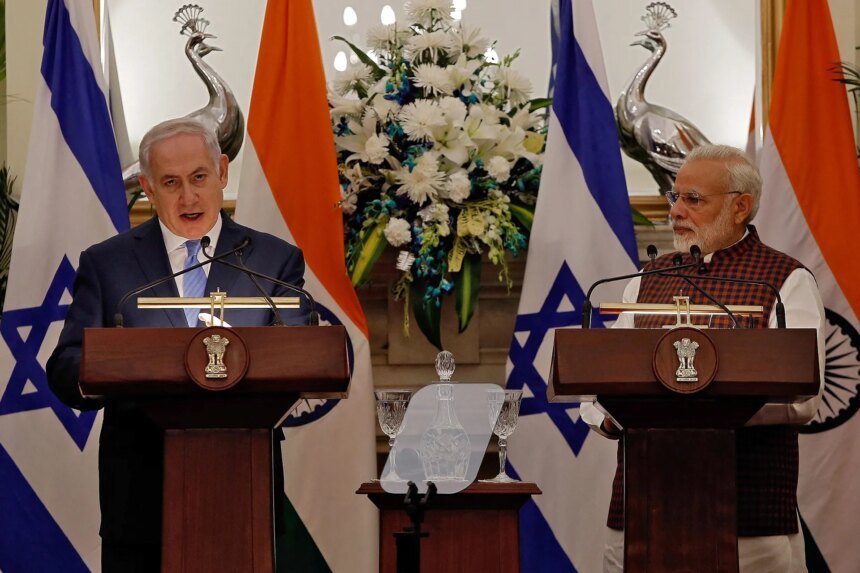
Modi was the first Indian prime minister to visit Israel in 2017, in a move that was considered a historic shift in Indian foreign policy, and Netanyahu responded to it with an official visit to India the following year, to consolidate a partnership that has today become one of the most important bilateral relations in the region.
The report confirms that military cooperation constitutes the backbone of this relationship, as India is one of the largest importers of Israeli weapons in the world, while companies from both countries participate in the development and production of advanced defense systems, including missile systems, drones, and surveillance and intelligence devices.
The names of major companies stand out in this cooperation, such as the Indian businessman Gautam Adani Group, which works with Israeli companies to produce drones and light weapons, in addition to huge investments in Israeli infrastructure, including the port of Haifa.
India has also become a center for manufacturing some Israeli military systems with the aim of meeting the needs of the Indian army and exporting them to other markets.
Growing cultural ties
Cooperation is not limited to the military side. According to the article, there are ongoing negotiations to conclude a free trade agreement between the two countries, in addition to partnerships in the fields of technology, agriculture, water management, and innovation.
Indians benefit from Israeli expertise in developing agriculture in dry areas, while Israel attracts thousands of Indian workers and students annually.
The article also talks about the growing cultural and intellectual ties between the two sides. There is a growing interest within Hindu nationalist circles in the Zionist experience, as a model for building a national state based on religious and cultural identity.
On the other hand, Israel seeks to enhance the presence of Indian culture within Israeli society through cultural and symbolic projects, including erecting a statue of the Hindu king Shivaji in an Israeli city.
At the same time, this rapprochement raises increasing criticism within India, as former diplomats and opposition figures see that Modi’s government is gradually moving away from India’s historical legacy of support for the Palestinian cause. They also believe that New Delhi’s silence regarding Israeli military operations in Gaza and Iran threatens India’s image as a country that defends international law and the rights of peoples.

A partnership that has become solid
Critics fear that India’s increasing bias towards Israel will harm India’s relations with other Middle Eastern countries, especially Iran, which for decades has been an important partner for India in the areas of energy, trade, and access to Central Asia.
The article points out that the apathy shown by New Delhi towards Tehran during the recent crises has raised questions about the future of this traditional balance in Indian foreign policy.
Despite these criticisms, most of the experts cited in the report believe that the Indian-Israeli partnership has become established enough to continue even after Modi and Netanyahu leave power, because the mutual strategic, economic, and military interests have become very large, and the common security threats, in the eyes of decision-makers in the two countries, provide a permanent basis for this relationship.
The article concluded that Israel views India as one of its most reliable partners in a world where international criticism of its policies is increasing. India also sees Israel as a partner that provides advanced military technology and intelligence support without major political restrictions.
Thus, the alliance between the two countries has transformed from a limited and conservative relationship a few decades ago to a comprehensive strategic partnership that is expected to continue and expand in the coming years.