
Published on 6/20/2026
|
Last update: 6/21/2026 05:23 (Mecca time)
All eyes are on the Swiss resort of Bürgenstock, where the first high-level discussions between the United States and Iran are expected to be held after the signing of the recent memorandum of understanding that practically ended the war that broke out on February 28.
The Pakistani Prime Minister’s Office announced that “technical talks will be held on Sunday in Switzerland as part of following up on the implementation of the Islamabad Memorandum of Understanding.”
CBS News quoted a diplomatic source as saying that an emergency session on Israel and Hezbollah had been included in the talks between Washington and Tehran in Switzerland.
She added that incorporating the Lebanon truce file into direct negotiations with Iran represents a strategic shift for the Trump administration, noting that it has abandoned the strategy of separating the various conflicts that it was following in the Middle East.
The meeting comes despite regional tensions and field and political complications that preceded its holding, which places it on open paths ranging from consolidating existing understandings or sliding back into circles of tension.
Political delegations and multiple roles
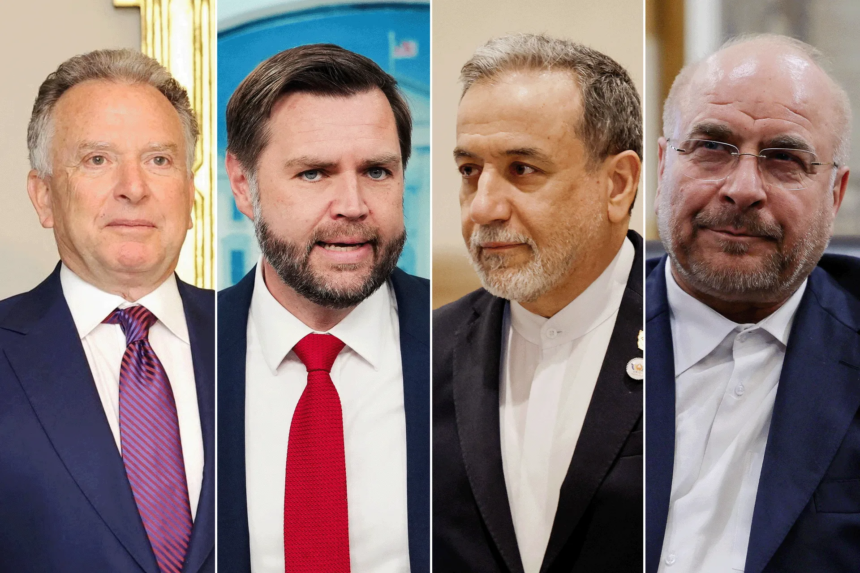
On the American side, Vice President J.D. Vance left Andrews Air Force Base heading to Switzerland to participate in the discussions.
“I am heading to Switzerland, where the Iranians have just arrived,” Vance said before boarding the plane, noting that the discussions would continue for two days.
At the same time, Iranian television reported the arrival of the Iranian negotiating delegation to the Swiss city of Zurich.
Iranian television had previously reported that the delegation includes Parliament Speaker Mohammad Bagher Qalibaf and Foreign Minister Abbas Araghchi, along with Central Bank Governor Abdel Nasser Hemmati, International Affairs Officer at the National Security Council Ali Bagheri, and other officials.
On the other hand, The Pakistani Foreign Ministry said that Pakistani Prime Minister Shahbaz Sharif And the army commander Asim Mounir They left for Switzerland to participate in the talks between Washington and Tehran.
The ministry added that the Prime Minister is expected to hold bilateral meetings with participating delegations from Iran, Qatar, Switzerland and the United States on the sidelines of the talks to affirm Pakistan’s permanent commitment to dialogue and lasting peace in the region.
Pakistan and Qatar play a pivotal role in sponsoring the current track, as Islamabad confirms that the technical talks in Bürgenstock are being held under joint supervision with Doha, and other mediating countries continue to support the track, and the data indicate that mediation is no longer just a traditional role, but has turned into direct management of the executive complexities between the two parties.
From the Memorandum of Understanding to “Implementation Follow-up”
The upcoming meeting will discuss the follow-up to the implementation of the memorandum of understanding that was signed electronically between Presidents Donald Trump and Masoud Pezeshkian, which stipulated an immediate and permanent cessation of military operations on all fronts, including Lebanon. Its most prominent items include:
- Immediate and permanent cessation of military operations on all fronts, including Lebanon.
- Opening the Strait of Hormuz to commercial shipping.
- Lifting the US naval blockade imposed on Iran.
However, the Iranian Foreign Ministry confirms that the delegation is not going to negotiate a final agreement, but rather to “follow up on the implementation of the other party’s obligations.”
The hours preceding the meeting witnessed rapid developments in several arenas. Israeli reports announced a ceasefire in southern Lebanon under American coordination, without a complete withdrawal from military sites, in a move that circles interpreted as an attempt to contain tension.
In this context, an American official confirmed to Al Jazeera that the Israeli army informed Central Command that it had ordered its units to adhere to the ceasefire with Lebanon.
CNN also quoted sources as saying that Iran requested guarantees regarding stopping Israeli attacks on Lebanon before starting negotiations with the United States in Switzerland.
On the other hand, Iran announced, on Saturday, through the headquarters of Khatam al-Anbia, the closure of the Strait of Hormuz, considering the move a response to what it described as “breach of commitments” and the continuation of Israeli operations in Lebanon.
Tehran described the decision as “the first stage of the response,” while hinting at additional options if the escalation continues.
The first round of talks was supposed to be held on Friday, but disagreements related to the escalation in Lebanon and security understandings led to its postponement, and a temporary or unresolved absence of some delegations was recorded, amid conflict over the final level of Iranian representation.
Mutual political pressure
The Washington Post quoted a Pakistani official as saying that Islamabad is in contact with Tehran and Washington, and is striving to remove obstacles. The American newspaper quoted mediators as saying that Washington and Tehran do not want the peace process to collapse completely.
In a related development, Pakistani Foreign Minister Muhammad Ishaq Dar attributed the failure to start negotiations in Switzerland to the association of Iranian officials with the rituals of the month of Muharram.
He denied the existence of obstacles to the start of negotiations, stressing the need to complete them between Washington and Tehran within 60 days, as stipulated in the signed memorandum of understanding.
These developments come with a clear discrepancy within the camps concerned. On the American-Israeli side, disagreements are escalating between the White House and Benjamin Netanyahu’s government regarding managing the truce process, while the Trump administration is trying to cement an agreement that will avoid a wider explosion in the region.