Does he keep the new formation?



HOUSTON. Sweden switched to a four-back line after the liquid break and got better.
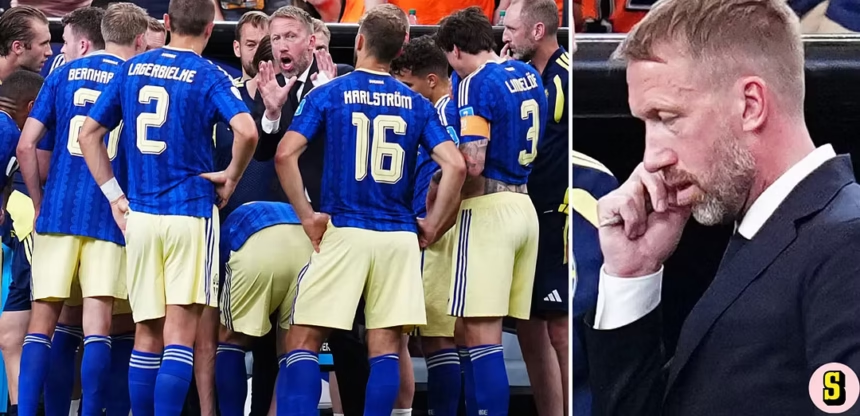
Now voices are being raised for Graham Potter to keep the new formation against Japan.
– It is always good to be flexible, says Jesper Karlström.
After the nightmare start (0–2) against the Netherlands, Graham Potter changed formation to stop the superior opponents.
– We switched to a four-back line and let Alex (Isak) drop to the left. We were good after the break, but you have to score goals. We didn’t, says Graham Potter.
Former national team centre-back Jonas Olsson, now WC expert on TV4, sees the advantages of a four-back line.
– Always when you play a five-back line, the distribution of roles becomes a bit diffuse when it comes to the centre-backs. In a four-back line with two inside backs, it’s easier: one takes the surface, one goes into a duel. I also think we get too low and too defensive with wingbacks. If you have a five-back line, you have to be more aggressive in the outer zones, says Olsson in the broadcast.

“In retrospect, you can always think differently”
Potter seems to agree with Olsson that they were too low:
– A five-back line can help you defend the entire width, but it can also lead to you being sheepish in the defensive game.
The Netherlands’ comeback Virgil van Dijk believed, like everyone else, that Sweden got significantly better after the formation change, even though it was still a blue-and-yellow defeat with 1-5.
– They were very good after the first liquid break. Because then they changed their system. Alexander Isak became more of a left winger between the lines, which was difficult for us. And so Sweden changed their build-up game from three to four players.
Should you have started with a four-back line, Graham?
– In retrospect, you can always think differently. We could have lost even that way, there are always different ways of seeing and doing. We tried to build stability, but today I don’t know if it was a big game or what, but we can learn from it, says the national team captain.

“Always good to be flexible”
Jesper Karlström:
– It was a different match picture and the feeling got better. We became tighter in defense when we changed. We fixed the ball better up there too.
Mattias Svanberg, who was left on the bench against the Netherlands, liked what he saw:
– It was much, much better after we changed. There were details that were clearly adjusted. Then the boys grew into the match.
The question is whether Sweden should continue with a four-back line (Potter played with a four-back line in his first two games as national team captain last fall).
– The coaches have to answer that. But it’s always good to be flexible, says Karlström.
– It depends on which team we face and what the match picture is like. It is a strength that we have two formations to go between, says Lagerbielke.
Sweden then advances to the round of 16
To finish top two in the group – and thus go to the round of 16 – a victory against Japan in the last group stage game is probably required.
To progress as one of the eight best group threes (out of a total of twelve) it is not yet clear what is required, but it depends on how things go in the other groups.
Three points – which Sweden has right now – is likely enough to make one of the top eight group threes, so Sweden can afford to lose to Japan. But in such cases, the loss should preferably not be too great because goal difference is used to separate the different group threes if they have the same number of points.
Sweden’s goal difference is currently 6-6.
According to a statistical model from the Norwegian newspaper VG Sweden has an 89.5 percent chance of progressing to the round of 16.
BET THE ENTIRE WC – COMPETE FOR GREAT PRIZES IN THE WC PROPHET
The national team