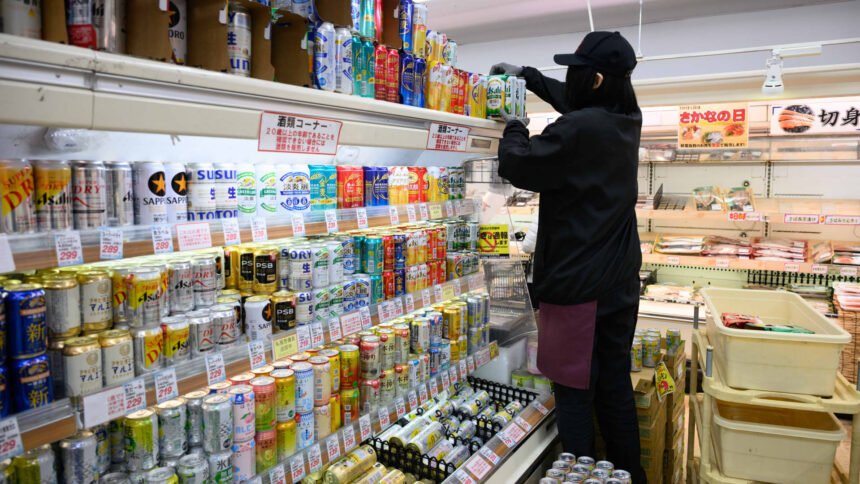
An employee at the Celsior Wadamachi supermarket in Yokohama, Japan, on Thursday, Jan. 15, 2026. Soaring food costs are a key component driving broader inflation higher, with data Friday expected to show consumer price growth has stayed above the central bank’s 2% target for four straight calendar years.
Bloomberg | Bloomberg | Getty Images
Japan’s core inflation rate held steady at 1.4% in May, matching expectations and suggesting that underlying price pressures remained contained despite concerns that higher energy costs could push inflation higher.
The inflation figure — which excludes prices of fresh food — was in line with the 1.4% expected by economists polled by Reuters and unchanged from April.
Headline inflation edged up to 1.5% from 1.4% a month earlier, while the so called “core-core” inflation rate, which strips out prices of fresh food and energy, eased to 1.8% from 1.9% in April.
The inflation data comes as the Bank of Japan raised interest rates to their highest level since 1995 and warned of a possibility that its key “underlying inflation” metric may overshoot its 2% target due to high energy prices.
Energy prices saw a smaller drop year on year, falling 2.5% compared to the 3.9% dip in April.
While households have been relatively shielded from rising prices by government support measures, businesses have faced stronger cost pressures.
Japan’s producer price index rose 6.3% in May, marking its fastest pace of increase in more than three years, driven largely by higher energy costs.
“The price pass-through stemming from the rise in crude oil prices has been progressing at a relatively fast pace in business-to-business transactions, which could spread to an increase in consumer prices across a wide range of items,” the central bank noted.
The yen has also remained under pressure, trading at the 161-per-dollar level despite intervention by the country’s finance ministry and the Bank of Japan’s rate increases.
A weak yen would increase inflation, especially in a time where Tokyo needs to use dollars to buy energy to cope with the fallout of the Iran war.

This is breaking news, please check back for updates.