Published on 6/17/2026
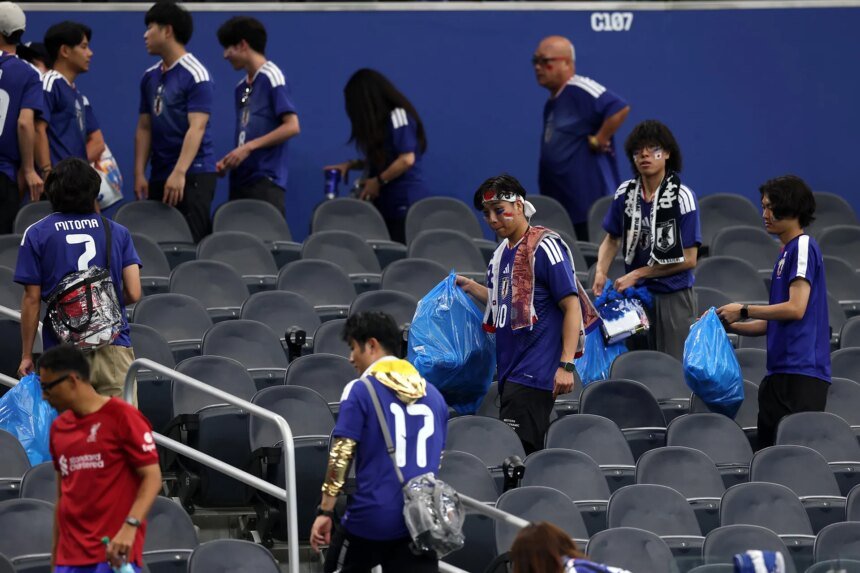
In light of growing international interest in the behavior of some Japanese fans in stadiums, scenes of cleaning the stands and collecting garbage during the 2026 World Cup have brought to light an image presented as a reflection of the values of discipline and collective responsibility in Japanese society.
However, this image, which received widespread acclaim outside Japan, quickly became the focus of a more complex internal debate, going beyond sports to deeper social issues.
Read also
list of 2 itemsend of list
Messages and posters attributed to Japanese women have spread on social media platforms, linking this behavior in the public space to what they considered to be a gap in the distribution of roles within the family, especially with regard to unpaid housework.
These messages indicate that the manifestations of cooperation and discipline that appear in public places are not reflected to the same degree inside homes, where the burden of cleaning and caring for the family – according to these opinions – remains unbalanced between men and women.
Some circulating comments suggest that men’s contribution to household chores in Japan is still limited compared to international standards, with calls to reconsider the concept of “shared responsibility” to include daily life within the family, not just general behavior in public spaces and sporting events.
On the other hand, this proposal sparked widespread controversy, as critics considered that some of the slogans or translations circulating may be inaccurate or misleading, and that linking fans’ behavior in stadiums directly to their behavior inside the home ignores the difference in social and psychological contexts between the two fields.
Others also believed that generalizing these comparisons might reduce complex issues related to the social structure and work roles within the family, and ignore the differences between the public sphere and private life.
Between this and that, the case has reopened a renewed social debate within Japan about the extent of unpaid work within the family, and the limits of the ideal image that is exported abroad as a model of discipline and collective responsibility, in contrast to a more complex daily reality within homes, where levels of participation in household chores vary and roles and responsibilities overlap.
This debate goes beyond just behavior seen in stadiums or public spaces, to raise deeper questions about the gap between image and practice, and how behavior that is celebrated globally can turn at home into a point of discussion about family justice and burden-sharing within daily life.