Published on 6/17/2026
The widening trade deficit with China is prompting the European Union to take protectionist measures in almost all sectors, from electric vehicles to e-commerce platforms, raising fears of a trade war between two of the world’s largest economic powers.
Beijing called for dialogue with Europe, but at the same time warned that it might respond to European protectionist policies.
Read also
list of 4 itemsend of list
The relationship with China received attention at the G7 summit held in France, where the group’s leaders are discussing how to restore balance to global trade and address “monopolistic competition,” especially from China.
France summarizes these imbalances, according to what Reuters reported, by saying that China produces too much, the United States consumes too much, while the Europeans invest less than required.
Concern is growing in Europe about China’s record trade surplus, in what analysts describe as a “second Chinese shock” after its dominance of low-value industries in the first decade of the second millennium.
These are the most important dimensions of the trade relationship between the European Union and China, which the Union’s leaders believe is strongly tilted in favor of Beijing, and measures must be taken to correct them.

How big is the EU’s trade deficit with China?
The European Commission deemed last May that the bloc’s trade deficit with China had become “unsustainable.”
In April alone, the deficit amounted to 31.9 billion euros ($37 billion), according to Eurostat, the European statistical office.
European Trade Commissioner Maroš Šefčović said this week, according to Agence France-Presse, “Our trade relationship with China has reached a point that requires a reset,” stressing that what is required “is not confrontation, but rather a rebalancing.”
In May, China’s ambassador to the European Union, Cai Ren, confirmed that Beijing understood the European Union’s concerns, pointing out that it had “never deliberately sought to achieve a trade surplus” and remained ready to “address this issue.”
He said that China has taken practical measures such as enhancing market access for European agricultural products, canceling tax cuts for Chinese exporters of solar energy products, and imposing restrictions on Chinese electric vehicle exports.
China rejects Western criticism that believes that the success of its companies abroad is due to the huge government support available to them, and attributes its superiority to innovation, economic production systems, and its industrial base.
What is the current state of relations?
Relations between the two parties deteriorated this year as the European Union sought to harden its legislation in the face of Beijing.
The union fears that the dominance of Chinese companies in important sectors, such as electric cars, chemicals and environmentally friendly technology, may cause serious harm to European industries.
He also demands more access to the Chinese market, arguing that Beijing does not treat European companies the same way Europeans treat Chinese companies.
Beijing warned that it would take “countermeasures” if the bloc goes ahead with the “industrial acceleration” bill, which excludes some products manufactured outside it from public procurement and restricts the acquisition of European companies.
The European Commission reviewed its cybersecurity rules with the aim of excluding suppliers considered high-risk, such as the Chinese company Huawei, from telecommunications networks.
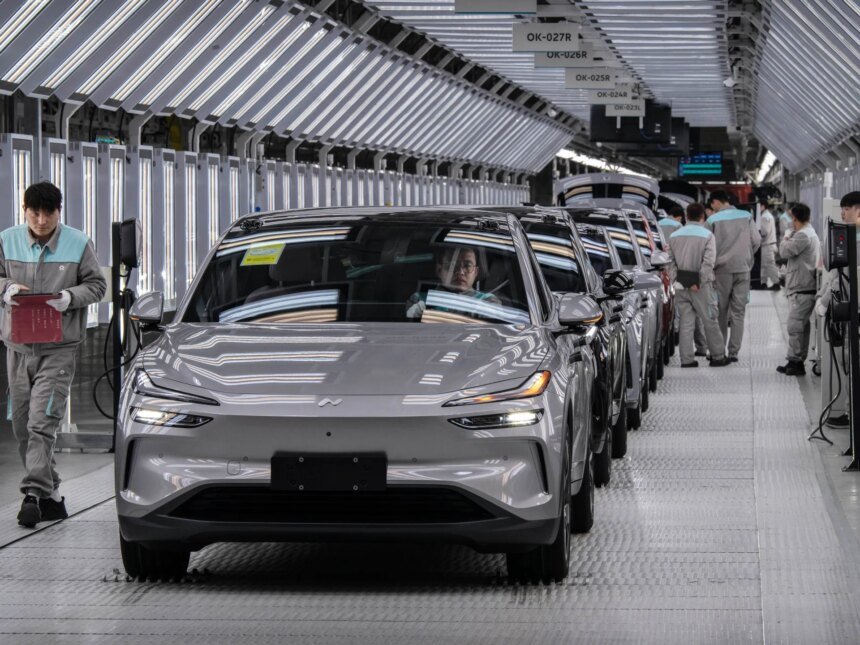
Since 2024, Chinese electric cars exported to Europe will face additional customs duties.

Is a trade war possible?
“The risk of a trade war between the EU and China is real,” said Xu Dingbo, a professor at the China-Europe International Business School in Shanghai.
However, Zhu Tian, an economist at the same college, believes that both sides have an interest in reaching a settlement. “Neither party benefits from escalation: Europe will face higher costs and a slower environmental transition, while China will lose access to a major market,” he says.
On the other hand, Elvire Fabry, a specialist in political trade geography at the Jacques Delors Research Institute, believes that “it is necessary for the Europeans to show their determination and establish a balance of power.”
How can China respond?
Zhou Tian believes that “China could respond with anti-dumping investigations, tightening supervision, restrictions in selected sectors, or pressure on European products considered politically sensitive.”
Beijing has previously imposed duties on European alcoholic beverages, and conducted investigations against pork and dairy products from the bloc, as part of anti-dumping steps. This time, the Union fears that China will restrict its exports of rare metals needed for high-tech industries.
Zhu believes that “China will act in a calculated manner,” whatever its response, and will strike a balance between “sending a message that the European Union’s measures have a cost, but without the matter reaching the point of collapsing the entire relationship.”
What is the importance of the European Union to China?
The European Union is China’s second largest trading partner. Researcher Fabbri believes that China “needs access to the European market” in light of American restrictions.
Zhu believes that increasing Chinese investments in Europe may be a way to create job opportunities and reassure European decision-makers that “China takes European concerns seriously.”
He added, “China can contribute by further opening up its markets and encouraging more imports and investments, but Europe must also enhance its competitiveness.”
Jörg Wöttke, former president of the European Union Chamber of Commerce in China, believes that Beijing can avoid a trade war, but that will require it to be “actually open and not just pretend to be.”