Published on 6/16/2026
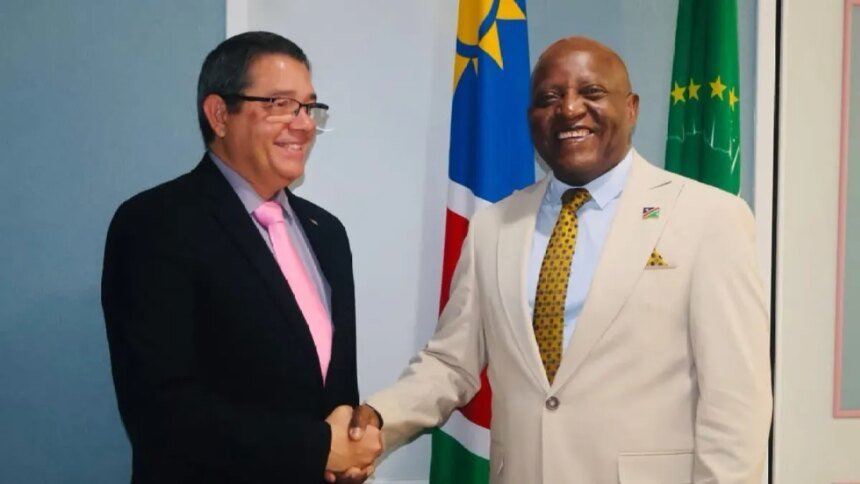
Namibian Prime Minister Tjitunga Elijah Ngurare called on citizens, companies and institutions in his country to participate in a humanitarian solidarity campaign to help Cuba overcome what he described as a severe economic and energy crisis linked to US sanctions imposed on the island for decades. Ngurari’s invitation came during a courtesy visit made by the Cuban Ambassador to Namibia, Sergio de la Oz, to the capital, Windhoek, last week, where the Prime Minister recalled Cuba’s standing alongside the liberation movements in Africa, stressing that Namibia has a “historic responsibility” to stand with Havana in its difficult times.
“They came to die for us, and it would be extremely selfish for us to forget them. We stand with you in this difficult time,” Cuba Headlines quoted Ngurari as saying, adding that “Cuba is being suffocated to death” and that its support is “a matter of principle.”
Ngurari described the situation in Cuba as a “humanitarian crisis accompanied by unprecedented social and economic hardships,” saying that residents may remain “48 hours without electricity,” and that “hospitals lack basic medicines, and surgeries are often canceled due to a lack of medical supplies,” according to the same source.
The Prime Minister said that the US sanctions put severe pressure on Cuba and affected access to fuel, medicines and other basic supplies.
The campaign was launched this year at the initiative of the Namibian-Cuban Friendship Association and the Sam Nujoma Foundation, and aims to collect donations to purchase basic supplies and medicines for Cuba. So far, the initiative has raised more than 700,000 Namibian dollars (about 43,000 US dollars), and Ngurari personally contributed with a donation of 5,000 Namibian dollars.
Last April, the President of the National Assembly (Parliament), Sarah Cogonguiloa Amadela, launched the National Solidarity Campaign with the People of Cuba in Windhoek, and said that the initiative reflects a unified parliamentary position. The Namibian newspaper quoted her as saying, “In Namibia, we are united across political parties, and we may disagree on many issues, but when it comes to Cuba, we stand together,” noting that the Friendship Association includes representatives of all parties.
Relations between the two countries go back to Cuba’s presence in Africa during the 1970s and 1980s, as thousands of Cuban military personnel and collaborators participated in the region during the conflicts that preceded Namibia’s independence, which remains a present part of the country’s political memory, according to Cuba Headlines. The website quoted Ngurari as saying, “Cubans died and their precious blood was shed for our freedom.”
Official and international positions
According to Cuba Headlines, last May, Namibian President Nitumbo Nandi Ndayetwah described the US blockade on the energy sector as “unacceptable” and “extremely regrettable,” which Cuban President Miguel Díaz-Canel thanked, saying that “Cuba is not alone.”
These moves come in a broader international context, as the United Nations General Assembly adopted, for the 33rd time, a resolution calling for an end to the economic, commercial and financial blockade imposed by the United States on Cuba since 1962, according to UN News. Cuba had appealed to the international community to help it avoid what it described as a “humanitarian catastrophe” resulting from the blockade.
The extent to which the Namibian campaign can transform into a broader international movement remains dependent on the positions of other countries, at a time when General Assembly resolutions calling for lifting the blockade are repeated without being binding.