Published on 6/16/2026
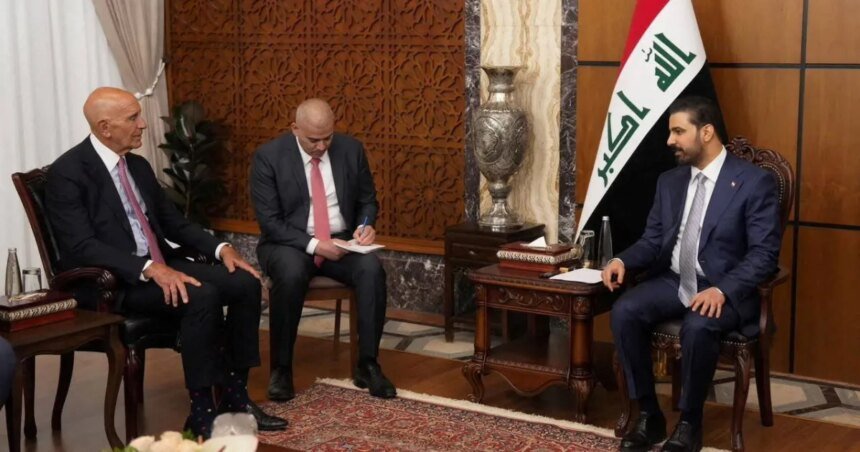
The first joint statement of its kind between Washington and Baghdad, the day after talks between US Special Envoy Tom Burke and Iraqi Prime Minister Ali al-Zaidi, establishes a new phase of mutual relations restricted to security and economic conditions.
The administration of US President Donald Trump has put in place the economic and trade partnership issue and a pressure paper to confine weapons to the state and dismantle the factions, ahead of Al-Zaidi’s expected visit to the White House in mid-July.
New barter
Political analyst Hamza Mustafa explained that Barak’s visit to Baghdad comes the day after the announcement of an American-Iranian memorandum of understanding in Geneva, stressing that the new relationship pattern gives the United States “the upper hand,” especially in the issue of arms control, which is being raised for the first time with practical seriousness, as factions have already begun handing over their headquarters and weapons.
Mustafa stated – during his speech on the “Beyond the News” program – that Washington is exerting public pressure through its ambassador, Barak, and the statements of Trump and his Secretary of State, Marco Rubio, to link vital economic benefits, such as partnership at the corporate level and the (Kirkuk-Baniyas) line project, to disarmament to end Iranian influence.
“Tehran kept the Iraqi issue silent in its understandings and focused on the Lebanon front, which makes the Iraqi government’s task easier to resolve the issue with the support of major political forces within the coordination framework.”
Mustafa based his speech on the fact that the military presence of the US Army will end next September, which will remove the excuses from the rejectionist factions that used the occupation as an excuse.

Washington vision
For his part, Paul Davis, former senior intelligence analyst in the Iraq Department of the US Department of Defense, confirmed that Washington seeks an open and beneficial relationship that frees Iraq from the shackles of the factions that are under the control of Iran and runs them instead of Baghdad.
Davis pointed out that Barak’s visit discussed ways to disarm armed militias, reduce their military capabilities, or integrate them into the Iraqi security forces, despite his acknowledgment of Washington’s lack of ability to put direct pressure on Baghdad in this issue.
“The presence of these armed militias represents a threat to the desire of American companies to engage in joint investment work.”
He considered that protecting diplomatic missions, consulates and American forces from attacks by armed factions is a legal duty on the government to protect its foreign guests, pointing out that the issue of sovereignty over Iraqi airspace will be discussed between Washington and Baghdad within broader regional arrangements.
Refused guardianship
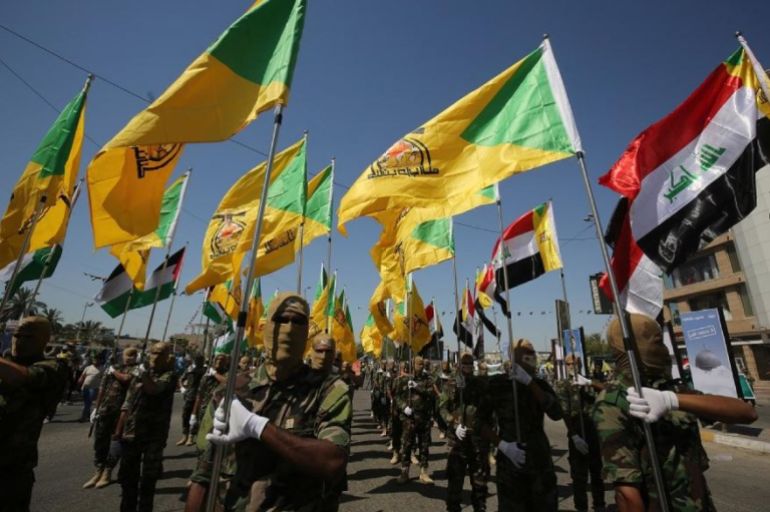
On the other hand, political analyst Ali Fadlallah refuted the American proposals, describing them as a “policy of arrogance” and the deliberate demonization of the factions by painting them with absolute subordination to Iran.
According to Fadlallah, the relationship is a strategic alliance, as evidenced by the factions’ non-interference in the “12 Day War” when Iraq was not targeted, and their response was limited to the “40 Day War” after the headquarters of the Popular Mobilization Forces and the Iraqi army were directly targeted by America and Israel.
“Weapons are a purely internal matter between the government and the resistance, and the American side does not have international guardianship to dictate conditions at a time when Iraq enjoys great security stability.”
Political analyst Fadlallah accused Washington of wrapping the “New Middle East” project with a political and economic veil to secure its companies after its failure against Iran, recalling its confiscation of the 2011 framework agreement and keeping it on the military side only.
He called on the Al-Zaidi government – which was the result of American pressure on the coordination framework, which included a tweet by Trump that prevented the appointment of Nouri Al-Maliki – to invest in this decline and reduce the obligations of obedience to Washington.