Published on 6/15/2026
Field and political developments in the Middle East region are accelerating amid a striking paradox between the language of international diplomacy and the rhythm of iron and fire on the ground.
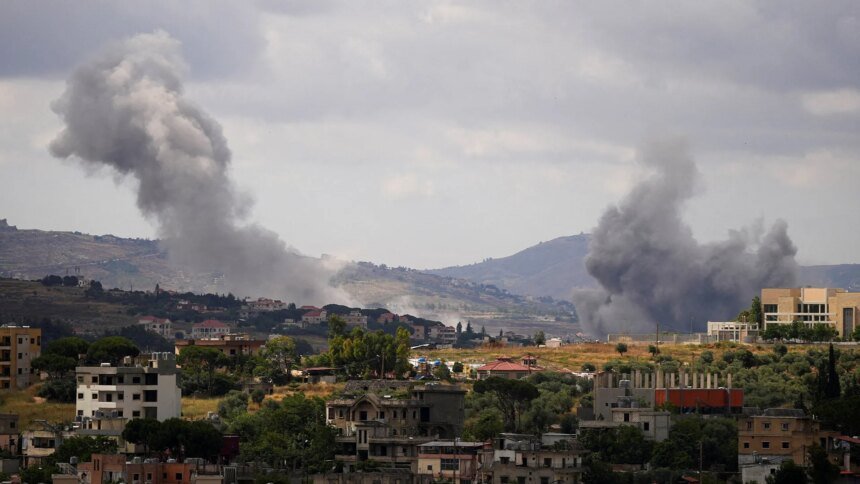
While US President Donald Trump delivers speeches on the necessity of not targeting the Lebanese interior, the Israeli occupation army continues its field escalation by bombing the southern suburbs of Beirut and ground incursions into the towns of the south, crossing what is known as the “yellow line.”
This contradiction raises pivotal questions about the dimensions of the recent Israeli military movements. Does it represent an attempt to impose prior field facts in the last hours before completing the agreement between Washington and Tehran, or does it reflect a discrepancy in strategic calculations between Tel Aviv and Washington?
Dynamics of land incursion
According to the geographical and field reading on Al Jazeera’s interactive screen presented by colleague Mahmoud Al-Kin, the ground operations of the Israeli occupation army in southern Lebanon have passed through three main stages since the start of the last round of escalation on March 2, 2026:
- The first stage: It focused on distributing the occupation forces on 5 main points extending from the eastern sector to the central and western sectors, from Labouneh in the west to Al-Hamams in the east, passing through the towns of Jabal Balat, Jal al-Dir, and Al-Awaidah, which are high hills whose height ranges between 800 and 850 meters, overlooking northern Israel and a depth of 5 kilometers inside Lebanese territory.
- The second stage: moving to what the occupation army calls the “yellow line,” which is a deeper line of incursion extending between 5 and 10 kilometers into southern Lebanon. This step was aimed at preventing Hezbollah fighters from using border infrastructure and keeping anti-armor missiles with a range of between five and ten kilometers away from the northern settlements.
- The third stage: The continuous effort to develop military maneuvers from the eastern and western sides and to advance beyond the yellow line, which was recently represented by the control of the strategic Beaufort Castle and the attempt to penetrate towards the Ali al-Tahir hill axis with the aim of establishing control over the ruling heights, in conjunction with the continuation of the clashes in Majdal Zun, Rishaf, Hadada, Ghandouriya and Wadi al-Hujair.

The strategic dilemma of the occupation
Military and strategic expert Hassan Jouni believes that the Israeli security doctrine currently applied in southern Lebanon is similar to the models implemented by the occupation army in the Gaza Strip and areas of Syria, which is based on the concept of creating a geographical and population vacuum by destroying the infrastructure in the border villages to impede any infiltration operations or progress towards the border.
However, Johnny believes that this field progress faces a complex political challenge. Imposing a withdrawal on Israel without parlaying this military achievement into political gains, the main title of which is withdrawing Hezbollah’s weapons, represents a major strategic dilemma for Tel Aviv.
Israel seeks to exploit field control to subjugate the Lebanese state and impose certain security arrangements, but the crystallization of the expected US-Iranian agreement may change these calculations, according to the military expert.
Johnny adds that the understandings between Washington and Tehran may at a minimum lead to a comprehensive ceasefire, with the withdrawal arrangements and security mechanisms being referred to direct negotiations between Lebanon and Israel under American sponsorship.
Experimental area
If the Israeli withdrawal is approved, Hassan Jouni clarifies that the mechanism does not mean an immediate return to the armed manifestations of Hezbollah, but rather it will be subject to what was stipulated in the recent joint statement between Lebanon and Israel under the name “Pilot Zone Philosophy.”
This philosophy requires the withdrawal of the occupying army from specific areas, such as the vicinity of Beaufort Castle and its neighboring villages, in exchange for the immediate deployment of the Lebanese army. This step represents a testing and scrutiny phase to ensure the extension of the authority of the Lebanese state and prevent any military presence of Hezbollah in those areas.
Johnny concludes that Israel’s strategic success or failure depends on the final formulation of the US-Iranian agreement, and whether it will oblige Israel to withdraw within specific time limits or leave it suspended in the negotiation process.