Published on 6/14/2026
Since the launch of NASA’s Lucy astronomy mission in 2021 to study primitive asteroids, scientists have sought to explore objects that preserve an almost complete record of the beginnings of the solar system.
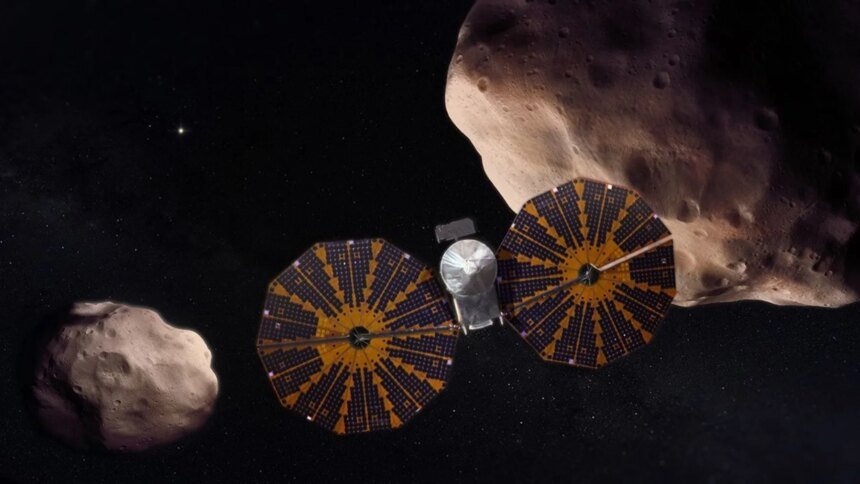
During the spacecraft’s flight near the asteroid “Dinkinesh” in 2023, it discovered an unusual small moon called “Selam” that is characterized by a structure resembling two bodies joined into one entity.
Read also
list of 2 itemsend of list
This discovery sparked researchers’ interest because it does not fit easily with traditional ideas about the formation of asteroid moons, opening the door to reconsidering how these small systems evolve over time.

A new study published in the journal Nature Communications indicates that some asteroid moons may be the product of a long series of successive events, rather than the result of just one formation process. Over the course of millions of years, new moons can form while older moons migrate to more distant orbits, creating interactions and mergers between them that reshape the entire system.
These results provide a possible explanation for the unusual shapes and orbits observed by modern space missions, and also reinforce the importance of the “Lucy” mission in revealing the hidden dynamic history of small bodies that contributed to building the solar system as we know it today.
Asteroids may give birth to moons over successive generations
The researchers used advanced computer models to simulate the evolution of asteroid cumulonimbus, objects composed of relatively loose rock aggregates. The results showed that the asteroid does not go through just one material loss event, but may witness several rotational mass ejection processes over millions of years, and each time new material is formed that can turn into new moons.
Over time, older moons may move away from the parent asteroid due to tidal or thermal effects, becoming in more distant orbits. When new moons are later formed, they begin to interact with old moons, opening the door to a complex series of collisions and mergers.

Scientists relied on N-body simulations to study these interactions, and the models revealed three main patterns of evolution of binary asteroid systems.
The most interesting of these patterns is what researchers call an “interaction regime,” where an old moon is in medium-distance orbit while new moons form near the asteroid. In this case, low-speed collisions, tidal breakups, or even gravitational dispersion can occur.
Researchers believe that this scenario naturally explains the formation of the moon “Salam,” which appears as if two small bodies slowly merged until they became one body with two connected lobes.
The phenomenon is more widespread than expected
The results were not limited to the Dinkenish system only, but the study indicated that a number of other asteroids may have a similar history. Examples include the triple asteroid systems: 2001 SN-263 and Balam, which may be the product of multiple generations of moons.
The researchers also pointed out that there is similar evidence in some active asteroids, such as the comet Pan-STARRS 311P, which repeatedly ejects material from its surface.
What is most exciting is that the study indicates that about 44% of known binary asteroid systems may bear the imprints of this multi-generational history, which means that the phenomenon is not a rare exception, but rather an essential part of the evolution of many small bodies in the solar system.
This discovery reveals that asteroids are not just static rocks silently orbiting the sun, but rather dynamic worlds that witness a long history of birth, change, and interaction. The closer our spacecraft get to these small bodies, the more we discover that nature is more creative and complex than we imagined.
Understanding how moons and asteroids were formed not only helps us learn about the past of the solar system, but also reminds us that science is an ongoing journey to uncover the hidden stories written in the oldest objects in the universe.