Starbucks has more than 2,000 stores across South Korea, including one that overlooks a North Korean village, one in a century-old traditional street market and one that sits on the 99th floor of a glass skyscraper. In a first, they all closed early on Monday.
But the 3 p.m. closure that did not mean extra time off for its 24,000 or so baristas, supervisors and corporate employees. Instead, they all had to do training on historical awareness and cultural sensitivity. It was damage control for a marketing debacle.
Last month, Starbucks unveiled a new line of tumblers that it called “Tank Day.” The campaign began on the anniversary of a massacre in 1980, when South Korea was a military dictatorship and used tanks to crack down on pro-democracy protesters in the southern city of Gwangju.
The backlash to the Starbucks promotion was immediate. South Korea had a brush with martial law less than 18 months ago and the criticism was fierce. Shinsegae Group, the conglomerate that owns Starbucks Korea, took down the ad, issued an apology and fired the Starbucks Korea chief executive. Later, it said that employees had used artificial intelligence to come up with the wording for the promotion and were not aware of the context. The training on Monday was supposed to be the fix.
“Starbucks is trying to demonstrate its commitment to change and their sincerity to consumers and the public by taking the measures of closing stores to train all employees,” said Jongwoo Lee, a professor of marketing at Namseoul University. “Ultimately, the core focus here is restoring a damaged brand image.”
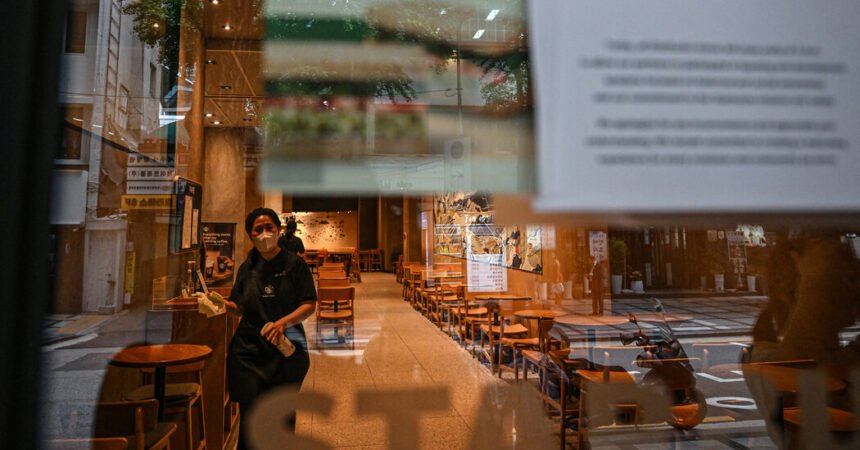
Starting last week, Starbucks had put up signs about the shorter schedule. At about 2:40 p.m. on Monday, baristas at a store at Seoul Station, a busy transportation hub, started telling customers about the early closing. Ten minutes later, workers began closing the window shutters and only accepted takeout orders. At 2:58 p.m., they announced they were closed.
Most customers seemed surprised. “I’ve never heard of ‘Tank Day’ and didn’t know that they would be closing” said Ko Jin-sun, 65, who was visiting from the city of Gumi and was drinking an iced Americano from a to-go cup.
Inside the store, according to a Starbucks spokesman, employees were scheduled to watch recordings of talks by two professors from Sungkyunkwan University in Seoul.
“In many cases, these issues arise because companies fail to properly understand society, its sensitivity, historical events, collective memories or pain points,” said Jeong-Woo Koo, who teaches sociology and spoke during the cultural sensitivity portion of the training. “Ultimately, it comes down to how well a corporation can read society.”
Oh Jeyeon, who teaches contemporary Korean history, gave a lecture on major events since the 1950s for the historical awareness component of the training. He declined to comment.
But the company is not out of the woods yet. The police are investigating Shinsegae executives on charges of defamation, insulting the bereaved families of the victims of the Gwangju massacre and violating the Special Act on the 5.18 Democratization Movement.