Published on 6/14/2026
From the beginning, China was not included in the G7 summit, whose first summit was held in 1975 in a palace in Évian-les-Bains outside the French capital, Paris, to address the global economic crisis, in the first summits that became annual, and which the group of rich countries holds to promote their interests.
This is not surprising, as it was unexpected at the time for anyone to imagine Chinese revolutionary leader Mao Zedong exchanging ideas with US President Gerald Ford and other leaders.
At the time, China was in turmoil, and was nowhere close to becoming the economic giant it is now.
It is remembered that Leader Mao contributed to the defeat of the French and American forces in Vietnam, through his military support for the communists led by Ho Chi Minh who seized power.
So, it would have been strange for Mao to have attended the inaugural six-nation Rambouillet summit, which later evolved into the G7 with Canada joining the following year.
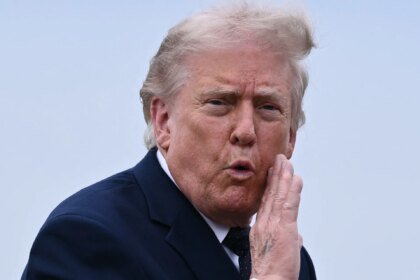
But with US President Donald Trump and his G7 counterparts meeting again in France tomorrow, Monday, excluding China from the summits of this unofficial club seems strange, given its current enormous influence on global economic well-being and issues related to it.

Does the G7 make sense without China?
If the only criterion were economic success, China would have already joined the group. Its economy, which has swelled over decades of growth since the death of Mao Zedong in 1976, now far outstrips those of the G7 countries: Germany, Japan, the United Kingdom, France, Italy, and Canada, with only the United States left to catch up.
Based on this criterion, the G7 summit without China is very similar to the FIFA World Cup without Brazil, the five-time champion, according to John Kirton, a G7 specialist at the University of Toronto, who describes China’s transformation by saying, “From just a gentle little panda in 1975, China has become a mighty global dragon.”
The obstacle to democracy
Many are asking, and it is a valid question: Would the G7 and the international community be better off if China joined it? The logical answer is: yes. But this is limited to democracies.
A year ago, Trump hinted at the possibility of expanding the group to include China, saying “it’s not a bad idea” when asked by a reporter, but the G7’s unwritten rules have long stipulated it is limited to democracies.
The founding leaders of Rambouillet had already declared in 1975: “We are all responsible for governing an open, democratic society, committed to individual freedom and social progress.”
China would not have met this standard then, during Mao’s rule, which claimed millions of lives due to famine and revolutionary unrest. China will not do so now under President Xi Jinping.
According to several indicators, including the annual Freedom in the World study, the World Press Freedom Index, and the Canadian Fraser Institute’s ranking of economic freedom, China lags far behind the G7 countries in terms of civil liberties.

Influence
China’s influence affects all G7 countries in many ways. It sells far more goods than it buys, announcing a record trade surplus of nearly $1.2 trillion in 2025, which is a source of tension with other industrial powers.
China also controls supplies of vital rare earths. Its technological achievements and growing military power worry its competitors. It is also the world’s largest emitter of global warming pollution.
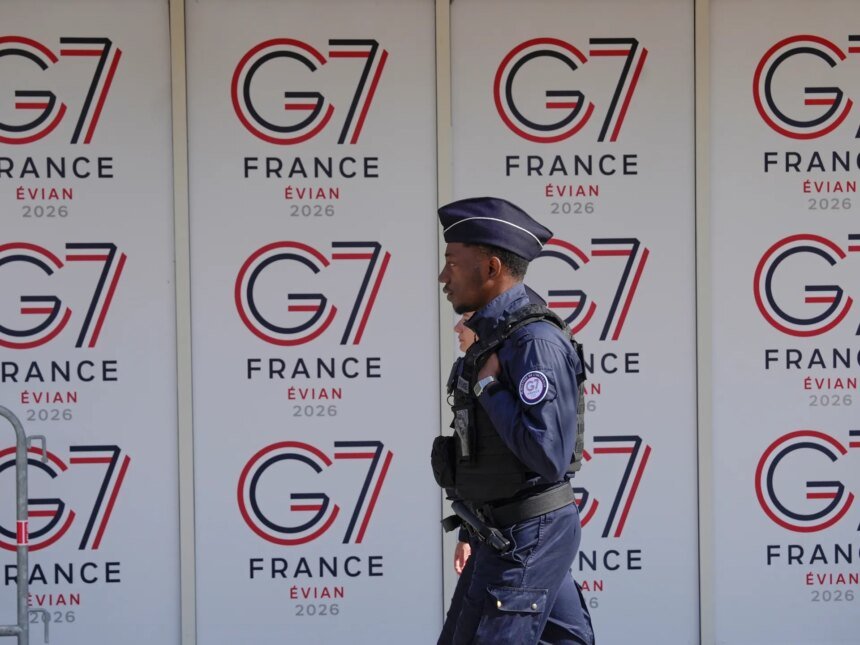
All of this means that China will be strongly present at the G7 summit, which will be held from Monday to next Wednesday in the city of Evian-les-Bains, a health resort located in the Alps.
As host, French President Emmanuel Macron made time for the leaders to discuss how to rebalance trade with China, amid concerns that rising Chinese exports of cars and other products could hurt G7 industries.
Cédric Dupont, a specialist in international politics at the Geneva Institute for Graduate Studies, believes that relations between Trump and other G7 leaders have deteriorated recently due to his war on Iran and other points of contention, but China may be an issue that unites them. “They agree on the same thing, which is that China is a problem.”
Beijing is watching
The Chinese government, led by the Communist Party, has in the past criticized the G7, calling it a relic of the Cold War when the world was more divided along ideological lines.
In a statement to The Associated Press before the Evian meeting, China’s Foreign Ministry took a more nuanced view, saying: “The G7 should be a catalyst for solidarity and cooperation, not an amplifier of division and confrontation.”
According to Beijing-based analyst Wang Zichen, China “is wary of the G7 because it sees the group as structurally allied with Western powers led by the United States, and increasingly views it as a platform where China is discussed as a challenge or threat.”
He also believes that China “realizes that the G7 still represents a significant concentration of economic, technological, military and financial power,” while others consider China a threat to the cohesion of the G7, and analysts say that its acceptance into the group “may undermine its cohesion, and not only because of Beijing’s authoritarian regime.”
conflict
China’s interests and positions on Russia, Iran, and other key issues do not align with those of the G7 countries, not only because its presence may test its long-standing alliances, but also because its presence may test its long-standing alliances.
In Kirton’s view: China’s presence in the group “would be a Trojan horse, and with a Chinese leader at the negotiating table, some members may be tempted to defect from the G7 ranks to obtain special privileges from him on economic issues, vital minerals, digital technology, and other issues that the group addresses.”
As for Chris Alden, an international relations expert at the London School of Economics and Political Science, he believes that adding China to the G7 “will make its work very difficult.”
Russian example
Opponents of China’s accession cite the example of Russia and consider this to be another obstacle facing China. The last expansion of the G7 – by accepting Russia’s membership in 1998 – did not end happily, as the G7 excluded Russian President Vladimir Putin when he annexed the Crimean Peninsula from Ukraine in 2014, which foreshadowed the all-out war that has erupted since 2022.
Trump said last year that excluding Russia “was a terrible mistake,” but Kirton believes that this experience convinced other leaders “that they should never risk a completely undemocratic country joining their democratic club again.”