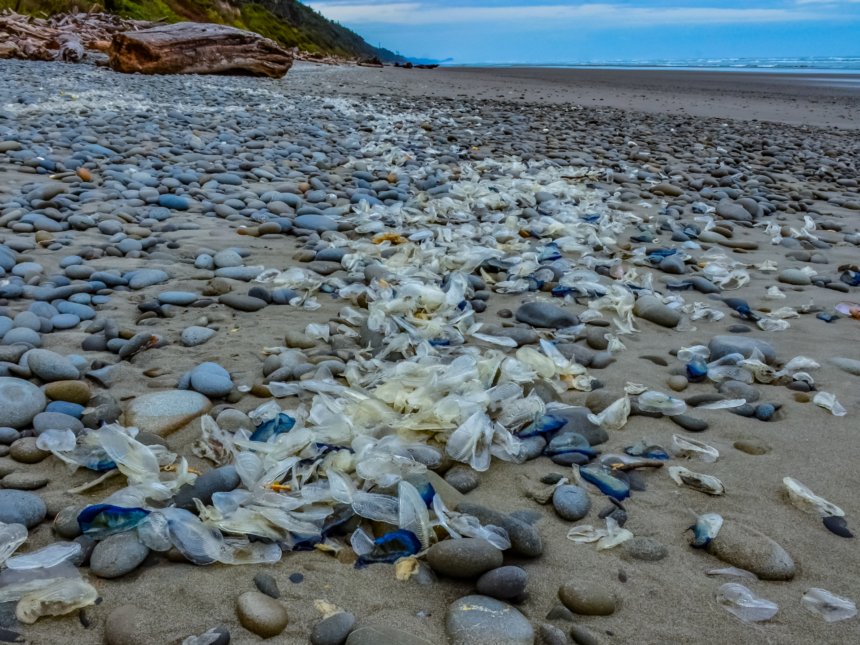
Every few years, including this year, the waves of the Pacific Ocean wash away millions of soft, bright blue masses towards land, creating a striking visual spectacle that is repeated whenever certain marine conditions are present, accompanied by a pungent smell resembling the smell of rotting fish, along the west coast of the United States. From a distance, some beaches appear to have a blue layer extending across the sand.
Known as “By-the-Wind Sailors,” these creatures, characterized by their shimmering colors and iridescent reflections, flat gelatinous bodies and otherworldly appearance, are oval-shaped creatures no more than 10 centimeters long, with tiny stinging tentacles hanging from their limbs.
They gained this name because of the small sail-like fins that top their bodies, which enable them to catch wind gusts and drift across the surface of the ocean without a real ability to control their path. However, these sails themselves lose their usefulness when their journey ends, with thousands stuck on the beaches, as happened recently along the beaches of the states of California, Oregon, and Washington, and was documented by those interested in nature and passers-by alike.
Complex living colonies
These carnivorous marine creatures – known scientifically as “Velella vellella”, derived from the Latin word “vēlum”, which means “sail” – may appear similar in appearance to jellyfish, but they are not true jellyfish. Rather, they are closely related to them taxonomically, and researchers call them “cousins of jellyfish”, and they are in fact a type of zooplankton, and live in natural conditions near the surface of the ocean.
As with its relative known as the Portuguese man-of-war, which also superficially resembles a jellyfish, each individual wind sailor is not an individual organism, but rather an entire colony of thousands of genetically identical organisms, known as zooids.
These zooids work in complete coordination within a precise system that performs specialized functions. Some of them are responsible for catching prey through stinging cells, and their prey is often tiny planktonic crustaceans. Others are responsible for digesting food, and others perform the function of reproduction and production of new colonies that may accumulate in some locations to thicknesses of up to several centimetres.
The role of these creatures is not limited to their strange shape and sky-blue colors that help to camouflage them in the water, but rather they represent an important nutritional element in the marine ecosystem, as larger animals such as sea turtles and ocean sunfish (Mola mola) feed on them, and they also provide food for a number of creatures, including fish, snails and marine slugs.
When these organisms reach the shore, they also transfer amounts of carbon, nitrogen, and nutrients stored within their bodies, but the exact impact of this transfer on the ecosystem is still unclear.

Mass drift towards the beach
Wind sailors typically appear near the shores of the Pacific Coast each spring in an event that has been repeated for millions of years, but they usually become a remarkable event only when environmental conditions combine to push them ashore in huge numbers.
According to marine ecologist and professor at the School of Aquatic Biology and Fisheries at the University of Washington, Julia Parrish, “The arrival of these creatures on the beach is not an exceptional event as much as it is part of the mechanism of their spread and movement in the ocean, as they tend to gather in huge masses above the surface of the sea, and then drift collectively towards the coast, which leads to the formation of phenomena known as dense reproduction and mass stranding along large areas of the beach.”
During this year, the numbers reached unusual levels, and their appearance was recorded on the coasts of the states of Washington and Oregon, but the largest percentage of sightings so far were in California, to the point that the beaches of the San Francisco Bay Area appeared blue when viewed from afar.
On land, these creatures are not a real danger to humans in most cases, although they have stinging tentacles that they use to catch their prey. They are unlikely to sting someone who catches them from the topsail, but they may make walking on the beach more difficult due to the slippery surfaces they leave behind. Therefore, visitors are advised to keep small children and pets away from it, as it may cause irritation to the mouth and eyes and other minor problems.
Life depends on the wind
The life of a “wind sailor” depends entirely on the movement of wind and currents. They drift with the water, and cannot swim against the horizontal currents in the ocean or control their direction, which is why they often end up stranded on beaches.
Speaking to Al Jazeera Net, Barish, who holds the position of Executive Director of the Coastal Monitoring and Seabird Survey Team (COASST), explains, “What happens is that when the winds become strong enough and blow in the appropriate direction, they can push millions of individuals of these creatures floating on the surface of the sea towards land simultaneously.”
She points out that “the phenomenon of mass stranding is not limited to a specific coastal area, but can extend along the western coast of North America, from Baja California in the south to Alaska in the north, which reflects the presence of huge marine populations that move and reach the shore at the same time under the influence of winds and sea currents.”
A study in which Parrish participated in 2021 concluded that this phenomenon often occurs during the spring when winds blow on the Pacific coast from west to east until they push objects floating on the surface towards the shore, but these western winds do not bring these small creatures every year, because sometimes they are not even there to be pushed towards the coast.
Sea conditions must also allow sufficient numbers of these gelatinous creatures to reproduce so that they reach the shore in such large numbers. This phenomenon also becomes more common when the water is warmer than usual, which may explain why such a large number arrived this year.
Why do you drift ashore?
Scientists believe that the large numbers recorded this year are linked to a possible return of the El Niño phenomenon, a natural weather pattern that usually causes water temperatures off the West Coast to rise.
Researchers’ estimates also indicate that climate change may also contribute to an increase in the phenomenon of mass delinquency. Last March was the warmest March in the United States in 132 years, and this is likely due to climate change.
Parrish suggests that milder and less turbulent winters likely allow more colonies of wind sailors to survive during the colder months, leading to larger numbers of them accumulating on beaches come spring in some years.
When these organisms reach land and cover the beaches, they have usually already reached the final stages of their life cycle, and begin to enter the stage of decomposition, a process that spreads a strong, unpleasant fish-like odor in the air, and may give the beach an additional marine character.
Within just a few weeks, their bright colors begin to fade until they turn white. They then lose all their moisture and gradually dry out, leaving only fragile remnants of their sails, similar in consistency to transparent candy wrappers or potato chips, making them an unattractive source of food for land animals such as seabirds, which then blow away in the wind like a thin piece of rice paper.