Published on 6/13/2026
|
Last update: 21:50 (Mecca time)
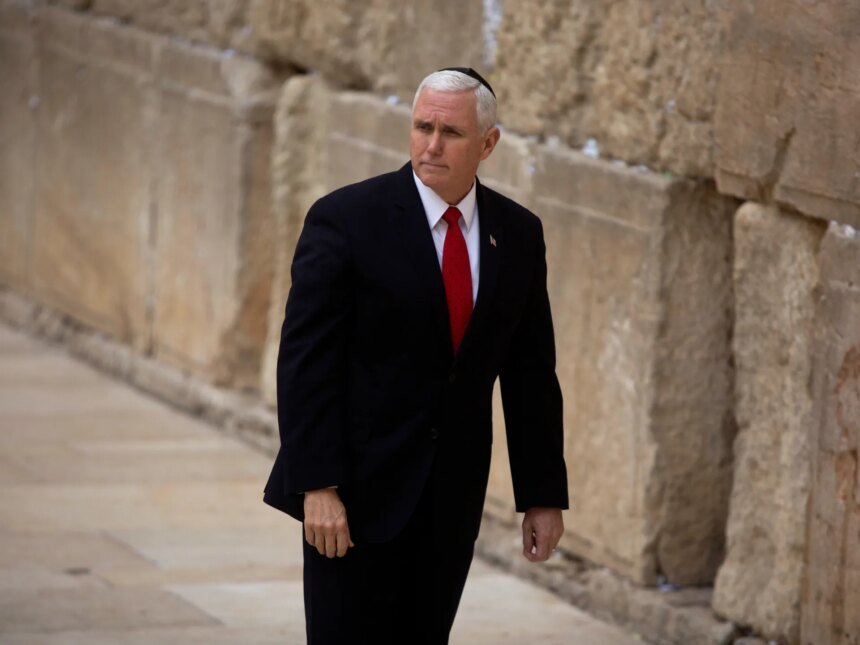
In an article entitled “In Defense of Israel,” Mike Pence, former US Vice President Donald Trump during his first term, presented a lengthy defense of America’s alliance with Israel, considering that its support is not just a passing political stance, but rather part of a conservative identity that he links to the religious and cultural roots of the United States.
The article is an excerpt from Chapter 16 of his new book, “What Conservatives Believe: Rediscovering the Conservative Conscience.”
Read also
list of 3 itemsend of list
The article was published in the Washington Free Beacon, an American conservative website founded in 2012, which defines itself as a private electronic newspaper concerned with politics, public policy, government, national security, and the media.

Religious and political alliance
Pence builds his article on the central premise that Israel – in his view – is the “dearest ally” of the United States, and that standing with it reflects what he sees as a sharing of values and destiny.
From the first lines, Pence formulates his defense in sharp moral language, as he links support for Israel to standing with “right” and “freedom” in the face of “tyranny,” as he puts it.
Pence not only presents this position as a current foreign policy option, but also returns it to what he describes as the Judeo-Christian tradition in American culture.
Therefore, he invokes the stories of the Founding Fathers, and George Washington’s letters to American Jews, to conclude that the Jewish story – as he reads it – is present in the American perception of freedom and salvation from persecution.
Within this vision, Pence portrays Israel as a democratic state surrounded by enemies in a turbulent region, and recalls the wars of 1967 and 1973, and the attacks that he attributes to groups supported by Iran, all the way back to October 7, 2023.
In this context, Pence uses language that is very biased towards Israel, considering that that day was the bloodiest in Jewish history since the Holocaust.
Attack on Democrats and universities
On the other hand, Pence holds the progressive left and the Democratic Party responsible for the erosion of the old American consensus on support for Israel.
He goes back to the Democratic Party conference in 2012, when there was a dispute over including recognition of Jerusalem as the capital of Israel in the party platform, considering that moment an early indicator of the shift in the democratic base.
Pence then links this shift to the positions of a number of progressive representatives after the October 7 attack, and to the protests that took place at American universities.
He accuses university administrations and progressive activists of tolerating anti-Semitism under the guise of criticizing Israeli policies, recalling Congressional sessions in which university presidents faced questions about anti-Jewish calls on campus.
Right-wing populist
Pence does not limit his attacks only to the left, as he devotes a remarkable part of his speech to attacking voices on the American populist right, accusing them of isolationism and turning against traditional support for Israel.
He mentions by name Tucker Carlson, Steve Bannon, Nick Fuentes, and Candace Owens, considering that some of these voices not only criticize military support for Israel, but rather, in his opinion, promote a discourse that is tolerant of or based on anti-Semitism.
Pence recalls the experience of conservative thinker William Buckley, who he says distanced anti-Jews from the conservative movement in the 1960s, calling on conservatives today to adopt a similar stance toward voices that oppose American support for Israel or promote anti-Jewish rhetoric.
Pence’s speech ends with a clear conclusion: The United States, as he wants it, must remain engaged in defending Israel, and not compromise its security or separate its power from “the chances for peace in the Middle East.”
He concludes by saying: “Peace begins with Israel’s strength, not with pressure on it.”