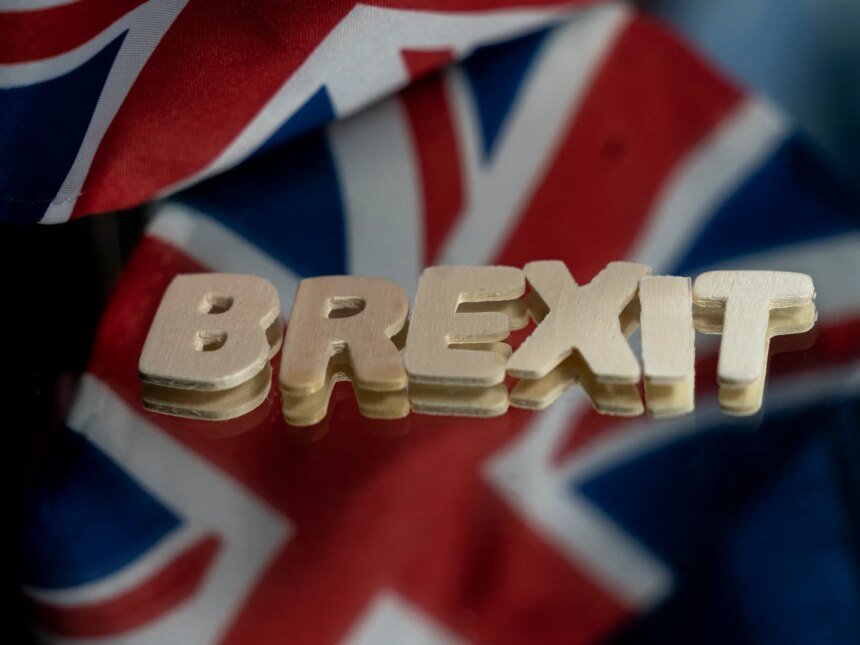
Ten years after the historic “Brexit” referendum that removed Britain from the European Union, the United Kingdom is witnessing a state of “regret,” according to opinion polls, which show that most Britons now believe that leaving the European Union was a mistake.
57% of British voters, compared to 30%, believe that leaving the European Union was a wrong decision, while a clear majority supports establishing a closer relationship with Europe, and 56% even support rejoining it, according to opinion polls indicated by the British newspaper the Financial Times last week.
While Brexit supporters promised to restore sovereignty, achieve greater economic growth, and get rid of European restrictions, recent articles and analyzes indicated growing doubts about the feasibility of Brexit, and voices calling for restoring the relationship with the European Union, and perhaps returning to it in the future, also grew.
The issue has returned to the spotlight, with Andy Burnham, who is likely to become one of the most prominent potential rivals to current Prime Minister Keir Starmer, winning the Labor leadership race, as Burnham stated his desire to see his country one day return to the European Union.

Does the European Union welcome Britain’s return?
According to Agence France-Presse, 6 European diplomats confirmed that their countries are prepared in principle to reintegrate the United Kingdom, and one of them argued that Europe would gain a lot from readmitting a “nuclear state,” which has one of the largest economies in the world and a seat on the United Nations Security Council.
But all Western diplomats – according to the agency – warned at the same time that London would need to prove its commitment to this alliance, and the duties that entail it.
While some went further, noting that the 27-nation bloc had managed to bypass Britain’s exit, noting that it was a “difficult partner who tends to make special requests.”
One European diplomat says: “Things are easier now. We no longer have to constantly deal with withdrawal options in every file. There is greater cohesion.”

Cohesion of the Union and the London Exceptions
Britain is seen as having always been an exceptional member within the European Union, and not fully integrated into it, while the European Union has adapted and changed a lot after London left, according to observers.
It is noteworthy that Britain has maintained exceptions, as it has never joined the euro or the Schengen area for freedom of movement, and has negotiated a refund of part of its contributions to the joint budget, which has led to the belief that London is seeking to benefit from the union but without fully adhering to its rules.
However, others point to the benefits of Britain’s presence within the union. Sebastian Maillard, of the British think tank Chatham House, stated that countries that “tend toward liberalism in economics or Atlanticism in geopolitics lack Britain as a counterweight to France’s sovereign tendencies.”
However, between British strategic independence and European cohesion, the Union recently adopted policies that “may have been difficult to convince London of,” according to the French agency.
In this context, Maillard says: “The United Kingdom does not really realize how much has changed in the European Union over the past ten years.”
This new path has largely resulted from external factors, such as the pandemic, the Russia-Ukraine war, the rise of China, and US President Donald Trump.
But Britain’s exit – according to one European diplomat – did not weaken the Union, but rather provided a practical lesson for other European countries about the costs of withdrawal, adding: “This led to a more mature discussion about the European Union,” noting that “right-wing populists” throughout Europe were no longer calling on their countries to leave the Union.

European caution
The political situation in Britain requires caution, according to the French agency’s analysis, especially with the lead of the right-wing, anti-European Union “Reform UK” party, according to opinion polls.
European capitals hesitate to strengthen relations with London, fearing that they will later be forced to dismantle these relations if the British political mood changes.
Moreover, some point out that it is almost impossible to allow Britain to return on its previous special and preferential terms.
Meanwhile, the protracted negotiations to mitigate the effects of London’s separation are proving difficult to return, raising questions about the possibility of rapprochement in the future, and bringing to the fore the European Union’s complaints about Britain’s efforts to “pick” what suits it from the benefits of the Union.
Talks about London joining a European defense program collapsed due to the high cost that Britain would bear, and a British proposal to join the single market for goods without the freedom of movement of capital, services and individuals was rejected in Brussels, where most parties insist on a comprehensive agreement or nothing.
London and Brussels hope to present several agreements at the upcoming July 22 summit, specifically on food and animal safety standards, a youth mobility programme, and linking emissions trading systems.
Although these agreements do not match the ambitions of those calling for London’s return to the European Union, it may be more appropriate to take small steps.
What are the results of Brexit so far?
Richard Partington, chief economics correspondent for the British newspaper The Guardian, believes that the economic outcome of Brexit has become clearer, as most economic indicators indicate that the country has become poorer than it would have been if it had remained within the European bloc.
One of the most prominent indicators mentioned in the article – published last week – is the decline in the value of the pound sterling. After it was close to $1.50 and 1.31 euros in June 2016, today it is only about $1.34 and 1.15 euros.
As for economic growth, the author uses a study prepared by economist Nick Bloom from Stanford University in the United States, which concluded that the gross domestic product per capita has become lower by between 6% and 8%, compared to the scenario in which Britain would have remained a member of the European Union.
The article also focuses on the decline in trade and investment, as Brexit imposed border restrictions and bureaucratic procedures that slowed the growth of goods exports, especially since the European Union remains Britain’s largest trading partner.
It is estimated that the volume of investment has become about 18% less than it would have been in the event of remaining within the union, while productivity has declined by up to 4%, while employment levels have become about 3% to 4% lower than in the alternative scenario.
At the labor market level, the report shows that real wages have witnessed many years of stagnation, while employment rates have become lower by between 3% and 4% compared to the alternative scenario. The number of young people who are neither working, studying, nor receiving training exceeded one million, the highest level since 2013.
Britain and Europe…two possible paths
European economic affairs expert in the Financial Times, Martin Sandbo, concludes that the future of British-European relations is limited to two paths: either a continuation of the current situation with some limited rapprochement, or a complete return to the European Union.
Given growing public discontent with the Brexit results, he believes the re-joining option may ultimately become the most politically and economically attractive path for Britain.