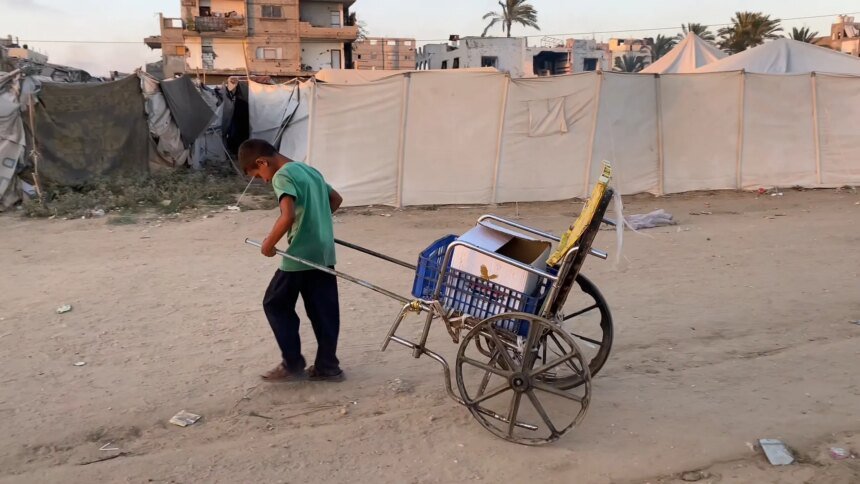
Gaza – Malek Abu Nasr goes out every morning with a cart he made from a worn-out wheelchair, to roam the markets and streets in search of an easy livelihood to support his displaced family in a dilapidated tent east of the city of Deir al-Balah in the central Gaza Strip.
Malik, a ten-year-old child, dreamed of becoming a dentist, but he suddenly found himself responsible for his mother and three siblings after losing his father as a martyr in an Israeli air strike during the genocide, so he was forced to leave his childhood aside to be the only support for his family.
His family was displaced from their home before it was destroyed by the occupation in the town of Beit Lahia, north of the Gaza Strip, during the first months of the war, and lives a miserable and dangerous life in a tent in one of the displacement camps near what Israel calls the “yellow line” under its control east of Deir al-Balah.

livelihood through a disability chair
While the world celebrates the World Day Against Child Labor on June 12 annually, which was established by the International Labor Organization in 2002, to focus attention on the extent of the spread of the phenomenon of child labor around the world, and to strengthen efforts to eliminate it, the reality produced by the extermination war in Gaza appears completely different, as thousands of children found themselves forced to work early and support their families, whether due to the martyrdom of the breadwinner or to help their families under disastrous living conditions.
Malik is one of them, and he converted a worn-out wheelchair for people with special needs into a hand cart that he uses to transport people’s luggage and daily needs for a small fee not exceeding 15 shekels (about 5 dollars), which he returns to his mother, Alaa Abu Nasr, who depends on this modest income to secure the minimum needs of her family.
The child pushes his handcart in front of him or drags it behind him, and with it he roams the markets, streets, and displacement camps, in search of his daily livelihood. Such a simple means has become a forced choice for people to transport their luggage and needs, in light of a stifling transportation crisis after the war destroyed traditional means of transportation.
Malik told Al Jazeera Net that he loves education, and his dream is to become a dentist, but this dream has been postponed, and he was forced to leave education and devote himself to working for his family.

Between oppression and pride
His mother, Alaa (34 years old), describes him as “the only support for me and his brothers.” She expresses sadness over his lost childhood and pride in his sacrifice, despite his young age and small body.
With great emotion, Umm Malik talks about her child, who was one of the outstanding students in his school before the war, and has distinguished abilities. She tells Al Jazeera Net: “He inherited from his father, the martyr Sheikh Ziad Abu Nasr, the talent of oratory and the sweet voice in reciting the Holy Qur’an, and he memorized 5 parts of it.”
Between feelings of sadness for her son’s stolen childhood and pride in his responsibility, this mother monitors her son’s daily journey in the face of circumstances beyond the capacity of children, and indicates that she is worried about him from the time he leaves until his return.
Girls have their share of misery
Between Malek’s handcart and Nour Baroud’s stall, the tragedy of Gaza’s children is embodied, and their lives have turned into a daily struggle for survival, while their dreams of studying and playing remain postponed, as the reality of war has forced them to be small workers who carry the burdens of adults.
On a small stall on the main street of the city of Deir al-Balah, Nour (13 years old) stands – from the early morning hours until sunset – alongside her father and younger siblings to sell fuel containers manufactured locally by burning plastic waste, after the occupation prevented the supply of fuel to the Gaza Strip.
This child dreamed of becoming a doctor in the future, but the war forced her to leave her studies and engage in work early in a way that was not appropriate for her as a female of her age, to help her family, under deteriorating living conditions.
The war completely changed the details of her life, transforming her from a child busy with studies and dreams into a young worker searching with her family for means of survival and life. She told Al Jazeera Net that the war deprived her and the rest of Gaza’s children of their right to education and play, and they became the segment most affected by its unprecedented repercussions.

Psychological and physical effects
For her part, human development and bioenergy specialist, Dr. Nawal Askoul, told Al Jazeera Net that the child in Gaza was transformed by the repercussions of the war from a being in need of care to a support for an entire family that found itself facing a difficult and complex life.
Child labor in Gaza is no longer just a social phenomenon, but rather a forced survival strategy undertaken by children who have not yet reached the age of dreaming, under bombardment and with great risks, in order to provide the minimum means of life for their families, according to Askoul.
She referred to what she described as an “army of orphan children” who lost their fathers during the war, and in light of a relief system unable to meet the enormous needs of the population in the sector destroyed by the war, they found themselves in the position of the father and breadwinner.
According to her, this phenomenon is not limited to males, but rather affects girls who have been forcibly entered into the labor market, avoiding the streets, standing behind stalls, and facing the harshness of life early, in order to earn a living.
She stressed: “Our children have grown up before their time, and they bear responsibilities that will have long-lasting effects on their mental and physical health.” She added, “The war and its repercussions turned their bodies into tools of misery.”
Genocide and “complex crime”
In turn, the director of the Addameer Foundation for Human Rights, Alaa Al-Sakafi, told Al Jazeera Net that the children of Gaza are suffering from a complex crime as a result of the occupation’s violations, whether by direct killing, or by robbing them of their childhood and basic rights.
He explained that the occupation deliberately targets children in various ways, including killing, injuring, and depriving them of the right to education, play, and safety, in addition to the phenomenon of orphans left by the war, forcing them to bear the responsibility of the breadwinner, and pushing them to work early in hard work, and even digging up waste in search of means of life.
Al-Sakafi stressed that what the occupation is committing against the children of Gaza is classified as a crime of genocide, by working to make their lives tragic and disastrous, and by resorting to early labor, with the aim of completely or partially destroying this group.
Official data published by the Palestinian Ministry of Social Development on its official website indicate an unprecedented rise in the number of orphaned children in the Gaza Strip, as their number exceeded 64,616 orphans, including more than 55,000 children who lost one or both of their parents during the war, in light of extremely harsh humanitarian conditions, accompanied by displacement, loss of shelter, decline in basic services, and interruption of education and health care.