Published on 6/8/2026
An archaeological site listed on the World Heritage List in the city of Tire in southern Lebanon was damaged by an Israeli bombing, according to what an official in the Lebanese Ministry of Culture said on Monday, at a time when Culture Minister Ghassan Salama called for the protection of the city’s archaeological monuments.
The director of archaeological sites in southern Lebanon, Ali Badawi, told the French Agency that the Israeli bombing that occurred on Sunday caused “the greatest damage to the site during this war.”
The Israeli army launched massive raids on Tire on Sunday, according to official media, shortly after issuing a warning to evacuate many neighborhoods, including the neighborhood in which the archaeological site dating back thousands of years is located.
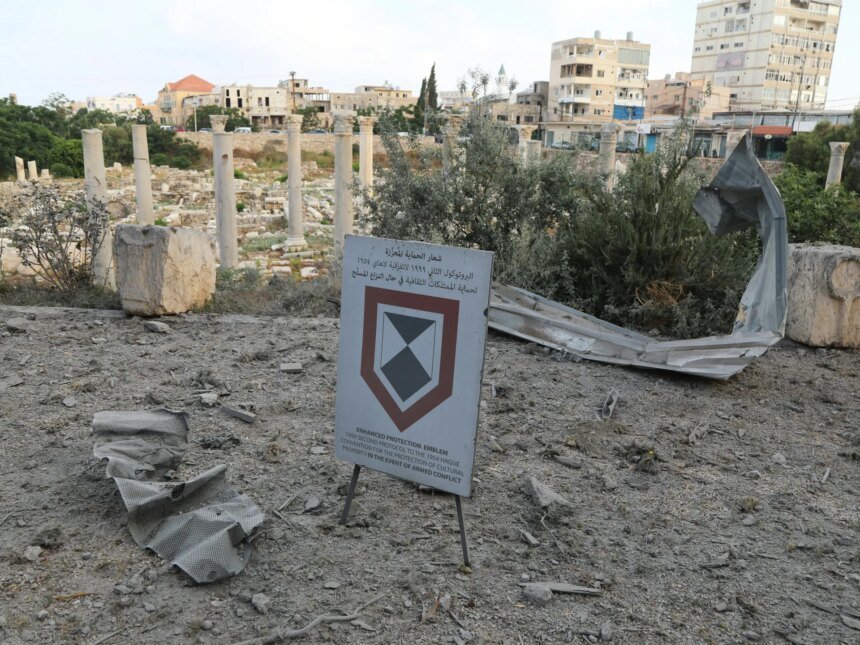
On Monday, the French Agency photographer saw dust and debris covering part of the site near archaeological columns, twisted metal and broken branches near ancient stone pieces, in addition to metal and cement debris that appeared to have fallen on a stone staircase leading to a passage inside the site.
Badawi explained that “the amount of rubble and destruction at the site is high,” resulting from strikes on neighboring buildings, as well as a “direct hit” on the site that “led to major damage to civilian facilities.” He added that some of the artifacts were damaged by the rubble falling on them after it was scattered over long distances, affecting a large number of the site’s elements, including columns, capitals, mosaics, and others.
He pointed out that work is currently underway on a preliminary assessment of the damage, but security conditions have so far prevented experts from arriving at the site to study it closely, stressing that UNESCO has been informed.
Badawi stressed that the archaeological site in Tyre “is a civil site and a world heritage site, not a military site at all, and there are no military activities there.”
Coastal Tire, located about 20 kilometers from the border with Israel, is one of the oldest cities on the Mediterranean coast. It dates back to the era of the Phoenicians and was then occupied by several civilizations. It includes monuments listed on the United Nations Educational, Scientific and Cultural Organization (UNESCO) World Heritage List, distributed over two sites.
Badawi confirmed that the other site in the city, known as the Al-Bass site, was also damaged earlier in the war between Israel and Hezbollah, which began on March 2 and did not stop despite the announcement of a ceasefire in April, with both sides exchanging accusations of violating it. The Al-Bass site includes an archaeological cemetery whose roots extend back 3,000 years, when Tire was one of the most prominent Phoenician cities, and remained in use until the Arab conquests in the seventh century AD.
Salama addressed the agency with “a call to avoid targeting archaeological sites in the country… especially the ruins of Tire, which are the common heritage of humanity,” adding that the authorities will assess the damage “as soon as a ceasefire occurs or we are able to reach the antiquities without endangering the lives of our archaeologists.”
The minister considered that Israel “does not respect” the Hague Convention, which stipulates the preservation of cultural property in armed conflicts, nor the “Blue Shields” established by a committee linked to UNESCO to protect about 30 sites in Lebanon, including Tire, after the outbreak of the recent war.
Since the outbreak of a previous round of confrontations between Israel and Hezbollah in 2023, UNESCO has granted more than 70 heritage sites in Lebanon, including Tyre, the slogan “enhanced protection.”