Published on 6/8/2026
|
Last update: 16:25 (Mecca time)
Attention is turning to the 2026 World Cup, scheduled for the United States, Mexico and Canada, not only because it is the largest historically in terms of the number of teams, but also because it has adopted a package of revolutionary technologies based on artificial intelligence and digitalization, which aims to improve the viewing experience and provide absolute arbitration justice.
From robotic dogs and marches to artificial intelligence balls
Here are the most important technological developments and developments that the World Cup stadiums will witness:
Read also
list of 2 itemsend of list
1. “Trionda”: smart balls that monitor movements with extreme accuracy
The International Federation of Association Football (FIFA) unveiled the official ball for the World Cup, which bears the name “Trionda” – which means “three waves” in Spanish – and the ball manufactured by “Adidas” features the integration of an advanced sensor chip to measure inertia (IMU).
This chip captures data with high accuracy at a rate of 500 times per second, to track the ball’s acceleration and movement in three-dimensional space. FIFA confirmed in an official statement that this technology will send real-time data directly to the Video Assistant Referee (VAR) room, enhancing the speed of decision-making, especially in complex offside shots.

2. 3D avatars and referee cameras
As part of the partnership between FIFA and Lenovo, World Cup players will undergo a digital scan that takes one second for each player, to create a high-resolution 3D digital model. This technology allows tracking the movement of body parts with extreme accuracy, even during fast running or physical contact.
These 3D models will be integrated into live TV and stadium screens, to display offside decisions in a realistic and attractive way to viewers. The visual experience is completed by the deployment of cameras integrated into the referees’ clothing in all 104 matches of the tournament, allowing fans to see the events of the field from the perspective of the referee himself.
3. Semi-automatic stealth technology.. Goodbye to the late flag
Fans are accustomed to being frustrated by the delay in raising the assistant referee’s flag in offside cases, which is something FIFA seeks to end through the developed version of the semi-automated offside technology. Whereas the previous technology alerted referees if a player exceeded the offside distance by 50 centimetres, the new system is now able to detect offside at only 10 centimeters, almost instantly.
Referees will receive a direct audio alert via earphones without having to wait for a VAR review, reducing dead periods in play and protecting players from injuries resulting from continued canceled attacks. However, the technology remains limited to spatial stealth, and does not interfere with discretionary decisions such as blocking views or disrupting gameplay.

4. Robotic dogs… the eyes of the police in Mexico
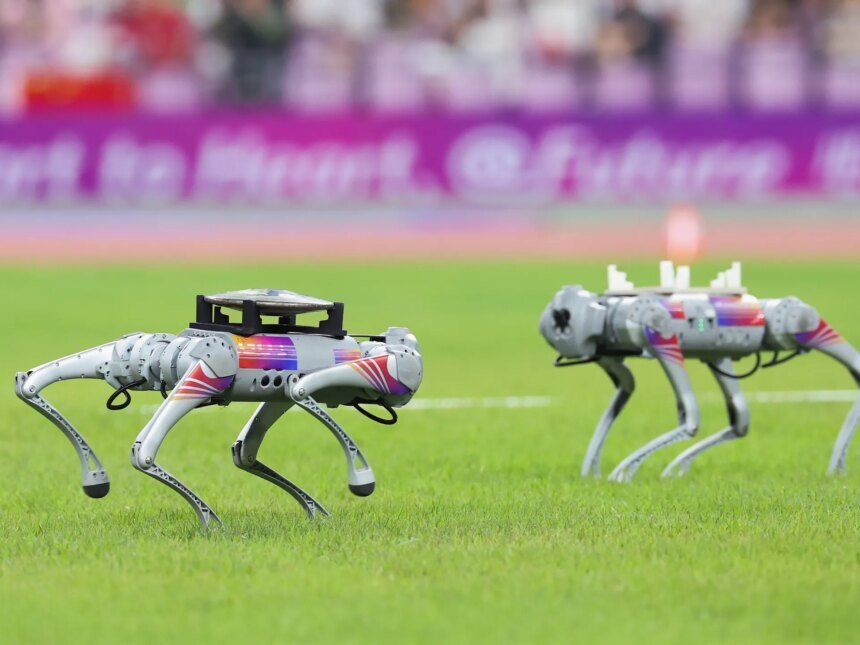
On the security level, the Mexican authorities announced an unusual step to combat riots and maintain security in the host cities. The police will use four-legged robotic dogs around the stadiums.
Hector Garcia, mayor of the city of Guadalupe (in the Monterrey metropolitan area), explained that these robots – which cost $145,000 – were designed to enter hot areas and broadcast live footage to security forces before human intervention, stressing that their purpose is to protect the physical safety of police officers and quickly deal with any quarrels that may break out between fans.
Robotic dogs are also used in security missions related to the World Cup in America as well.

5. Drone response systems
The Mexican authorities also announced a plan to address the threat of drones in the stadiums hosting the World Cup. It will use the army in the vicinity of the stadiums, with modern military tracking systems, to monitor and confront any drones, for fear of any terrorist act by armed gangs, whose threat is growing in the country and which have entered into armed confrontations with the army and police.