There are no trains to “Vår drivkraft” in Skellefteå
There are none train to Skellefteå. Since passenger traffic ceased on the Skelleftebanan in 1990, only goods pass on the way out to the ports, and the Norrbotniabanan – which will connect Umeå in the south with Luleå in the north – is not expected to be fully completed until around 2040. In the meantime, as in decades, people are referred to, hour by hour, behind the wheel along an E4 bordered by roadworks.
Although I grew up far out in the country, my real car awakening only came five years ago, when I moved back home without a driver’s license. For the first few months, I took the bus to and from the grocery store – there was only one option on weekdays if you were quick at the checkout. My life only became tolerable when I took an intensive course, bought a cheap Volvo and suddenly wasn’t completely governed by a tight bus timetable.
Anyone who does not live in sparsely populated areas cannot possibly understand how strong the relationship with the car becomes when there are no alternatives. Cars are safety, a gathering place, a bubble of warmth during freezing winters, an assurance that we can move when the need calls for it.
The interdependence between man and vehicle in sparsely populated areas has created fertile ground for ceremonial, tradition and skilled motoring culture that extends far beyond the technical. Västerbottensteatern’s interactive engine hit “Our driving force” takes its roots from this fact.
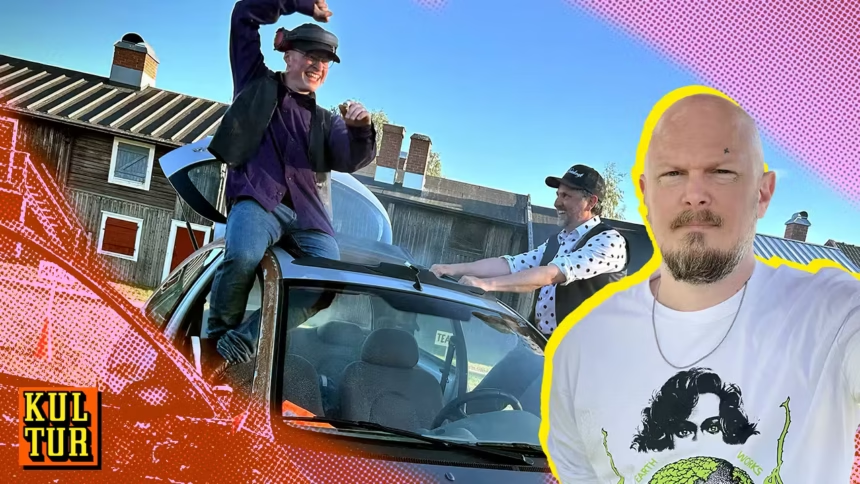
Bonnstan just outside The center of Skellefteå – one of the few remaining church towns in Sweden, built around 1830 – is the first of several playgrounds in the county. It is seventeen degrees warm and bright sun. On a grass field stands a white marquee surrounded by old American luxury cars parked side by side with modern tractors. In the middle: a car wreck that slowly smokes out of the sunroof. It’s packed, which in this case means 40 people in the audience – everyone has to fit in the cars that will take us to the show’s outposts around town. I’ve read up on the setup beforehand, but it’s still completely impossible to understand what’s going to happen.
We are divided into groups of four. Me and my company are toted together with Bengt and Little mothera very nice skellefte couple whose daughter-in-law is involved in the production. When it is revealed that I traveled from Hälsingland for this premiere, the reaction is strong: did you come all the way here!
The carpooling with Bengt and Lillemor, and the subsequent inevitable interaction, is a central part of the performance. Here – just like where I live – transport is a collective experience, regardless of who owns the vehicle. Someone always needs to drive so that we can get there and home, and if there is space, whoever needs to go along.
In five a lot different cars take the audience out into the city, to secret destinations that all carry their own cultural expression. The first stop for us is the music station in Stämningsgården, where we drive up and park on a regular plot of land owned by local motor geniuses Ove. Sandwiched between a shiny Harley Davidson and a work in progress in Ove’s garage, five peg chairs are lined up: one for the folk musician playing a waltz from Burträsk, four for us in the audience. For the few minutes the waltz lasts, we sit only a few meters from the violin. It’s almost uncomfortably intimate – a feeling that recurs in more garages during the evening – but also searching for contact, and stripped down on the verge of boozy leaping.
Between the excursions, a choreographic piece is in progress around the car wreck in Bonnstan: actor Emil Grudemo El Hayek’s and dancer Jonathan Starr’s car duet alternates between dance elements, costume changes, smoke and sparks. Sometimes the audience has to tangibly help roll the car a few meters, usually it’s enough to watch with a cup of thermos coffee in hand.
But the strongest impression make the last drive, with the actor Malin Vispe. Behind the wheel of an epa-decorated Saab 9-5, she navigates smoothly between conversations with the passengers and a monologue that tells about overcrowded epas on their way to parties in villages on the other side of the river, of which we also get to see mobile images. In the carpooling and tailgate trips, carpooling is not the only thing that gets a cultural context. When she plays an audio clip with her fictional grandmother, who tells an almost identical story from her own youth, a generational bridge is created that points to the universal human desire to be on the way somewhere and the importance of the vehicle as a social container.
On the way back, the monologue reverses. In recent years, the e-culture has become a veritable action movement against youth suicide, manifested by stickers in rear windows, media attention and long mourning processions at 30 km/h. Here in the car, on the outside of the glove compartment, there is a sticker with the telephone number of the non-profit organization Mind’s suicide line. Malin Vispe lets the story of the car’s gathering, possibly healing, influence end the monologue. In silence we play epadunk at high volume all the way back to Bonnstan.
When the last car is parked in the semi-circle and the audience is gathered, we break out, with dance band classics on the radio, together in a liberating and all-encompassing bug. Then we drive home.

Our driving force
Director: Tove Berglund & Ludvig Daae
Playwright: Alexandra Loonin
Playwright: Tora von Platen
Concept, scenography, costume, sound: Tove Berglund
Concept, choreography, sound: Ludvig Daae
Cast: Emil Grudemo El Hayek, Theresa Eriksson, Jonathan Starr, Malin Vispe, Karin Wiklund
Epa consultants: Adrian Elf and Edith Vallo Jonsén
Photo: Maja Daniels
Performances: