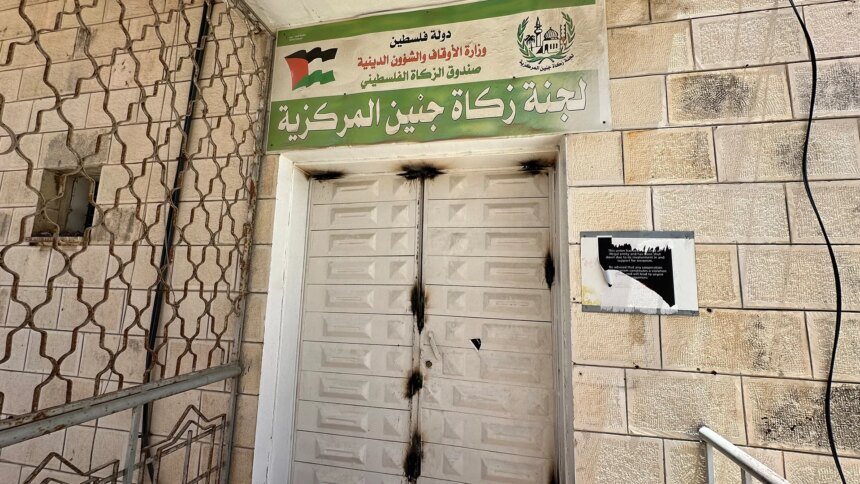
fetus – In front of the headquarters of the Zakat Committee in the city of Jenin in the northern West Bank, which was closed by the Israeli occupation authorities last week, the young man Yasser Arif stood in surprise, asking those present about the reason for the closure, as he was coming from his village to fill a prescription through the committee.
Like Arif, the elderly woman, Saada, whose journey from her village of Jalqamous, east of Jenin, to the committee’s headquarters took about half an hour, stopped to obtain medicines for her chronic diseases, after she stumbled in obtaining them from the Ministry of Health, due to the crisis of shortage of medicines and medical supplies in the health directorates in the West Bank.
As she looked with sad eyes at the closed door of the Zakat Committee, Saada said that she paid the transportation fare from her village, hoping to find treatment, but the closure of the committee’s headquarters shocked her and put her in a difficult position, as she no longer had hope of providing medicine for her illness.

Locked doors
Next to the elderly woman, Umm Ayman (35 years old) is in no less bad and destitute condition. She says that she used to receive coupons before Eid to buy her children’s clothes, in addition to her share of the sacrifices, confirming that her husband’s name is included in the lists of patients for whom treatment is paid by the Jenin Zakat Committee.
She added, “During the last Eid, we had about 25 families come in one day, and sums of money were distributed to us, or the Eidiya as we used to call it. The Zakat Committee helps my husband, who suffers from neurological diseases, and provides us with food parcels and portions of sacrifices, in addition to financial aid.”
The Israeli occupation army closed the headquarters of the Zakat Committee in the city of Jenin, affiliated with the Palestinian Ministry of Endowments, after raiding it, destroying its contents, and confiscating documents from inside it. This deprived hundreds of needy families in the Jenin Governorate from obtaining the assistance that the committee used to provide, especially with the approaching Eid al-Adha.
Sudden closure for no reason
According to the head of the committee, Samir Al-Souki, the occupation has dashed the hopes of thousands of families in Jenin and its villages to obtain sums of money to buy their children’s needs, in addition to shares of sacrificial meat that were supposed to be slaughtered and distributed during the Eid, and thus today they lost one of the most important sources of assistance that helps them manage their lives.
Al-Souki spoke – to Al Jazeera Net – about the targeting and closure of the committee’s headquarters, saying: “Last Thursday, we arrived at the headquarters to begin our work like any normal day, but we found the door closed and sealed with oxygen welding. This was surprising, as we had not received any prior notice or notification of the association’s closure, and until today the occupation has not explained the reason for the closure and the prevention of work in the headquarters, which has continued to carry out its role for more than 40 years.”
The Jenin Central Zakat Committee was established 1985It provides its services in Jenin Governorate, which include sponsoring orphans and helping the poor, the needy, and the elderly. According to Al-Souki, the number of beneficiaries from the committee reaches thousands of families, especially since Jenin is one of the governorates with the highest rates of poverty.
What happened days before the blessed Eid al-Adha – Al-Souqi explains – “was a shock to us as workers in the committee, and to the people in general. This is targeting the needy, the poor, and the most vulnerable groups in society.”
A targeting that confused calculations and dashed hopes
On the same day of the closure, Al-Souki continues, “We were scheduled to distribute Eid gifts to a number of orphans registered with us, in addition to a number of other families, but the occupation deprived thousands of the joy of Eid,” explaining that last Eid, the committee provided approximately $150,000 Eid gifts to hundreds of needy families in Jenin Governorate alone, and today it is inspecting the financial files and information files of the beneficiary families.
About a month ago, specifically in mid-April, the Israeli occupation army closed the headquarters of the Zakat Committee of the Ministry of Endowments in the town of Idna, west of the city. HebronAfter storming it and detaining a number of its employees.
This was followed by the occupation closing the headquarters of the Madeed Charitable Association in Nablus, which was providing medical, food, and educational aid to dozens of families in the city of Nablus, and extended the closure of the Charitable Association in the city of Hebron.
Al-Souqi points out the problem of another impact of the closure, as many supporters and philanthropists who make donations to the Zakat Committee from inside and outside Palestine have become afraid to make donations.
He pointed out that the committee was in the process of implementing the Eid program with the support of Tkiyet Um Ali, a Jordanian non-governmental organization founded in 2003 to combat hunger in Jordan and the Arab world, and provides food parcels to needy families, in addition to the sacrifices and its sponsorship programs.
He added, “We used to slaughter approximately 17 calves and 25 sheep annually for the Jenin Governorate on Eid al-Adha, while the State of Qatar provided us with about 1,600 kilograms of sacrificial meat on Eid al-Adha last year, in addition to other countries. Today we are losing all these supplies.”

Important role
In addition to financial aid, food coupons, and meat, whether sacrificial meat or meat distributed during the year, the association provides assistance with some expensive medicines, including neurological treatments, in addition to services that help people with various disabilities.
According to the Palestinian Central Bureau of Statistics, the unemployment rate in the West Bank during the year 2025 reached approximately 27.5%, while international estimates indicate that the poverty rate in Palestine rose in the first months of the war on Gaza to 58%.
As Eid al-Adha approaches, livestock markets are witnessing weak demand, coinciding with the rise in the prices of sacrifices and the decline in the number of livestock offered in the markets, as the price of a kilogram of live lamb reached between 45 and 50 shekels (one dollar = about 3 shekels), according to data from the Palestinian Ministry of Agriculture, while approximately three thousand heads of sheep and five thousand heads of calves are available in the Jenin market before the Eid.
What does the occupation want?
The political analyst explains, Suleiman Bisharat, said that the associations targeted for closure are located in areas belonging to the Palestinian Authority and licensed by it, and the occupation authorities create security pretexts to target them. The goal is summarized in a set of points:
- Fabric of society: Dismantling the societal structure and fabric, and the interconnected relationship between these associations and the beneficiary families, donors and contributors, which is a condition and societal fabric that Israel is trying to target and dismantle.
- Double the suffering: Working systematically to increase and multiply the suffering of the Palestinian citizen, as it can be linked between the closure of associations, the prevention of workers from entering the interior lands, the closures of cities and checkpoints, and the Israeli attacks on agricultural lands, farms and greenhouses, in addition to the withholding of Palestinian Authority funds.
- Demolishing institutions: Dismantling any institutional structure by targeting public institutions, schools, health centers, and even charitable societies, which is targeting the Palestinian institutional entity.
Systematic work
Bisharat added, “All of this represents a systematic effort by Israel to bring the largest possible segment of Palestinians below the poverty line (2,717 shekels according to the Palestinian census and the Monetary Authority) and make them preoccupied only with making a living, diverting their attention from political issues and the accelerating Israeli Judaization project.”
This also reflects – according to the same speaker – on the citizen who will seek any way out of the economic pressure, which serves the occupation’s attempts to voluntarily displace the Palestinians.
According to data from the Palestinian Ministry of Endowments for the year 2020, about 32 thousand citizens benefited from the zakat committees affiliated with the Palestinian Zakat Fund in the West Bank, with a financial value exceeding three million shekels.
The number of charitable organizations registered with the official Palestinian authorities is 648, constituting 30% of the 2,160 registered organizations, according to a previous report by the Palestinian Financial and Administrative Control Bureau.