Published On 12/5/2026
|
Last update: 15:46 (Mecca time)
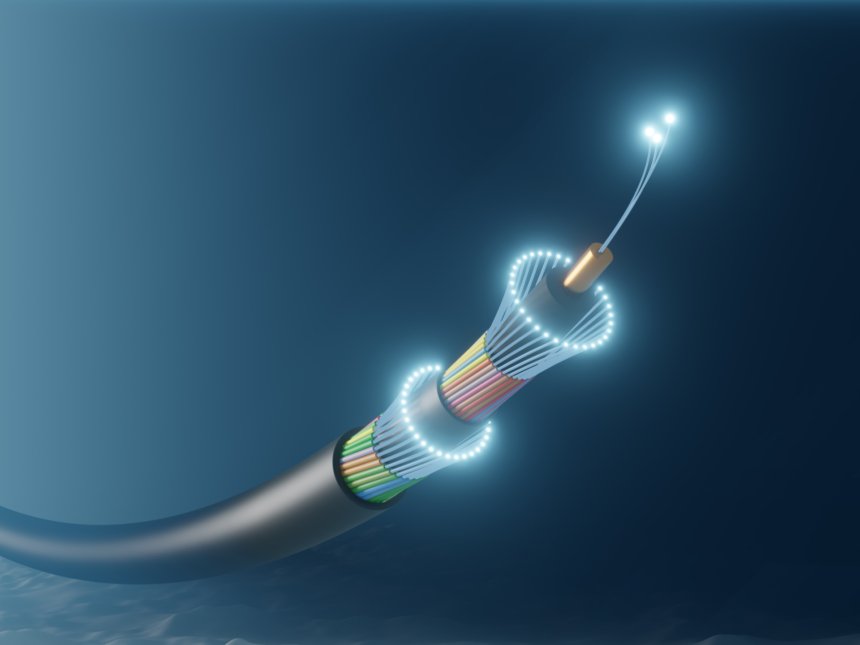
There has long been a belief in technical circles and among the user public that fiber optics cables are the “fortified zone” in the world of communications. Unlike copper cables, which emit electromagnetic radiation that can be detected remotely, fibers rely on laser pulses inside tiny glass tubes.
But this belief in absolute immunity is beginning to fade in the face of a new generation of physical espionage techniques that aim not only at breaking digital encryption, but also at the transmission medium itself.
The physical vulnerability… “optical eavesdropping”
The basic process of espionage is based on the simple fact of physics: light does not need to be cut in a cable to escape. This technique is known as photoeavesdropping.
According to technical reports from the American Center for Strategic and International Studies (CSIS), hackers can create a very slight bend in the cable, and this bend does not lead to breaking the glass, but it changes the angle of reflection of the light inside, leading to a small portion of the photons (signal) leaking out of the glass core.

Using highly sensitive optical receivers, this leaking light is captured and converted back into digital data. Amazingly, this process causes only 0.1 dB of signal loss, making it completely invisible to traditional network monitoring systems that ignore small oscillations.
The cable that hears and sees
The most dangerous development, discussed in recent research published in the American magazine Science and the University of Hong Kong, is turning the cable into a giant microphone via distributed acoustic sensing technology.
This technology works by sending laser pulses through the cable and monitoring disturbances caused by surrounding vibrations. When someone speaks next to a fiber-optic cable hidden in the wall, the sound waves of his voice cause microscopic vibrations in the glass. These vibrations change the properties of light bounces, and using artificial intelligence algorithms, spies can manipulate these bounces to reconstruct voice conversations with amazing accuracy, meaning that the infrastructure that gives you the Internet is the same that records your breath.

Geography of espionage: submarine cables and landing points
At the international level, the real battle lies in the depths of the oceans, where submarine cables carry more than 99% of international traffic. According to previously revealed documents, and confirmed by reports from the British newspaper The Guardian and Reuters this year, major intelligence agencies such as the US National Security Agency (NSA) and the British Government Communications Headquarters (GCHQ) possess capabilities to directly access these cables via “landing points.”
At these points, optical signals are decompiled and converted into electrical signals for processing. Here, devices called “splitters” are installed that copy all the traffic and direct a copy of it to huge servers for analysis and storage, while the original continues on its way to the recipient without feeling any significant delay.

Sovereign threats: submarine warfare
Today, espionage is no longer limited only to the coasts, but has moved to the bottom of the sea, where military reports from the US Naval Institute indicate that specialized submarines such as the Russian submarine “Yantar” or the American submarine “USS Jimmy Carter” are specially designed to link to submarine cables in the deep depths.
These operations are among the most secret missions in the world, as self-powered listening devices are installed on the cable and continue to broadcast data wirelessly to buoys on the surface or via nearby ships.
Is encryption the solution?
Some believe that end-to-end encryption makes such espionage worthless. This is partly true, but it does not cover everything. Metadata analysis, even if the spy does not know the “content” of the message, knows who contacted whom, when, and from what location, which is enough information to build complete intelligence files.

Future decryption, where huge amounts of encrypted data are stored, is currently awaiting the development of quantum computers that will be able to decode the strongest current types of encryption in seconds.
To confront these threats, countries such as China and France have begun to adopt quantum key distribution (QKD). This technology is based on the laws of quantum mechanics, as any attempt to monitor or measure light photons will immediately lead to a change in their physical state, which means that the spy will destroy the information as soon as he tries to read it, and both parties will receive immediate alert of the location and type of hack.