Published On 1/5/2026
|
Last update: 15:24 (Mecca time)
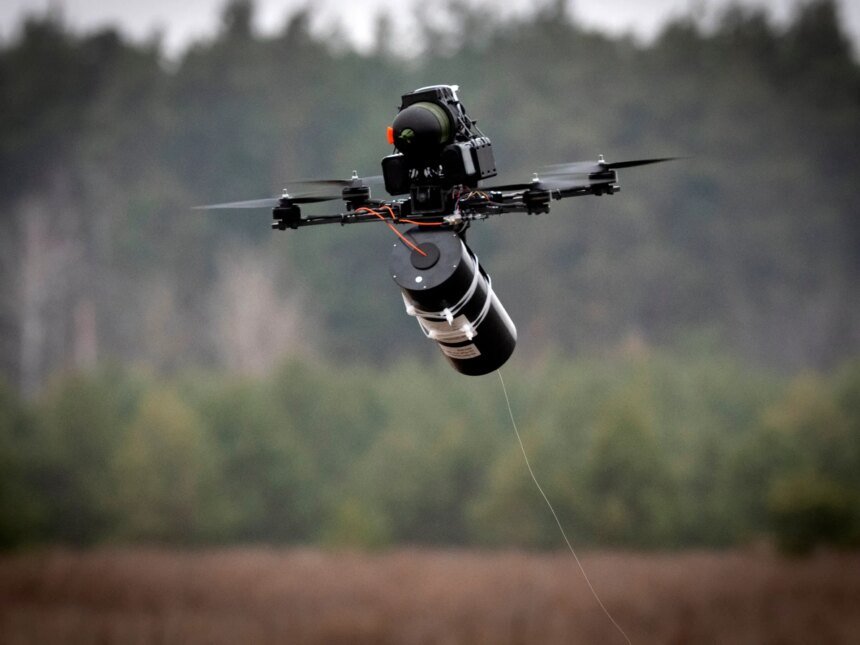
Small, camouflaged and effective, drones controlled via very thin fiber-optic cables quickly became a deadly weapon in the hands of Hezbollah to track down Israeli occupation army soldiers in southern Lebanon.
This development on the ground has brought about a qualitative shift in the war tactics used by the party against the Israeli army, and has indeed become a worrying weapon for Israel, which has so far been unable to confront it.
Read also
list of 3 itemsend of list
Invisible killer
This technology attracted strong attention after it succeeded – yesterday, Thursday – in eliminating an Israeli soldier in southern Lebanon, and wounding at least 12 others in northern Israel, two of whom are in serious condition. It also killed a soldier and a military contractor with the Israeli army in Lebanon earlier this week.
Hezbollah announced that it had begun using fiber-optic-guided drones for the first time during the round of fighting that began on March 2, after years of using other types of drones.
Ali Al-Jazini, a journalist who specializes in security and military affairs and closely follows Hezbollah’s capabilities, estimated that the cost of some of these drones – which the party uses – ranges between 300 and 400 US dollars per aircraft.
He added that they appear to be manufactured locally using 3D printing technology, in addition to readily available electronic components that are typically used for civilian purposes, but are capable of dual use.
According to military expert Nidal Abu Zeid, Hezbollah’s resort to fiber-optic technology was not a luxury, but rather a response and counter-tactic, after the occupation’s electronic warfare systems succeeded in shooting down or jamming most of the traditional wireless drones that the party was using.
Abu Zeid – in an analysis for Al Jazeera – demonstrated the accuracy of this new weapon by what happened when Hezbollah targeted with great accuracy one of the Israeli army’s medical evacuation helicopters.
The military expert believes that this development clearly indicates that Hezbollah is not acting randomly, but rather is pursuing regular tactics aimed primarily at “blinding” the Israeli Air Force, according to him.
This is clearly evident from the party’s focus on targeting the northern settlements, the sensitive “Meron” intelligence base, and the “Aerostat” spy balloon concerned with collecting information and directing aircraft in the south.
Anti-jamming
Unlike traditional drones, fiber-optic drones are not piloted via GPS signals or radio control. Rather, they are equipped with a thin cable running behind them, connecting the operator’s console directly to the drone, making it impossible to electronically jam.
The characteristics of these aircraft can be determined through this monitoring, which was determined by specialized experts:
- They can fly at low altitudes and high speeds, making them more difficult to detect and destroy.
- They are made of lightweight fiberglass, which means they emit almost no thermal or radar signature.
- It has the ability to bypass the “Trophy” active protection system installed on Israeli Merkava tanks.
- The bandwidth of fiber allows continuous high-quality video transmission even in complex terrain such as valleys and between buildings.
- It has the ability to carry out precise targeting operations against military vehicles and troop concentrations.
- The string extends between 10 and 30 kilometers, allowing the drone to reach distant targets.
- These aircraft carry an explosive warhead weighing between 10 and 20 kilograms in some versions, capable of destroying armored vehicles.
The New York Times quoted a Hezbollah official as saying that this technology is low-cost compared to Israeli weapons, yet it has made Israeli army soldiers and vehicles easy targets on the battlefield.
Israeli confusion
Military experts and former officials in the Israeli security services admitted that there is a state of confusion and randomness in the Israeli army’s use of drones equipped with fiber optics.
An Israeli military official told the Associated Press – without revealing his identity – that these drones have become a relatively new threat during the latest round of fighting with Hezbollah.
The former head of the Israeli Army Air Defense Command, Ran Kochav, attributed Israel’s failure in its attempts to confront these aircraft to their ability to fly at low altitude and at high speed, in addition to their small size, which makes monitoring them very difficult, and even after monitoring them, it is difficult to track them.
Kokhav explained that Israel has spent years focusing on strengthening its air defense systems to improve protection against rockets and missiles, but drones were not considered a top priority.
He said that Israel should have followed developments in the field of fiber-optic drones in the war in Ukraine, assuming that – as happened in Russia – they would eventually be used by other Iranian allies.
Previous warnings
For its part, the Wall Street Journal quoted military officials and soldiers as saying that Hezbollah’s increasing use of drones operating with the first-person perspective (FPV) system poses a major threat to the Israeli army.
The officials and soldiers told the newspaper that bringing down the march could take an entire hour, and that Israel did not take seriously the problem of Hezbollah’s marches until after recent deaths.
They pointed out that the units are floundering and trying to devise solutions to Hezbollah’s marches, such as covering military equipment and sites with nets to catch aircraft.
The newspaper also quoted a Ukrainian official as saying that Kiev had repeatedly offered to exchange expertise with Israel to confront the threat of Iranian aircraft, but this was ignored, and Israel did not take “our warnings into account, and since October 7 until today it has been facing aggressive application of combat expertise derived from Russia through Iranian proxies.”

Improvisational solutions and frustration
The New York Times quoted an Israeli official and another former official as saying that the Israeli military was not adequately prepared to defend against this new tactic, although it was not surprised by it.
According to the former National Security Advisor to the Israeli government, Eyal Holata, Israel is currently resorting to improvised solutions. He explained that the army uses, among other means, nets that drones cannot penetrate to protect buildings and vehicles belonging to Israeli forces.
Despite this, a state of frustration is spreading within the Israeli army in light of the actual inability to neutralize this new technology in battle.
Director of Al Jazeera’s office in Ramallah, Walid Al-Omari, stated that the Israeli army – despite the intensification of its raids and its announcement of targeting more than a thousand facilities – faces “very serious challenges,” pointing to a state of frustration within the combat units as a result of not having sufficient tools to intercept these drones.
Al-Omari added that these fiber-optic-guided aircraft continue to carry out precise strikes, causing deaths and injuries among soldiers in recent days, which deepens the feeling of field helplessness among the forces that find themselves facing a threat that is difficult to contain.
He explained that the continued effectiveness of these marches – despite the intensity of the Israeli strikes – reflects the limited effect of firepower in neutralizing this threat, and reveals an operational gap that expands with time, in the absence of quick technical solutions by the Israeli army.