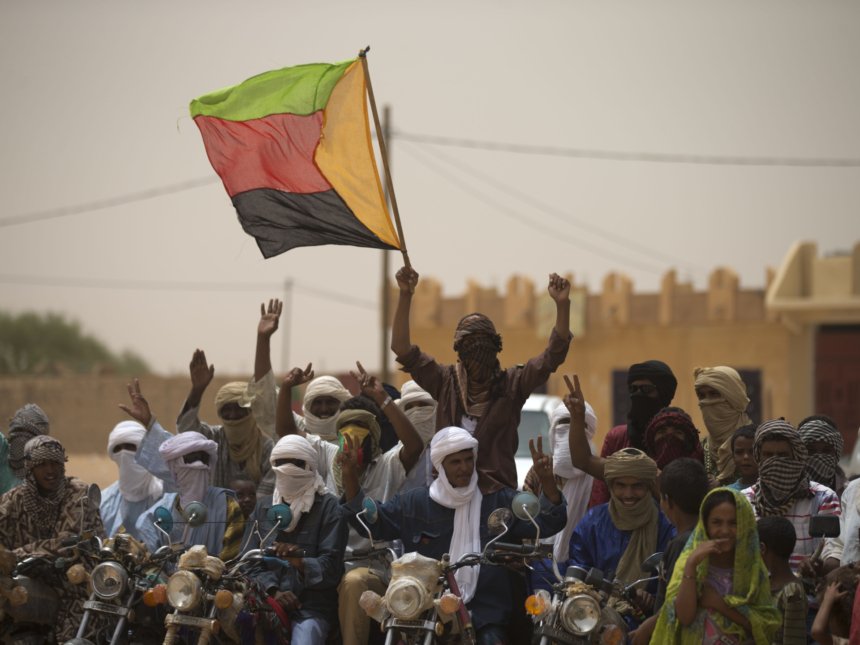
Mali witnessed a remarkable security escalation, in the context of the continued efforts of the Tuareg and their allies towards independence in the north of the country and the overthrow of the ruling military regime. In this context, the Front for the Liberation of Azawad emerged as a rebel alliance founded in 2024 from multiple Azawadian factions.
The Front’s agenda is based on seeking the right to self-determination for the people of the North, while pushing towards a form of autonomy in the North, within a highly volatile political and security environment.
According to reports, on April 25, 2026, the country was subjected to attacks targeting military areas and bases, which resulted in the killing of Defense Minister Sadio Camara and his wife, in addition to other victims. Intermittent explosions were also recorded in the vicinity of Modibo Keita International Airport in the capital, Bamako, and the city of Kidal in the far north fell into the hands of the rebels.
The process of formation of the Front for the Liberation of Azawad
The announcement of the formation of the Front for the Liberation of Azawad in November 2024 was a direct result of the security and political accumulations witnessed in northern Mali, which reshaped the landscape of armed actors in the region.
In 2017, the Organization for the Support of Islam and Muslims emerged as a dominant force after the merger of several groups linked to Al-Qaeda, which led to an escalation of attacks and an expansion of control in northern Mali.

As the security situation worsened, Bamako witnessed a military coup in August 2020, led by Colonel Assimi Goeta. On May 25, 2021, he overthrew elected President Ibrahim Boubacar Keita, followed by another coup, also carried out by Goeta, who overthrew the interim president, Bah Ndaw, and his prime minister, Mokhtar Wan, saying that they had failed to perform their duties and that they “seek to sabotage the transition process in the country.”
In parallel, relations between the coup authorities and international partners became tense, especially France, which was later forced to end its military presence in the country under pressure from the coup plotters, and amid an escalation in popular rejection of the French forces remaining in the country.
With the withdrawal of French forces in 2022, elements of the Russian Wagner Group entered the scene to fill the security vacuum, at a time when Mali was repositioning itself politically after suspending its membership in ECOWAS and demanding the exit of the United Nations mission in 2023.
This transformation led to field vacuums, especially in the north, where a direct conflict broke out between the Malian army and fighters of the movements active in Azawad to control the evacuated bases, which exacerbated human losses and forced tens of thousands of civilians to flee.
In January 2024, the cancellation of the Algiers Agreement signed in 2015 represented a turning point, as it reopened the fighting fronts with armed groups, including the Tuareg factions. In light of this escalation, the need emerged among some Azawadian movements to restructure their ranks within a more effective unified framework.
Within this context, several factions, the most important of which are the National Movement for the Liberation of Azawad (Tuareg), the Supreme Council for the Unity of Azawad, the Arab Movement of Azawad and others, announced the establishment of a new entity, the Front for the Liberation of Azawad, to represent a comprehensive entity of the previous components, led by Abbas Ag Intalla, and for the new entity to be a new political-military platform that re-presents the demand for self-determination, and seeks to strengthen influence in northern Mali within a complex and changing regional environment.
Roots of conflict
The roots of the conflict in the Azawad region in northern Mali go back a long time, as the Tuareg have sought since the beginning of the twentieth century to establish their own state. After Mali’s independence from French colonialism in 1960, these demands escalated further.
Northern Mali is mainly inhabited by Tuareg and Arabs, and they have social and cultural ties with neighboring countries such as Algeria, Niger, and Mauritania, more than with the rest of the components of society in southern Mali.
The first rebellions began in 1962, when the Tuareg launched attacks on government sites, but the army was able to end them, which led to the displacement of a large number of residents and increased tension. The drought waves that struck the region also contributed to worsening the situation, due to their significant impact on the lives of the Bedouin population.
In 1990, a new rebellion broke out with the participation of Tuareg from northern Niger, and several armed movements emerged, most notably the Popular Movement for the Liberation of Azawad, the Arab Islamic Front of Azawad, and the United Movements and Fronts of Azawad.
Although a peace agreement was signed with some of these groups in 1995, tensions did not end, and attacks continued sporadically in northern Mali.

Independence is not complete
In early 2012, after a new wave of attacks led by the Tuareg along with other armed groups, some of which were affiliated with Al-Qaeda, the National Movement for the Liberation of Azawad, led by Bilal Ag Sharif, announced the establishment of an independent state in northern Mali.
At the beginning of the conflict, the movement allied with the Ansar Dine group led by Iyad Ag Ghali, but this alliance was not stable, as clashes soon broke out between the two parties.
The rebels took advantage of the chaos that followed a military coup in Bamako in March 2012, and were able to control major cities in the north such as Kidal, Timbuktu and Gao. On April 6 of the same year, the National Movement for the Liberation of Azawad declared the independence of the region.
But differences arose again. The Tuareg’s goal was self-rule, while Ansar Dine and its allies sought to impose Sharia law in the areas under their control. Over time, these groups took control of the course of events, which led to a decline in the role of the National Movement for the Liberation of Azawad.
In 2013, France intervened militarily at the request of the Malian government, and deployed about 4,000 soldiers to support it.
In 2015, the Algiers Agreement was signed between the government and an alliance of Tuareg groups, with the aim of calming the situation, with promises to grant the north more autonomy and improve economic conditions. United Nations peacekeeping forces were also sent to the region to support stability.
The largest coordinated attack in years
Last Saturday, the Al-Qaeda-linked Group to Support Islam and Muslims, and the Front for the Liberation of Azawad, claimed responsibility for a series of attacks targeting several locations in Mali, including the city of Kati and the airport of the capital, Bamako, in addition to areas in the north such as Mopti, Sevare, and Gao, on April 25, 2026. These attacks were described as among the most daring operations against the government led by the Malian army.
For its part, the Malian army confirmed that it was able to repel the attacks that targeted several sites in Bamako and its environs, noting the killing of hundreds of attackers, and the start of extensive combing operations in the capital and its environs, in addition to other areas of the country, including gold mining areas.
In contrast, the armed group reported controlling the cities of Kidal and Gao in the north of the country.