Published On 4/29/2026
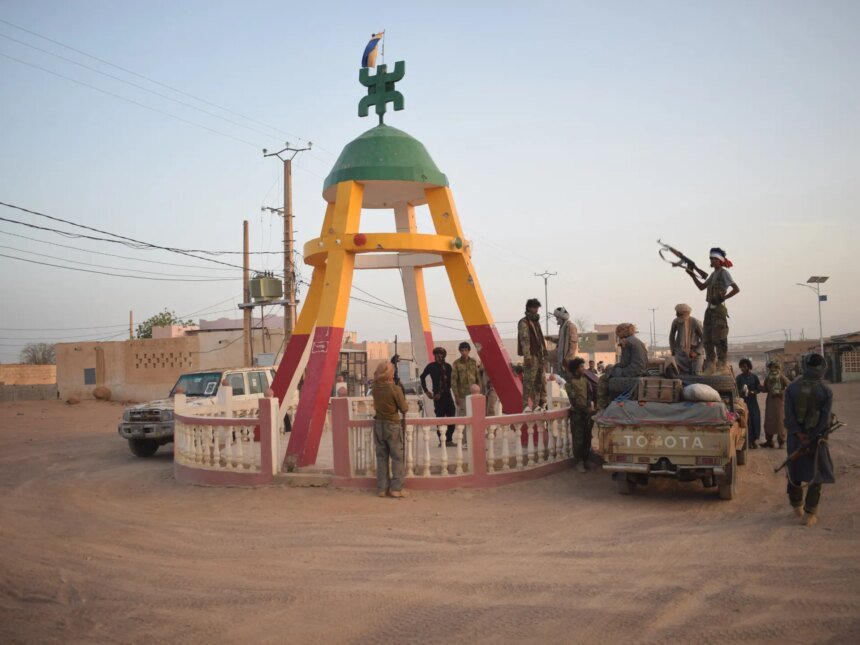
Fighters of the Front for the Liberation of Azawad raised their flags again over the streets of Kidal, hours after the coordinated attack launched on several regions in Mali. Within one day, the city in the far north ended a decade and a half of its stormy history, from a stronghold of the Tuareg rebellion, to a “recovered” city under the banner of Bamako for two and a half years, to a new rebellion at dawn on Saturday.
However, this is not the first time that Kidal has been surrendered or recovered, but rather the fifth time in 66 years. In this repetition lies the mystery of the city, which has turned into a mirror of both the financial state and its borders.
1963: “Falaka” and the founding era of estrangement
Only 3 years after Mali declared its independence from France, the first Tuareg revolution in the country’s history exploded in Kidal, as Zeid Ag Atahir led a rebellion known as “Falaga” on May 14, 1963 (a term the French army used to name resistance fighters during its occupation of Algeria and Tunisia).
The problems went beyond the economic dimension, as researchers – in a research paper published on the “Sage Journals” platform – describe the 1963 uprising as an explosion of anger with an ethnic background over a colonial decision that placed the Tuareg in the north “under the rule of blacks” in the south, which is the founding wound from which all subsequent uprisings fed. The government in Bamako violently crushed the rebellion, establishing in Kidal’s consciousness a “memory of wounds” that is still present today.

1990: The return of the Great Crisis Generation
After waves of drought and migration, the Tuaregs returned from their emigration loaded with weapons and political awareness. In June 1990, the Popular Movement of Azawad, led by Iyad Ag Ghali, attacked northern towns. Despite the signing of the Tamanrasset Agreement (a city in southern Algeria) in 1991, the movement split into competing fronts, perpetuating the tribal division between the negotiating Ifoghas tribe and the Imghad tribe, which rejected the settlements.
2006: The split of the commando and the birth of new rebels
On May 23, 2006, Kidal surprised everyone with a “quality” uprising. Fighters from the Democratic Alliance for Change, led by Ibrahim Ag Bhanga, attacked military barracks in Kidal and Menaka, killing two soldiers. The distinguishing feature was that two army officers defected from him with their soldiers and withdrew to Mount Adrar Ifoghas, which was the permanent stronghold of the rebels, and which once again received its fighters, including Iyad Ag Ghali.
In July 2006, the Algiers Agreement was signed, but Bhanga rejected it because it stipulated abandoning the demand for autonomy. Kidal has since become the site of a recurring scene; A peace agreement collapses before the ink dries.
2012: The height of the uprising and the collapse of the state
With the fall of Colonel Muammar Gaddafi, Tuareg fighters who had been in Libya returned with heavy weapons, and the National Movement for the Liberation of Azawad, in alliance with Ansar Dine, seized Kidal in March 2012, followed by Gao and Timbuktu.
Subsequently, the “National Movement for the Liberation of Azawad” declared the independence of the “State of Azawad” in northern Mali, but the alliance between the two groups quickly collapsed, and they were forced to abandon the major cities in the north after the military campaign launched by France and its allies starting in January 2013. The city was liberated symbolically, but it remained effectively closed to the Malian army until the Algiers Agreement in 2015, when Kidal turned into an area of actual control for the groups. Rebellious.
2023: Kidal under Bamako rule
In November 2023, the Malian Military Council launched a massive attack with the participation of Wagner mercenaries, and the battle ended with the raising of the Malian flag over Fort Kidal and the appointment of General Hadj Ag Gamou – a Tuareg from the Imghad tribe – as military governor. The message was clear: Bamako would run the city with its Tuareg, not its Tuareg.
2026: Return of the Circle
The new rule lasted two and a half years, and ended in a coordinated operation on Saturday, April 25, as the Azawad rebels announced on Sunday an agreement that allowed the African Corps (formerly Wagner) of Russian forces to withdraw from Kidal, leaving the city “entirely” under their control. On the same day, the Malian government confirmed the killing of its Defense Minister, Sadio Camara, at the Kati base near the capital, Bamako, completing the image of a city that is not subject to a state, and rewriting the legitimacy of its rulers for the fifth time since independence.

Kidal “the rebel city”
- Geography: Kidal is about 1,500 kilometers away from Bamako, and is located in the heart of the Ifoghas mountain range, which is difficult to encircle militarily.
- Demographics: It is overwhelmingly Tuareg, and Bamako did not succeed in integrating it. Each peace agreement (1991, 2006, 2015) granted it an exceptional status and then collapsed when the state tried to impose its sovereignty.
- Sociologically: Its tribal structure is complex between Ifoghas, Imgad, and Ednan, and every regime that tried to play on these divisions backfired on it.
Kidal’s return to rebellion opens a question that goes beyond the geography of northern Mali to the depth of the idea of the state in the Sahel. If one city was able – five times in 60 years – to rewrite the legitimacy of the regime in Bamako, is the problem in Kidal, which rejects state hegemony, or in a state that has not been able to absorb Kidal since 1960?