Published On 4/29/2026
It is described as one of the world’s most dangerous migration routes, but tens of thousands from several African countries take it by land and sea in an attempt to reach the Gulf countries, in search of life, and to escape armed conflicts.
It is the eastern path between the Horn of Africa and the Arabian Peninsula, which begins by walking for long days, then by sea amid storms and pursuit by the Coast Guard, and if the migrants survive all of this amidst their hunger and thirst, they arrive in Yemen at a stop – perhaps – for what follows.
The hardship of the journey is not limited to crossing the sea or deserts. After reaching Yemen – the poorest country in the peninsula – which has been witnessing conflict since 2014, tens of thousands seek to move to the Gulf states, especially Saudi Arabia, where they work in humble professions.
Many people take the eastern route, most of them from Ethiopia, which is the second largest African country in terms of population (about 130 million people), and which, like many countries on the continent, is witnessing bloody armed conflicts.
According to the International Organization for Migration, between 200 and 300 migrants arrive daily in the Obock region in Djibouti, where most of those wishing to immigrate seek to cross from there because it is one of the closest points to Yemen, as it is only 30 kilometers away.
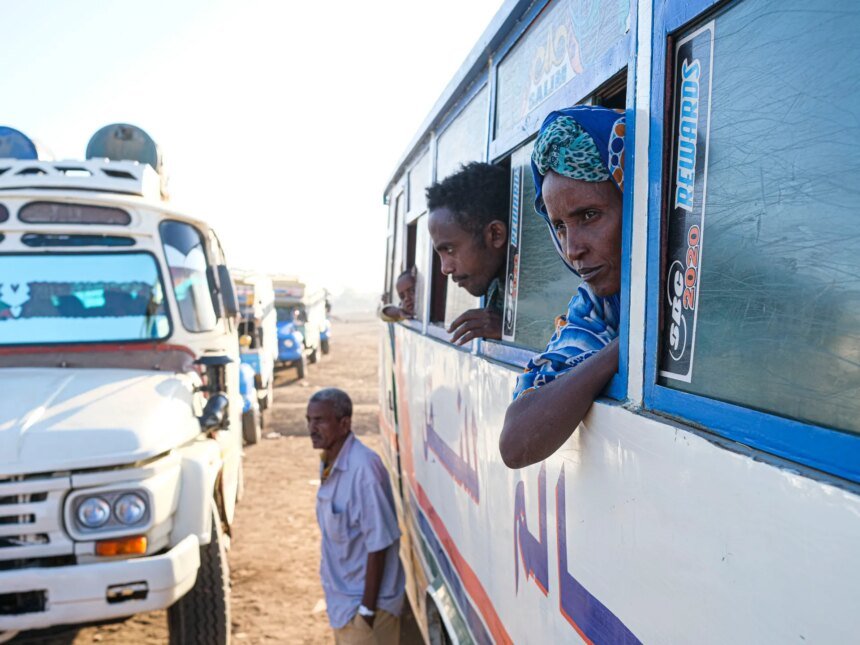
In a flat sandy area in Djibouti, under the rays of the hot sun, a group of men with exhausted, exhausted and sad faces are walking back to where they came from, after failing to reach Yemen.
Agence France-Presse met a number of those who took this path, and they spoke about the atrocities they experienced and witnessed, as most of them did not succeed in reaching the “safety” they intended.
A number of these men say that they have not eaten for days, and are looking for some rest in the midst of scanty trees scattered from one place to another. Although this April is considered a moderate temperature in Djibouti, it is common for temperatures to exceed 35 degrees Celsius during this period.

There is no safe place anymore
Among these examples is Ibrahim Hassan (25 years old), who was forced to flee by fighting between federal forces and rebels in Ethiopia. “We no longer have a place to live in peace,” he said in his testimony.
Hassan, who earned his living from agriculture, set off from his village in northern Ethiopia towards Djibouti, on a 550-kilometre arduous journey that required 15 days of walking.
Hassan arrived with swollen feet at his initial destination, from where he boarded a crowded boat bound for Yemen one night. But hours passed until the Yemeni Coast Guard stopped the boat and took Hassan and those with him to detention centers, where they remained without food for 8 days before being returned to Djibouti, according to him.
They die before our eyes
As for Zainab Gebrechristos from the Tigray region in Ethiopia, she left the country after paying 50,000 birr (270 euros) to a smuggler, which is a huge amount in a country where 40% of the population is below the poverty line.
On the way, Gebrechristos was stripped of her money and phone, and waited for 3 days in the Djibouti desert without food or water, she said. On March 24 at night, smugglers put 320 people on a small boat – according to Gebrechristos – to complete the route.
But the small boat could not bear all this number, and soon it began to sink. “Many people died before our eyes, including friends and family members,” Gebrechristos said.
Gebrechristos does not know how she managed to survive, so she settled in a reception center in the town of Obock run by the United Nations International Organization for Migration, whose patrols roam the desert to help migrants.
In 2025, the Organization for Migration monitored the death and loss of 900 people who attempted to migrate along the “East African Trail,” and in the most recent incidents, at least 9 migrants died and 45 went missing when a boat sank in late March, while others survived, including Zainab Gebrechristos.
Mass graves
From their position in Khor Anjar – a town in the northern Obock region – the Djibouti Coast Guard is intervening to try to stop the smugglers. The site commander, Ismail Hassan Dorayeh, says that the smugglers “pack the migrants into wooden boats,” noting that a number of them were confiscated.
Gehir Beach – located about 50 kilometers north of Obock – is one of the departure points for migrants towards Yemen, and evidence of this is clear in the place, as abandoned clothes, slippers and personal items are scattered on its soft sand. But the clearest evidence is a stone monument indicating “two mass graves,” according to Youssef Musa Muhammad, the official in charge of the IOM office in this town.
He added, “Nearby, two mass graves were dug in which 5 bodies were buried. Behind this hill is a mass grave with 50 bodies, and another mass grave with 43 bodies.” He continues, “More than 200 bodies were buried nearby.”
For years, migrants who die at sea or on the road have been buried in the Obock cemetery, where dozens of piles of earth are lined up side by side.
The official at the IOM office points out that most of those he met are from Ethiopia, noting that it is a landless country, which makes migrants venture into the sea for the first time in their lives most of the time.
Lost in the desert
Drowning is not the only danger facing migrants. There are great dangers that precede it, represented by severe sandstorms and high temperatures in the Djibouti desert, which can reach 45 degrees Celsius in June and August.
Due to severe sandstorms, many migrants get lost in the desert and go missing. “We found about 20 bodies a month during the hot season last year,” says Youssef Musa.
He added, “Even if they escape from the water and sand, some people end their lives themselves,” noting that a migrant committed suicide by hanging out of “despair” last year.
With weak capabilities and the continued influx of migrants, Youssef fears that the year 2026 will witness a new record number of deaths.