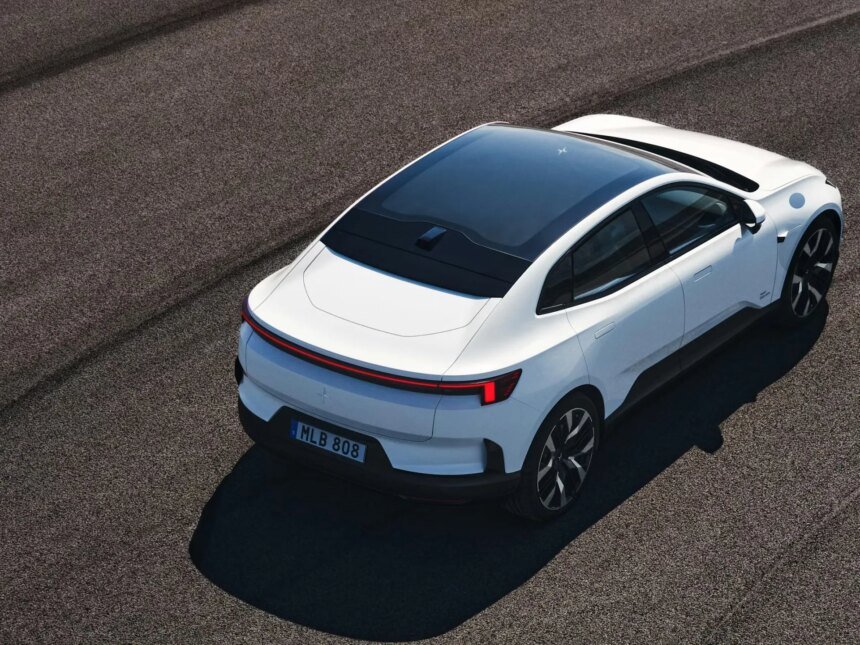
In the world of the automobile industry, there are few design darings that redefine “axioms,” but in 2026 the Swedish company “Polestar” made its biggest bet with a fully electric car that raises the slogan “Goodbye to the rear window.”
This trend is not just a passing aesthetic modification, but rather a comprehensive re-engineering of the concepts of vision, privacy and aerodynamics, which puts the entire industry before a pivotal question: Do we trust “pixels” more than we trust “glass”?
Why was the window missing?
Technical reports agree that the decision to cancel the rear glass was not absurd, but was based on basic engineering pillars aimed primarily at improving aerodynamics and enhancing range, as the design seeks to achieve the least amount of air resistance, which directly increases the battery efficiency.
In addition to the technical gains, this decision came in the service of redefining passenger comfort. Instead of sacrificing interior space in favor of a low, flowing roof, eliminating the window allowed the roof structure to be pushed back, creating an exceptionally wide headroom that prioritizes the comfort of rear-seat passengers.
To ensure that the driver is not affected, the company provided digital visual superiority as an effective alternative, by replacing the traditional mirror with a high-resolution camera that provides a wider rear viewing angle, bypassing usual obstacles such as headrests or the accumulation of passengers in the back.

Opinions of experts and users
Despite this technical ambition, field reviews have revealed a clear discrepancy between the theoretical advantage and actual human experience. The physiological challenge of “digital mirrors” emerges here as one of the most important observations, as the digital screen lacks “depth of vision,” which causes fatigue to the driver’s eyes when switching quickly between observing the distant road and focusing on the near surface of the screen.
This challenge appears particularly acute for drivers over the age of 50, and becomes more complex in low-light conditions where screen performance is relatively degraded.
The observations did not stop only at vision, but also included the effect of the huge wheels on the range. Tests have shown that the Performance model equipped with 22-inch wheels suffers from a noticeable decrease in efficiency compared to the regular version, due to the increased rolling resistance imposed by the larger wheels, which presents buyers with a difficult trade-off between sporty appearance and practicality.

Cold weather test
The challenges were not limited to the design, but rather extended to operating efficiency, as real-life experiments in January 2026 documented that the actual battery range decreased sharply due to frost. The car recorded only 326 miles, compared to the official WLTP range of 372 miles.
In parallel with the decline in power, winter visibility challenges have emerged as an additional obstacle, as severe weather conditions, such as dense fog, rain, and dust, have a direct impact on the digital vision system.
According to the Polestar owner’s manual, the accumulation of dirt or ice on the camera lens requires manual cleaning to restore vision, which explains the delays caused by lens condensation or clouding in harsh environments.

The courage of innovation or an uncalculated adventure?
Polestar has opened the door to a new era in automotive design, and other companies are likely to follow in its footsteps, provided digital cameras prove themselves capable of withstanding the harsh “vicissitudes of nature,” just as they did in sterile testing laboratories.
Indeed, signs of this technical transformation have begun to creep into major manufacturers. The trend is no longer limited to deleting the window completely, but rather to transforming it into a “secondary” element in the face of the power of electronic vision:
- Tesla: embodied this reality in the “Cyber Truck” model, where the rear view is completely eliminated through the traditional mirror once the trunk lid is closed, which made relying on the camera an indispensable necessity and not just a technical option.
- General Motors (GM): took a preliminary path by incorporating “digital mirrors” as a basic option in its fleet of large cars, in a proactive step to prepare the market for future designs that may completely abandon the rear window, especially in the “coupe SUV” categories.
- Lotus: It went further in the “Eletre” model, by replacing the side mirrors with precision cameras, confirming the trend of sports companies towards reducing “aerodynamic resistance” at all costs to achieve maximum performance.
“Polestar 4” does not just sell a car, it sells a new “visual culture.” The truth is that the world is technically “prepared” for this revolution, but the “psychological habit” of replacing the mirror with a screen still needs more time to become part of the contemporary driver’s consciousness.