Published On 4/29/2026
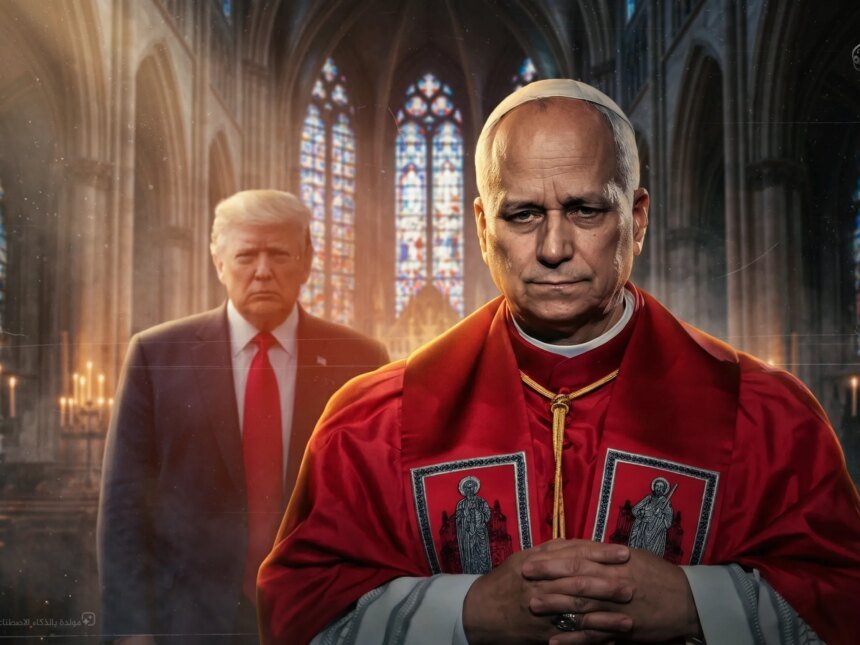
American writer Christine Impa believes that the escalating confrontation between Pope Leo XIV and US President Donald Trump reveals a deeper crisis than just a political dispute. It expresses the need for moral authority capable of confronting wars and the arrogance of authority.
Regarding the context of the confrontation between the Pope and President Trump, Emba said, in an opinion article in the New York Times, that Trump launched an “unstudied and unpopular war on Iran,” which was characterized by chaos and threats that reached the point of what she considered “genocidal language.” In contrast, the Pope’s position emerged as a different moral voice.
Read also
list of 2 itemsend of list
The Pope publicly condemned Trump’s threats and stressed the principles of “dignity, understanding and forgiveness” in the face of what he described as “the illusion of omnipotence.” Emba believes that these words directly struck Trump’s political ego, and encouraged many Americans to express their moral rejection of the war.
Ethical discourse
For Emba, the importance of this moment lies in what the Catholic Church uniquely offers: a strong moral discourse capable of distinguishing between good and evil, and demanding justice and peace, especially since, unlike political parties, governments, and the media, the Church speaks from a position based on spiritual legitimacy and historical continuity.
Emba compares this situation to the situation in the West during the twentieth century, when secular liberalism seemed sufficient to provide meaning and stability, gave people a sense of liberation, and provided a kind of “civil religion” that gave political life moral legitimacy.
But this model, according to the author, is beginning to collapse. Capitalism no longer guarantees stability or justice, excessive focus on the individual has produced isolation and anxiety, and ruling institutions have become weak, burdened by scandals, and unable to answer the major questions related to meaning, purpose, and justice.
Therefore, Emba says, people are once again searching for a spiritual and moral anchor. The question is no longer whether a religious return will happen, but rather what kind of religion will be able to provide this meaning.
She points to the growing media interest in Catholicism, with reports of a “quiet renaissance” within the church. Although the actual numbers do not confirm a major boom – the number of people leaving the church is still much greater than the number of those joining it – the symbolic appeal of the idea is what is more important.
A broader civilizational crisis
Even skeptical cultural elites are beginning to be attracted to the possibility that new generations, raised in a secular world, are searching for something deeper: transcendence, discipline, and belonging to a long and stable tradition.
Impa also explains why Catholicism seems more convincing than other Christian currents today, such as Protestantism, which has weakened itself by constantly trying to keep up with every new social wave, while many evangelicals have lost their moral credibility by becoming a political arm of the American Republican Party and Trump.
As for the Catholic Church, in the author’s view, despite its scandals and internal crises, it has maintained a greater degree of moral independence and remains capable of confronting authority from the outside, as Pope John Paul II did in resisting communism, and as Pope Francisco did with his call for humility and openness.
Impa concludes that the current clash between the Pope and the US President reveals not only a renewed religious interest, but a broader civilizational crisis: people searching for moral authority when politics fails. This “Catholic moment” reflects a deep desire for a voice capable of confronting injustice without fear, and may signal the beginning of a true spiritual awakening.