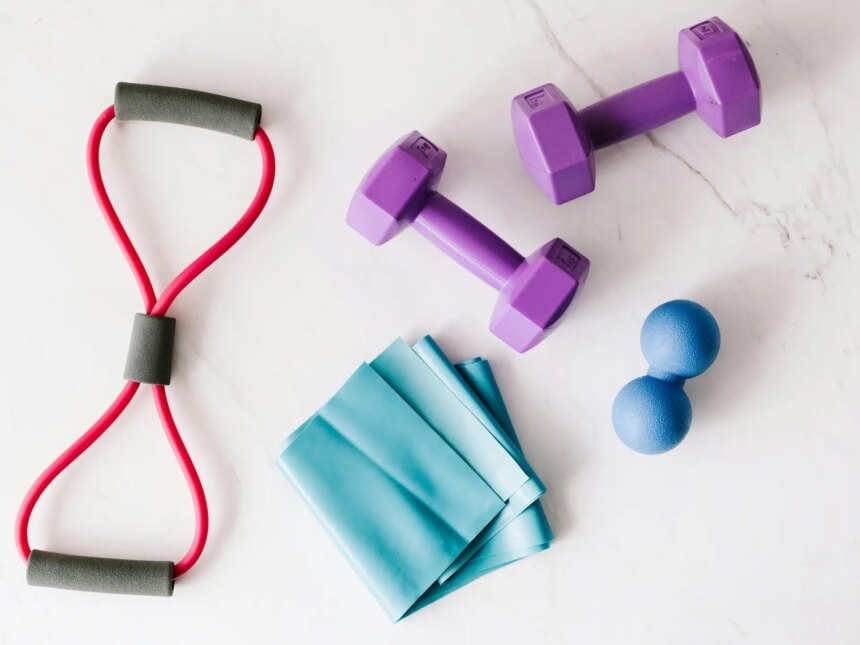
In recent years, with the increasing popularity of home exercises, many people have begun looking for simple and effective tools that help them build strength without the need for equipped gyms. Two popular options stand out here: resistance bands and free weights (such as dumbbells and barbells).
Both are capable of improving strength and fitness, but the real difference between them is not only related to ease of use, but rather to the nature of the resistance they offer, their effect on muscles and joints, and their suitability for different training goals, especially at home.
Read also
list of 4 itemsend of list
How do resistance exercises build muscle?
Resistance exercises are based on one basic principle: exposing the muscles to an external load that forces them to adapt and grow, whether this load comes from free weights, resistance bands, or even your own body weight.
American College of Sports Medicine guidelines indicate that any form of regular resistance training can increase calorie burning, increase muscle mass, and improve physical performance and overall health, when done consistently and at the appropriate intensity. Recent research also confirms that muscles respond to growth when exposed to a gradual increase in load, regardless of the type of tool used.
The basic difference…the type of resistance
The fundamental difference between free weights and resistance bands lies in the way the load is generated:
- Free weights rely on a relatively constant resistance resulting from gravity. The weight remains almost constant throughout the range of movement, which makes the beginning of the exercise more challenging and makes it easier to adjust the intensity of the load and apply the gradual principle accurately.
- Resistance belts provide variable resistance that increases as the belt is tightened, reaching its peak near the end of the movement when the muscle is fully contracted, a pattern that provides different stimulation to the muscle fibers and contributes to diversifying the response and muscular adaptation.
Despite this mechanical difference, recent evidence suggests that resistance bands can be an effective practical alternative to free weights in home training, especially with limited space and ease of transportation and storage.
A study conducted by researchers at the Norwegian University of Science and Technology and published in 2018 in the Journal of Human Kinetics showed a convergence in the activation levels of the upper muscles when using belts and free weights in a number of exercises.
A recent study from the Catholic University of Valencia, published in 2025 in the Orthopedic Journal of Sports Medicine (OJSM), also showed the presence of similar muscle activation patterns in terms of coordination and motor integration between the two methods, which supports relying on resistance bands as a suitable training option at home, especially for beginners or when traditional weights are not available.
Building muscle and strength…what does each offer?
Both resistance bands and free weights can contribute effectively to building strength and muscle mass if used within a structured program with appropriate intensity. This mainly depends on:
- Performance quality.
- Gradual load.
- Continuity in training.
However, free weights tend to excel in developing maximum strength over the long term, because they allow for a precise and regular increase in load, which is consistent with the progressive load principle necessary for progressive and sustained strength building.
In contrast, resistance bands provide various advantages, including:
- Increasing the time the muscle remains under tension during movement.
- Enhance muscle control and improve neuromuscular coordination.
- Reducing stress on the joints compared to some traditional exercises with weights.
Therefore it can be said that:
- Free weights are best suited for gradually building high strength.
- Resistance bands are an excellent tool for improving function, supporting motor control, and adding variety to exercises, especially in home training or when a practical, easy-to-use alternative is needed.
Safety and injuries…which is gentler on the joints?
Resistance bands are often a gentler option on the joints, especially for beginners or those recovering from injuries, as they provide progressive resistance that reduces stress at the beginning of the movement and distributes the load smoothly throughout the range of motion, which helps reduce stress on the joints and tendons.
In contrast, free weights are still more effective in building muscular and skeletal strength in the long term, but they require:
- Correct technique in performance.
- Pay special attention in shoulder and lower back exercises to avoid overload.
The mechanical challenge that weights provide also contributes to strengthening bones and tendons over time, which makes them an important tool for those who aspire to build great strength, provided that the correct technique is adhered to.
Overall, the judgment of “safest” is based more on fitness, technique and health status, than on the tool alone.
In home training…which is more practical?
In terms of daily life and home use, there are clear practical differences:
Resistance bands
- Lightweight, easy to carry, does not require storage space.
- Their cost is much less than a full set of weights.
- Versatile and suitable for most fitness levels.
Free weights
- Allows you to accurately measure progress by gradually increasing weight.
- It provides better stability in some compound exercises, and stimulates a clearer development of strength in advanced stages.
- It requires more storage space and is less easy to transport.
How do you choose the right tool for you?
The choice ultimately depends on your personal goal and circumstances:
- If you are a beginner, working out in a small space, or looking for an economical and practical option, resistance bands will be very convenient and can give you excellent results.
- If your goal is to build significant muscle strength and increase the weights gradually, free weights are often the best choice, because they allow more precise control of the load.
- If you are recovering from an injury or suffering from joint problems, start with resistance bands, then gradually move to free weights after consulting a specialist and making sure your condition improves.
The best results are often achieved when combining free weights and resistance bands within one program, as free weights contribute to developing maximum strength, while resistance bands help improve muscular stability, enhance motor control, and reduce stress on the joints.
Therefore, the real question is not related to “Which of the two tools is better?”, but rather how to employ each tool at the appropriate time within the home training program, according to the goal of the exercise, the level of fitness, the space and the available capabilities.