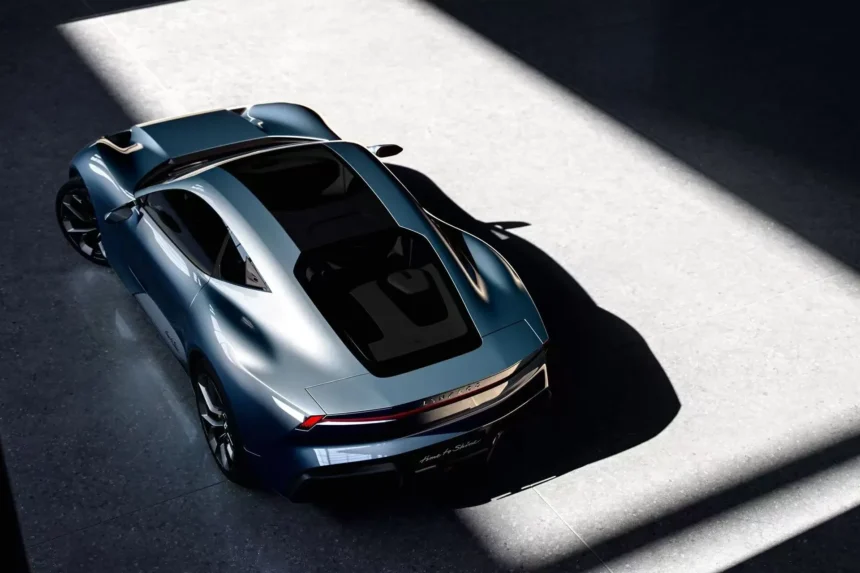
The 2026 Beijing International Auto Show was not just a platform for displaying new models, but rather a stage for a historic transformation in the path of the Lynk & Co brand. After years of dominating the SUV and sedan segments, the Chinese-Swedish brand decided to break the rules and unveil the first GT concept car in its history.
The GT symbol refers to powerful and luxurious sports cars that were specially designed to combine high performance and speed, with absolute comfort and luxury for long-distance driving.
Link & Co. was established in 2016 as a joint venture between Geely Holding and Volvo Cars, and quickly established its presence with practical models aimed at everyday use.
Under the slogan “Time to Shine”, the announcement of the “GT Concept” model came to be the culmination of a full decade of innovation. It is not just a car governed by numbers and engines, but rather a clear announcement of Lynk & Co.’s entry into the era of extreme performance with a futuristic touch.
Exterior design: an advanced identity, not a disconnect
The car was developed at the brand’s design center in the Swedish city of Gothenburg, and the company explained that the design team is internationally formed. The car relied on traditional GT proportions: a long hood, a 2+2 cabin, a wide, low body, and a stable wheelbase. But the design language was not a break with previous Lynk & Co models as much as it was a clear development of its distinctive elements.

At the front, the grille and vertical daytime running lights – a visual feature linked to the brand’s identity – are combined into a single high-tech light mass. This merger gave a cleaner interface, and the company considered it “more literal and clear.”
As for the exterior paint, it is called “Apex Blue,” which is a liquid metallic paint designed to enhance the bounces of light on the vehicle’s surfaces, creating a moving visual effect with the change in viewing angle. On both sides, a crescent-shaped line of light passes, which the company calls the “Halo Line,” inspired by light reflections on high-speed surfaces.
At the rear, there is a mainly functional orientation: a large rear diffuser and a sharp, well-defined trailing edge. The company states that this design “allows air to separate from the body as efficiently as possible,” indicating a clear engineering focus on aerodynamics and aerodynamics.
The taillights extended across the width of the car, with triangular units at the edges, appearing in a clear development of the brand’s visual identity.

Interior and double cabin
Lynk & Co described the cabin philosophy as “two worlds colliding”, referring to the combination of spacious luxury and a focused sporty experience.
The basic space is characterized by openness and simplicity, with white leather seats using a textile technology that the company calls “Digital Shimmer,” and a floating structure made of advanced carbon fiber that surrounds the driver’s cabin and visually separates it from the rest of the space.

But the highlight of the interior is the shift system linked to the prominent central yellow button bearing the (+) symbol. When pressed, the following happens:
The displays automatically retract and non-essential information disappears from the driver’s field of vision. The steering sensitivity increases and its response changes to be more direct. The entire cabin becomes more focused on driving.
The company states that this mechanism is not just a traditional “drive mode”, but “a complete transformation of the car’s character, from an open everyday space to a pure performance cockpit.”
![When you press a button [+] The displays automatically retract and non-essential information disappears from the driver's field of vision (company website)](https://www.aljazeera.net/wp-content/uploads/2026/04/669782-Lynk-Co-Concept-1777225791.webp?w=770&resize=770%2C433&quality=80)
Technical specifications…strategic silence
Although the GT category is associated with performance numbers, Link & Co. chose not to disclose any digital technical specifications. Nothing was mentioned about the type of propulsion system (fully electric or hybrid), nor about engine power, battery capacity, or official acceleration time.
The company justified this by saying, “True innovation does not begin with specifications. It begins with the idea and confidence that determines what comes next.” She added that the current reveal is a “design statement” that reflects the philosophy of performance as seen by the brand, and not a display of numbers.
Separately, unofficial estimates have been reported in some media analyzes indicating the possibility of accelerating from 0 to 100 km/h in “less than two seconds.”
However, this information was not officially confirmed by the company, and was not mentioned in any of the press materials distributed during the exhibition.

Expand into new sectors
This revelation comes in a broader context of transformations taking place in Chinese brands, which have begun to diversify their products away from the almost absolute dominance of the SUV category. By entering the GT category, Link & Co. opens a new front that may put it facing completely different competitors than those it is used to competing against.
The company’s focus on design and interaction aspects indicates that the brand is betting on what can be called “user experience” as a differentiating element, more than the traditional bet on absolute performance numbers.
The Lynk & Co GT Concept marks an official entry into the high-performance sports car segment. While the exterior and interior design presents an ambitious vision that combines luxury, technology and an intelligent transformation in the driving character, the actual performance file remains open. The question remains: When will a production version reach the roads? What are the real numbers then?