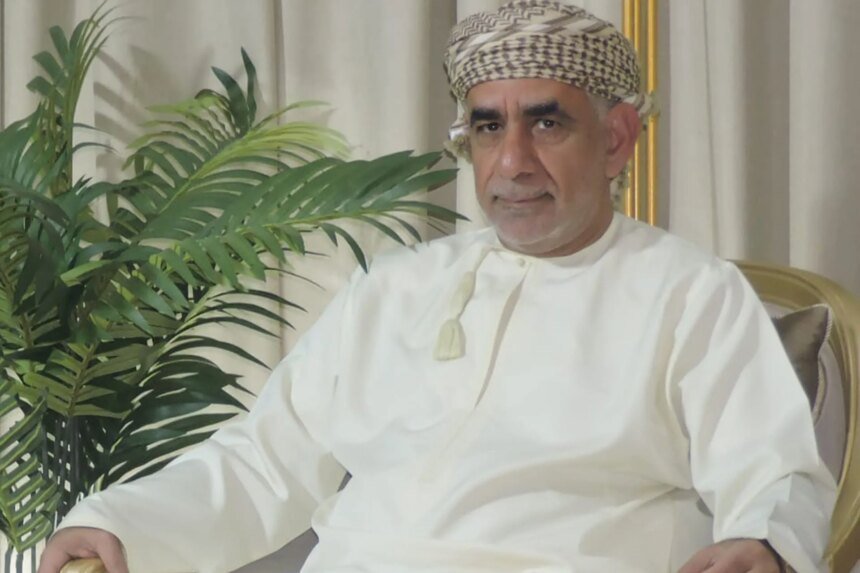
In the corner of Omani creativity, Dr. Mahmoud Al-Rahbi looks at us, carrying an inkwell filled with stories over the course of more than a quarter of a century. A storyteller and novelist, he moved between the corridors of the Ministry of Higher Education as an employee and director, making his life experiences into rich literary material. His works were distributed among collections of short stories and novels, and won prestigious awards, from the Sultan Qaboos Award for Culture, Arts and Literature (in 2012) to the Dubai Cultural Award (in 2009).
Today, Al-Rahbi returns bearing a new coronation, after winning the “Al-Multaqa Prize for Arab Short Stories” in its eighth session, 2025-2026, for his short story collection, “La Bar in Chicago.”
In his works, Mahmoud Al Rahbi paints a panoramic picture of the major social transformations in the Sultanate, moving between the bustle of nightlife in the capital, Muscat, and the calm of the Omani countryside in the 1980s.
Chicago is a symbol of alienation
- In your winning collection, “La Bar in Chicago,” there is confusion with American space alongside Omani space. Was Chicago just a place, or was it a symbol of a deeper subjective and cognitive alienation? How do you view the relationship between place and narrative in your stories?
Yes, whoever reads the story will discover this confusion. Inside, the narrative game is revealed. As for the question of the relationship between place and narrative, it is difficult to formulate a story outside its specific space, otherwise it will become a body without steel or bones.
Spatial space is the starting point, but it does not have to be specific or topographically defined. It can even belong to dream spaces. Experimentation in the short story sometimes reaches open lengths, and it is difficult – in some cases – to determine the space or spatial space around which the narrative revolves, but the writer can leave signs on the way that can be inferred, and this space may be open to mean the whole world, but in most cases the storyteller or narrator does not write in general except from what he knows and feels.

A village wiped out by rain
- You won the “Al Multaqa” Award in its eighth session, which is one of the most important Arab awards for short stories. What does this coronation mean to you in your creative journey? Do you think that Arab awards are now able to restore respect to the art of storytelling?
Yes, the Al Multaqa Prize for the Arabic Story in Kuwait is the most important Arab prize for the story ever, first because of the competitive nature of it, as story writers from different generations and ages take the initiative to participate in it, some of whom completely abandoned the short story in favor of writing the novel and then returned to it because of this award.
I felt the value of being crowned after a long life of writing stories, as I had been writing and publishing continuously since the end of the eighties in Al-Quds Al-Arabi newspaper, specifically in the important daily cultural page that was supervised by the late, great poet Amjad Nasser (1955-2019 AD). He used to append my story with the phrase “Omani storyteller who resides in Morocco for years.” I would sometimes write for him in university notebooks and send them, in my own handwriting, to see them published not long after. Among them was a story that was praised by writers at the time. Moroccans and Arabs entitled “A Village Wiped Out by Rain”, unfortunately I lost it.
The beginnings…the color of the clay and the village
- You have a clear imprint on the Omani story since the 1990s. How do you see the evolution of this scene from “brown” to today? What are the most prominent transformations that you witnessed in your generation and subsequent generations?
The beginning was before I published my collection of short stories, “The Color Brown.” Perhaps the title has something to do with nostalgia, as the color brown is the color of clay and the distant village. In the first stories, I was more fond of language than clarifying the event, so those stories came mixed with poetry and their gendered identity was disturbed, while part of the story’s identity was to monitor transformations, whether personal or social, while in the “brown color” stories I tried to find a balance between the texture of a language open to eloquence and the purity and clarity of the event.
Searching for a new idea outside the oral, but over time I was tempted by oral stories with an Omani flavor, and I tried to deal with them with extreme caution without destroying their original structure.
They were stories created for people to hear, so how could I create them narratively? These remain experimental attempts at topics. Searching for topics and writing stories was my preoccupation, and sometimes folk tales help me with material that is attractive and magical. Starting from the brown color of the first collection of stories, I was able to sense the transparent line between speech and wording. This matter requires skill and experience in writing. You cannot transcend yourself and advance if you do not try to delve into various topics and forms. You will stumble one hour and skip another, but you will continue to be amazed at the details of life with you.
![_Mahmoud Al-Rahbi... (Al-Jazeera)[1]](https://www.aljazeera.net/wp-content/uploads/2026/04/defrgtyhuj-1-1776781533.jpg?w=770&resize=770%2C513&quality=80)
Dreamer’s map
- The short story insists on remaining in the time of the novel. Why did you choose to return to it in “La Bar in Chicago” even though you are also writing the novel? What can a story do that a novel cannot?
I started writing short stories and did not move directly to the novel. I began to enter the novel with caution through the novels “The Dreamer’s Map” and “The Enchanted Path.” Perhaps the novels that I published were tied to the story because of their shortness and also because of the style based on economy and condensation. There is perhaps an exception in the novel “Butterflies of the Spiritual,” which came in about 50 thousand words.
Strange leaves
- In the novel “The Stranger’s Papers,” you worked on a character who has to do with archaeological excavation. Working on history and identity seems to be an Omani obsession in your literature. How do you balance the local and the global in addressing these concerns?
In any novel, I usually start with some philosophy. In “The Path of the Enchanted,” for example, I used to narrate a classic Omani poem about the enchanted Nizwa, mentioned by the great Omani historian and jurist Nour al-Din al-Salimi (1284-1332 AH), in the footnotes of his historical book “The Masterpiece of Notables in the History of the People of Oman.” The novel “The Dreamer’s Map” revolves around the subject of fascination with the West by a young man who is strict in his religiosity. His trip to New Zealand contributed to dismantling some ideas. Calcified in his mind about Christian society, and thus, for example, in “The Leaves of a Stranger,” its philosophy revolved around the atrophy of the Arabic language in the Gulf countries. This novel began with Al-Mutanabbi’s famous line, “But the Arab boy in it is a stranger in face, hand, and tongue.”
In any novel, I usually start with some philosophy. In “The Path of the Enchanted,” for example, I used to narrate a classic Omani poem about the enchanted Nizwa, mentioned by the great Omani historian and jurist Nour al-Din al-Salimi (1284-1332 AH), in the footnotes of his historical book “The Masterpiece of Notables in the History of the People of Oman.” The novel “The Dreamer’s Map” revolves around the subject of fascination with the West by a young man who is strict in his religiosity. His trip to New Zealand contributed to dismantling some ideas. Calcified in his mind about Christian society, and so, for example, in “The Leaves of a Stranger,” its philosophy revolved around the atrophy of the Arabic language in the Gulf countries, and this novel began with Al-Mutanabbi’s famous line, “But the Arab boy in it is a stranger in face, hand, and tongue.”
Privacy of place
The Omani narrative is more present today than ever before. Do you think there is an “Omani school” in the story or novel? What does Oman represent as a cultural and literary space on the map of Arab creativity?
Perhaps because Oman has a long history and geographical and social diversity that produced a large group of novels, although the Omani beginning with the narrative genre was the story before there was a mass shift to the novel.
The new speech
- Your characters in the story often shy away from directness and constructive sentences. Did you intend for Al-Rahbi’s characters to be silent or marginal sometimes? Do you find a wider space in the margin for disclosure than in the center?
By the nature of the short story, economy and condensation, it is the opposite of chatter and prolongation, and I always remember in this context that long letter that a Russian writer sent to his friend, and he ended it with the phrase, “Sorry, I did not find time to write a short letter.” Therefore, writing a good short story requires time and constant rewriting until the story reaches something resembling an alloy, and during this rewriting a lot of fat and excess falls out.
Also, the story in its current form is characterized by experimentation, and experimentation, whether on the level of topics or form, is important for presenting the narrative material with a new, unconventional discourse. Criticism has taught us that there are two elements in the novel or short story: the narrative material and the discourse, and discourse here means method, so the writer tries hard to diversify the way he presents his story with a new discourse and form every time.
Self review
- If you revisit your first collection, “The Color Brown,” after nearly thirty years, what do you see that has changed in your tools or your outlook on writing narratives?
Of course, the writer develops from one era to another and reviews his approaches to writing, but the imprint remains the same, and development here may mean a kind of expansion of the map of interest in the topics of stories or novels, and development comes in the sense of diversification and entering new deserts and valleys in writing, and this is what gives writing its vitality and continuity.
![***Interior****_Mahmoud Al-Rahbi... (Al-Jazeera)[1]](https://www.aljazeera.net/wp-content/uploads/2026/04/defrgtyhuj-2-1776781536.jpg?w=770&resize=770%2C513&quality=80)
Cash and prizes.. Return to life
- In your opinion, where is the crisis of Arab criticism today regarding the short story specifically? Is there a real critical reading of what storytellers in the Gulf and Oman produce, or is celebration limited to awards?
The story has remained the most present literary genre in our Arab world for decades, but with the translation of novels from other languages, especially Russian novels and Latin American novels, there has become a clear trend for writing novels, and when the awards came, more attention was paid to the novel, and thus with time, an authentic genre in our Arab world, which is the short story, withdrew. When the Forum Award for the Arabic Story came in Kuwait, it revived this authentic genre, and here it is necessary to mention the great credit of the Kuwaiti writer Talib Al-Rifai in his struggle for the continuation of the award. The forum and its renewal to the point that it now receives a large number of short story collections annually, and this is an indication of the recovery of this authentic literary genre in our Arab culture and its return to life after a long winter hibernation.
The traveler..
- After this diversity in writing between stories and novels, is there another literary genre that you would like to break into? Can we read Mahmoud Al-Rahbi’s work in travel literature or autobiography one day?
Yes, I am tempted by this beautiful literary genre, “travel writing,” especially since I am committed to traveling when circumstances permit, and I love discovering new countries such as India, Sri Lanka, Nepal, and Turkey, not to mention our Arab countries. I lived in Morocco for a long time, as well as some years in Tunisia, and I constantly visit Egypt and of course various Arab countries, and I also lived in France for several months, as well as in New Zealand. I think all of this requires a long pause of contemplation in order to write it down and put it into a coherent text, and this is what I hope for, God willing, and if the mood and age permit it.