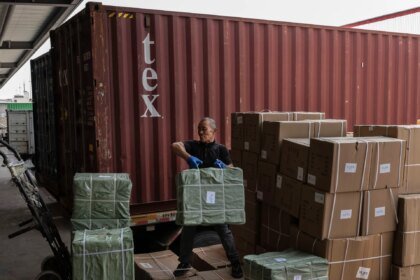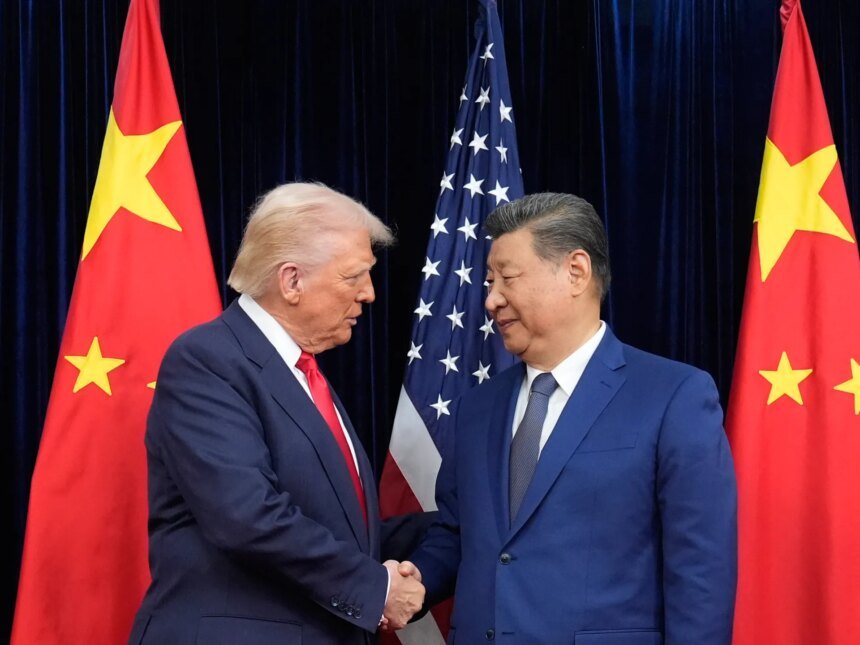
The tariff truce signed between the United States and China did not prevent either of them from increasing the economic pressures that could be exploited against each other, a confrontation that may erupt again by its end next November.
According to Reuters, China used the truce to strengthen its legal arsenal, supply chain controls and sensitive technologies, and enhance its tools of retaliatory economic measures before an expected summit between the two countries next month.
Since last October, China has enacted laws to punish foreign entities (organization, company, institution, association, or other) that move supply chains away from it, tightened the rare earth licensing system, banned the use of foreign artificial intelligence chips in state-funded data centers, prevented Chinese companies from using American and Israeli cybersecurity programs, and is also considering imposing restrictions on exports of solar panel manufacturing equipment to the United States.
Supply chains mean the links in the path that a commodity takes from just an idea or raw material until it reaches the hands of the final consumer (supply, manufacturing, storage, distribution, transportation, then delivery to wholesalers and retailers, then the consumer).
Beijing Tools
The following are the new countermeasures announced by Beijing since the signing of the “trade truce,” according to Reuters:
- On April 15, 2026, Chinese officials held preliminary talks with suppliers of solar panel manufacturing equipment, at a time when Beijing is considering restricting exports of the most advanced technologies to the United States, and estimates indicate that China produces more than 80% of the world’s solar panel components.
- On April 13, China’s State Council issued new regulations authorizing countermeasures against foreign countries over “unlawful external jurisdiction,” according to Beijing.
- On April 7, 2026, China’s State Council issued new regulations (rules) on industrial and supply chain security, giving authorities powers to investigate and take action against foreign countries, companies or international organizations that adopt “discriminatory measures” that undermine China’s industrial and supply chains.
- On February 24, the Chinese Ministry of Commerce, as part of the escalation between Beijing and Tokyo, banned the export of dual-use materials to 20 Japanese entities that it says supply the Japanese military, including vital rare metals used in cars, consumer electronics, and weapons.
- On January 14, 2026, Chinese authorities informed local companies to stop using cybersecurity software produced by more than a dozen companies from the United States and Israel, for reasons related to national security, according to Beijing.
- On January 9, 2026, China began restricting exports of “heavy” rare earths and the strong magnets they contain to Japanese companies.
- On December 30, 2025, China imposed that chip manufacturing companies must use at least 50% of local equipment when adding new production capacities, as part of Beijing’s efforts to build a self-sufficient supply chain in the semiconductor sector.
- On November 8, export controls imposed by China on some advanced lithium-ion batteries, cathode materials, graphite used in the anode (an essential component of batteries), and associated technical know-how came into effect.
- On November 5, 2025, China issued a directive requiring new data center projects that received any government funding to use only domestically made AI chips.

Readiness logic
Reuters quoted experts as saying that this pattern (in reference to the previously mentioned Chinese measures) goes beyond a simple reciprocal response, as China is using the “trade truce” to build a list of tools for economic influence, an area that until recently was largely exclusive to the United States, ahead of an expected summit between Chinese President Xi Jinping and his American counterpart, Donald Trump, in mid-May.
The agency quoted Joe Mazur, a geopolitical analyst at Trivium China, a company based in Beijing, as saying that the Chinese side hopes for a longer-term and broader-based truce, but is moving according to the logic of “if you want peace, prepare for war.”
It is noteworthy that the trade truce, which is scheduled to end in November 2026, came, according to Reuters, partly as a result of Beijing’s threats last year to restrict exports of rare earths to Washington.
Analysts said that these Chinese restrictions caused, within weeks, a shortage within American auto supply chains, which helped push Trump to the negotiating table with Xi during a meeting in Busan, South Korea.
Since then, China has not refrained from implementing any other steps, but rather approved several measures to confront any efforts to transfer production outside the country, or impose measures against its imports of raw materials, which are measures that Beijing deems necessary to defend its interests, according to Reuters.
Response rules
During this April, Chinese Prime Minister Li Qiang signed two regulations, the first of their kind in the country, granting the authorities broad powers to investigate foreign companies, governments, and individuals whom Beijing accuses of discriminating against Chinese industrial and supply chains, or imposing what China describes as “unjustified external jurisdiction” against Chinese entities. Under the two regulations, the authorities can prevent the entry of those found to be in violation, expel them, or confiscate their assets.
The US-Israeli war on Iran increased China’s focus on new economic measures, especially after US Treasury Secretary Scott Besent threatened in mid-April to impose sanctions on buyers of Iranian oil exports, 80% of which China buys.
Yuyuan Tantian, a social media platform affiliated with China Central Television (government), described the new regulations as legal countermeasures, writing two days after Besant’s warning: “In the past, our countermeasures were largely focused on the commercial field, but today’s international frictions are comprehensive, and these tools are no longer sufficient.”
The supply chain and extraterritorial intervention rules went into effect immediately, without an opportunity to receive companies’ opinions, according to Michael Hart, president of the American Chamber of Commerce in China.
It is noteworthy that the trade truce, which is scheduled to end in November 2026, came, according to Reuters, partly as a result of Beijing’s threats last year to restrict exports of rare earths to Washington.
Analysts said that these Chinese restrictions caused, within weeks, a shortage within American auto supply chains, which helped push Trump to the negotiating table with Xi during a meeting in Busan, South Korea.
Since then, China has not refrained from taking any other steps, but rather adopted several measures to confront any efforts to transfer production outside the country, or impose measures against its imports of raw materials, measures that Beijing deems necessary to defend its interests, according to Reuters.
Response rules
During this April, Chinese Prime Minister Li Qiang signed two regulations, the first of their kind in the country, and granting the authorities broad powers to investigate foreign companies, governments, and individuals whom Beijing accuses of discriminating against its industrial and supply chains, and of enforcing what China describes as “unjustified external jurisdiction” against Chinese entities. The authorities can prevent the entry of those found to be in violation, expel them, or confiscate their assets.
The US-Israeli war on Iran increased China’s focus on new economic measures, especially after US Treasury Secretary Scott Besent threatened in mid-April to impose sanctions on buyers of Iranian oil exports, 80% of which China buys.
Yuyuan Tantian, a social media account affiliated with China Central Television, explicitly presented the new regulations as legal countermeasures, writing two days after Besant warned: “In the past, our countermeasures were largely focused on the commercial field, but today’s international frictions are comprehensive, and these tools are no longer sufficient.”
The regulations on supply chains and extraterritorial intervention went into effect immediately, without an opportunity to receive companies’ opinions, according to Michael Hart, president of the American Chamber of Commerce in China.
Reuters quoted Hart as saying, “Companies now face an asymmetry: China can reduce its purchases from foreign companies with limited consequences, while a foreign company that reduces its dependence on China faces the risk of being subject to investigation.”
Washington pressure
Washington, in turn, has put pressure on Beijing, as last March it opened trade investigations into surplus industrial capacity and “forced labor” practices in China, in addition to export restrictions on semiconductors and chip manufacturing equipment to China, which slowed down Beijing’s ability to produce advanced chips.
“Because of export controls, China does not have access to some of the most advanced semiconductor manufacturing equipment in the world,” says Chim Lee, an industrial policy analyst at the Economist Intelligence Unit.
Competition over tools of influence has also complicated China’s mission to conclude a deal to buy American Boeing aircraft for tens of billions of dollars. Beijing wants the planes and spare parts, but Washington said it needs Chinese shipments of yttrium, a rare metal used in manufacturing aircraft engines, according to statements by American government officials and company officials familiar with the deal discussions.
China responded to the American position by escalating its regulatory controls. Since late 2025, it has obligated chip companies to use at least 50% of local equipment when adding new production capacities. It has also banned some American and Israeli cybersecurity programs, and forced state-funded data centers to replace foreign artificial intelligence chips with local ones, which pushes towards local substitution and excludes American suppliers from the Chinese market.
Chip chains
China’s Ministry of Commerce said it was closely monitoring US legislative plans after the US House Foreign Affairs Committee approved draft export control bills targeting semiconductors, and Beijing warned that such legislation could disrupt global supply chains if passed.
In a statement reported by Bloomberg, the ministry described the move by American lawmakers as expanding the use of the concept of national security to justify trade restrictions, and said that the misuse of export controls would undermine the international economic system and harm the global chip industry, according to a statement issued by the Chinese Ministry of Commerce last Saturday.
China said that it would carefully evaluate the impact of these legislative plans on its national interests if they became effective laws, and pledged to take the necessary steps to protect the legitimate rights of Chinese companies, without explaining what countermeasures it might resort to.
Disable anchors
The European Chamber of Commerce in China, in a report issued this April on Chinese export controls, considered that China’s use of export controls that have an impact outside its borders may “disrupt global supply chains on an unprecedented scale, leading to economic and non-economic damage.”
As the United States moves to reduce its dependence on Chinese rare earths, Beijing is racing against time to identify new areas of pressure and disruption. Chinese officials have held preliminary talks with suppliers of solar panel manufacturing equipment about the possibility of restricting exports of the most advanced technologies to the United States.
“There will be a greater effort on the Chinese side to identify new areas of pressure and disruption, and they will continue to try different tools to see what works,” said Joe Mazur, a geopolitics analyst at Trivium China.
Source: Bloomberg + POLITICO + Reuters + New York Times