Published On 4/18/2026
|
Last update: 4/20/2026 16:46 (Mecca time)
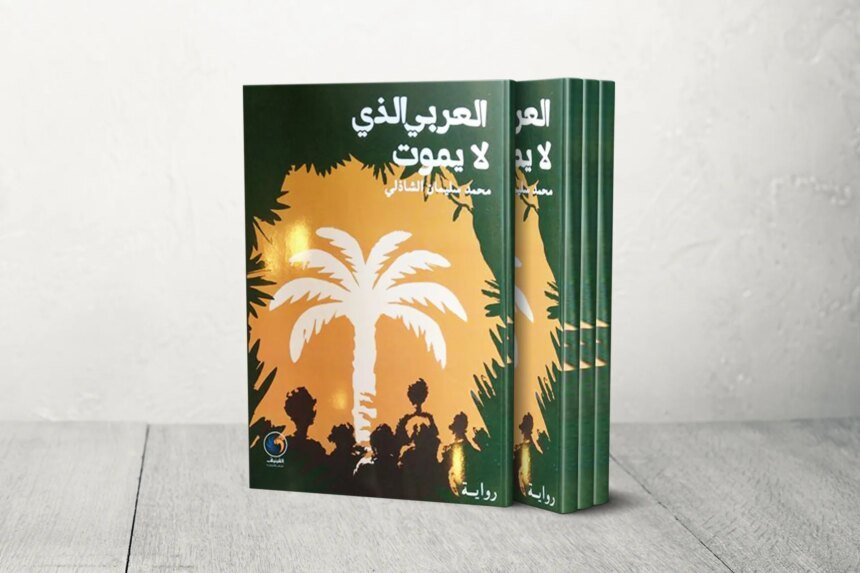
Written by Malik Al-Aloul “The Never-Dying Arab” is a human epic that weighs on your chest with the weight of history and the lightness of poetry at the same time. This is an equation that can only be mastered by writers who were born with the language in their blood, not just in their heads.
You will understand this when you see what the Arabs are experiencing today in Gaza, bleeding and crowded with the wounded, hunger and bitterness, when you look at Lebanon, the bombing and forced displacement, when you hear the echo of the bombs that fell on the Gulf states, when you look at Sudan; In the wake of all that, this novel comes to say in a voice that does not tremble: This is not new. The Arab was defeated and besieged before, but the Arab did not die.
Read also
list of 2 itemsend of list
A world untouched by an Arabic novel
The novel takes you to the town of Ramon, a proud Arab commercial city, on the banks of the Mountains of the Moon, in the heart of the conflict between the eroding remains of Rome and the ambitious Byzantium. It is an environment that no one dared to invoke in the Arabic novel in such a wide range: Arab Muslim merchants, Romans exhausted by imperial exile, African people with their magic, rituals, and leaders, epidemics rising from the river like black clouds, and boats bleeding on the waves.
“Ramon is Gaza in the language of deeper history, and Ramnus the bald, the Roman slave trader, is everyone who turned man into a commodity.”
This place does not exist on the map, but it exists in the heart, and when you read it today while Gaza is besieged and bombed and its people are forcibly displaced from their homes, fields, and memories, it becomes a place closer than any place on Earth.
Pulse does not subside
The boy, Ubaid Allah Al-Arabi, is a young man who clings to Ramon and refuses to leave his land when everyone abandons it. He is not a boring saint, he is a broken human being who loves deeply and loses deeply, raving about the name of his town on his sickbed, just as a lover ravens about the name of his beloved. When you read it today, you cannot help but see in it every young Arab who refuses to be displaced, digging under the rubble, folding his hands, and saying: My place is here. The same heroism, the same wound, the same determination.
The rich girl was given by Al-Shazli something deeper than the image of the gentle, loving woman usual in Arabic literature: complete madness, love that ignites fire, and pride that breaks. She is the most human wounded in the novel. She hates, cries, pulls her hair, holds a knife, and ends up lost in the desert, and her tragedy drips with real blood, similar to the blood of every woman who lost everything in one night.
Sarina is the most beautiful impossible love in the novel. The border girl who sits on the rock of the river bank, with her feet in the water and her eyes in the stars. Its ending is one of the most horrific and influential pages in contemporary Arabic literature, as beauty turns into ashes due to a crime that the heart cannot bear, just as a beautiful house turns into rubble in a moment that the mind cannot bear.
The wealthy girl was given by Al-Shazli something deeper than the image of the gentle, loving woman usual in Arabic literature
Laughter in the face of death
Asim bin Saeb, he is the character that will cheer you up, make you laugh while you cry. A short, fat boy who rolls like a barrel of fat. He teaches people the Qur’an and never stops going to the brothel. He sings “Trlal Trlal” in a heavenly voice at all seasons. He is the living, popular heart of the town, and when he dies, the novel says with amazing simplicity: “It was not the death of a man. It was the death of a town.” How many times have we said this! This man did not die alone; laughter, music, and memory died with him.
“The language in this novel is a physical rhythm… as if you hear a distant drum approaching every time you turn the pages.”
The novel does not address you from the outside; it sits next to you on the floor and tells. The voices of the four narrators, Ecclesiates, Ibn Doe, the priest of the two rocks, and the storyteller, take turns composing the scene like the voices of a Greek theatrical chorus, but Arab in spirit.
Confront the empire
Identity versus empire is the heart of the matter. Ramon is not a sovereign nation, it is a small town trapped between two rival imperial powers. Rome on the one hand and Byzantium on the other hand, both of them trade their promises and sell their covenants when the balance changes. The Arabs there pay the protection tax in gold, silver, and ivory, and then find themselves without protection when the crisis comes.
This structure is Gaza’s loud background in the face of a war machine supported by larger arsenals, and a people who are paying the price for balances they did not create. In a farther, fainter background, like wisps of smoke on the horizon of the novel, echoes of complex regional calculations reverberate: the presence that looms from behind a curtain, and the force that moves according to the logic of interest, not the logic of principle, just as the men of Arosan and Stavra were counting their steps on a chessboard in which the lives of the people of Ramon do not count much.
Love and dignity
Love takes a different form here. Ubaidullah and Sarina are talking on the stone beach and behind them are the whistles of the slave boats. Love does not exist in a vacuum. It fights the epidemic, the occupation, and human trafficking at the same time, and this is the only true love: the one that knows what is around it and does not run away from it.
As for human dignity and the slavery trade, the novel does not preach or preach about them, but it presents Ubayd Allah as he sacrifices the labor of his mother and his sisters to free slaves, and the Romans do not understand the word “emancipation,” and this contradiction in which an entire world is condemned with distilled calm.
The Arab who does not die is not only Ubaidullah, he is Ramon herself and her insistence, and the one-eyed parrot who shouts “Viva Ramon” and then faints. This meaning today, among the pieces and above the rubble, is not a metaphor. It’s quite literal.
Mirror of history
“The Never-Dying Arab” in which Ubaidullah sits in an empty market and says: “Ramon is the most beautiful poem.” In it, a one-eyed, lisping parrot screams, “Long live Ramon,” and then faints from the severity of what he is carrying. You will also faint, but you will wake up more human than you were before.