Published on 2/24/2026
Mount Qasioun is one of the most prominent natural landmarks in Damascus, and one of the sites most closely linked to the collective memory of Syrians. Its presence is not limited to being a geographical elevation overlooking the capital, but rather it is a historical and cultural site linked to events and narratives transmitted by ancient sources, and it has maintained its position as a point that reveals the city with its urban layers and transformations over the centuries.
Strategic location overlooking the capital
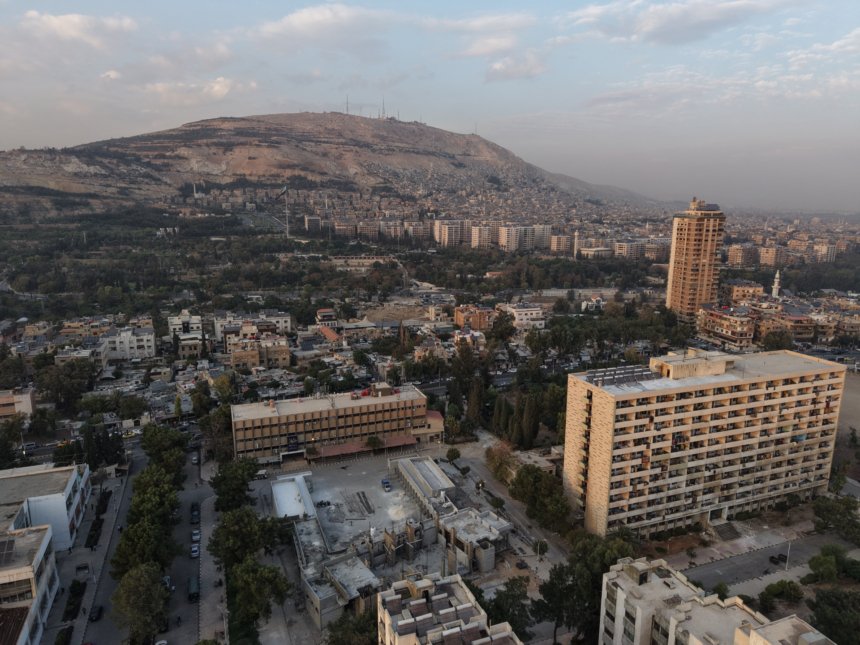
The mountain is located to the north of Damascus, and extends alongside the city for a length of approximately several kilometers, with a height of about 1,150 meters above sea level.
This height gives a direct view of the old and modern neighborhoods of Damascus, from the historic city walls to the new urban extensions.
From its summit, the features of the capital can be clearly traced. It shows the old area, including the Umayyad Mosque and Al-Hamidiyah Market, along with the neighborhoods of Mezzeh, Kafr Sousa, Abu Rummaneh, and Al-Maliki.

The view also reveals the urban sprawl that the city witnessed during the twentieth century, in a scene that summarizes the transformation of Damascus from a walled city to a sprawling capital.
Presence in historical sources
Qasioun is associated with a number of religious and historical narratives. Islamic sources mention that at its foot or caves there are places attributed to prophets, and what is known as the “Cave of Blood” is linked to his name, which traditional accounts indicate to be the site where Cain killed his brother Abel. Although researchers disagree about the accuracy of these accounts, they contributed to consolidating the mountain’s presence in the popular conscience.

Damascene historians, including Ibn Asakir in his book “The History of Damascus,” also referred to the mountain as part of the geographical landscape that surrounded the city since its inception.
It was repeatedly referred to in the writings of geographers and travelers who passed through Damascus, and it was considered a constant element in describing the capital.
Urban development on the slopes
Over the past decades, the foothills of Qasioun have witnessed remarkable urban expansion, as residential neighborhoods were established that gradually extended upward toward the heights.
This expansion changed the natural landscape of the mountain, making it part of the urban fabric of the city, not just its natural background.

Some of its areas have turned into points where residents go to watch the panoramic view of the capital, especially on national or religious occasions, as Damascus appears from above as a continuous network of lights revealing its breadth and the diversity of its neighborhoods.
A symbol in cultural memory
Qasioun was present in Syrian poetry and literature as a witness to the city’s transformations. His name was used in literary texts and patriotic songs, and it became a symbol of stability and elevation.
His name was also associated with popular expressions indicating his place in the public imagination, to the point that mentioning Damascus became associated with him in many contexts.
This cultural presence strengthened its position as more than a geographical location; It has become a sign of the capital itself. The reference to Qasioun is often a direct reference to Damascus, with its history, population, and details of its daily life.
A view that reveals the layers of the city
The mountain top gives a comprehensive view that allows reading the urban composition of Damascus. The historical core of the city can be distinguished by its markets and alleys, and then we can notice the modern extensions that appeared in later periods.
The differences between the old neighborhoods with high urban density and the modern areas with wide streets and multi-storey buildings are clearly visible.

The view also reveals the green expanse of Ghouta’s orchards, which historically formed an agricultural belt around the city, despite the decline its areas have witnessed in recent decades. In this sense, the mountain provides a visual reading point for the environmental and urban transformations that Damascus has undergone.
After religious and touristic
In addition to its historical symbolism, Qasioun has remained a destination for visitors wishing to view the capital from above, and its area includes a number of shrines and sites that some visitors visit for religious motives, in addition to being a site that provides a general view of the city.
This diversity has contributed to consolidating its position on the domestic tourism map, as it combines the natural and historical dimensions, and provides the visitor with the opportunity to see Damascus from a different angle, reflecting its breadth and diversity.

Watch the transformation of the capital
Over the centuries, Mount Qasioun remained present in the background of the Damascene landscape, and witnessed the succession of states and emirates, the transformations of the urban structure, and the change in lifestyles in the capital.
With each historical stage, the mountain remained a fixed point in geography. At its slopes, the details of the city changed, while it remained a unifying element in its general image.
With this status, Qasioun constitutes one of the keys to understanding Damascus. It is not just a natural elevation, but rather an area that reveals from above the history of a city that is one of the oldest inhabited capitals in the world, and its scene summarizes accumulated layers of time that reflect its cultural depth.