Published On 4/20/2026
A court in Kampala has convicted 8 young environmental activists on charges of rioting, after they participated in a peaceful protest against the East African Crude Oil Pipeline Project known as “Ecop”. The project is led by a coalition led by the French group Total Energies, along with the China National Offshore Oil Corporation and the governments of Uganda and Tanzania.
The defendants – most of whom are university students who are members of the “Students Against ECOP – Uganda” movement – have spent more than 8 months in pretrial detention since their arrest on August 1 in front of the headquarters of Stanbic Bank in Kampala, where they raised banners demanding the cessation of financing the project.
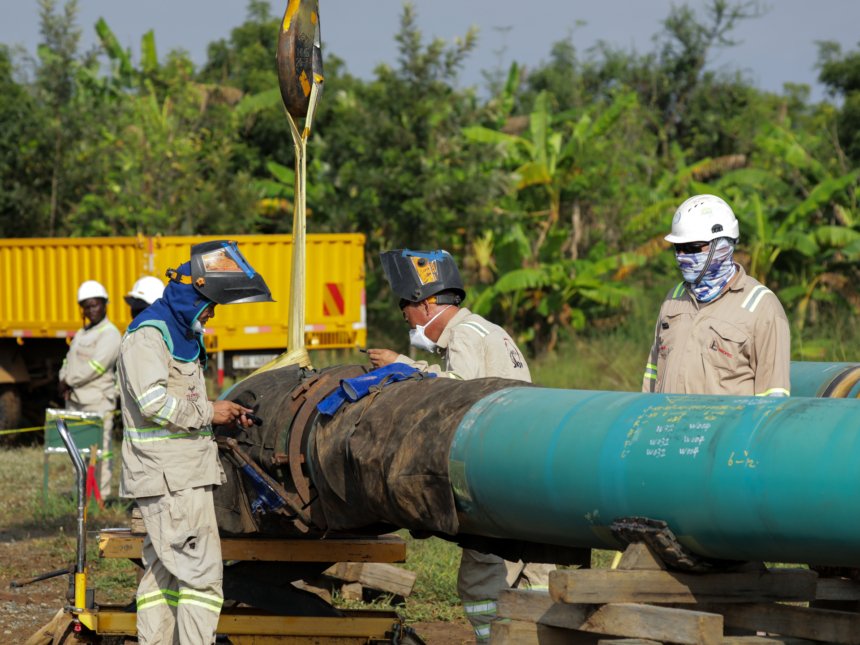
“ECOP” extends over a distance of 1,443 kilometers, transporting oil from the fields of Lake Albert in western Uganda to the Tanzanian port of Tanga, becoming – upon completion – the longest heated oil pipeline in the world, with exports starting in the second half of 2026. The American “Climate Accounting Institute” organization estimates its total emissions across the entire value chain at about 379 million tons of carbon dioxide.
Human rights reports indicate that about 460 kilometers of the pipeline’s route are located within the Lake Victoria basin, on which more than 40 million people depend for their livelihood, while land acquisitions led to the displacement of thousands of families amid complaints of weak compensation.

A wave of condemnations from Kampala to Paris
The StopEACOP coalition described the ruling as an example of using the judiciary to protect funders, and asked the UN Special Rapporteur on human rights defenders to intervene urgently. For its part, Human Rights Watch confirmed that there has been a continuing pattern of judicial harassment of environmental activists for years.
Regionally, the legality of the intergovernmental agreement between Uganda and Tanzania is still being challenged before the East African Court of Justice in Arusha, based on treaties including the Lake Victoria Basin Sustainable Development Protocol and the African Charter on Human and Peoples’ Rights.
As for Paris, last February, a court in the French capital held a session to consider a case against Total Energies, filed by a coalition that includes the organizations Notre Affaires, Sherpa, and France Nature and Environment, along with the municipality of Paris. The plaintiffs are demanding that plans be put in place to monitor and prevent environmental and human rights risks, and that the company be required to halt its new extractive projects. The ruling is scheduled to be pronounced on June 25 in a case that may set a European legal precedent on corporate climate responsibility.
The French Bishops’ Conference and the European Parliament also previously issued statements criticizing the project, to which the governments of Uganda and Tanzania responded sharply, describing the European position as “interference in the sovereign affairs” of two independent countries.
Causes of polarization
This file reveals the intertwining of four conflicting narratives about the “ECOP” project:
- The narrative of sovereignty and development: Uganda and Tanzania maintain that the project is a historic opportunity to exploit wealth discovered in 2006, and Ugandan President Yoweri Museveni believes that European criticism represents interference in sovereign affairs.
- Climate justice narrative: Activists consider that a project that pumps about 34 million tons of carbon dioxide annually over a quarter of a century cannot be described as development.
- The human rights narrative: Human rights organizations point to a systematic pattern of arbitrary arrests against environmental defenders.
- Transnational Accountability Narrative: The European investor in Africa is no longer immune from his country’s judiciary, after the French Duty of Vigilance law turned into a legal pressure tool available to civil society.
With the progress of work on the ground – as the rate of laying pipes has exceeded half of the path – the political, legal and symbolic battle of “Ecop” appears likely to extend for months to come, and may redefine the relationship between Africa and its traditional investment partners.