Published on 6/28/2026
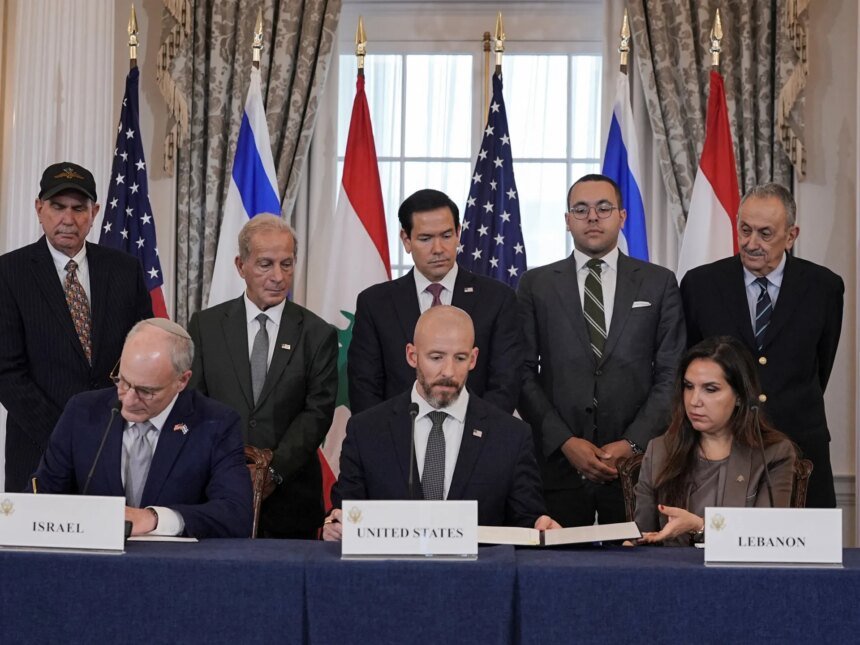
Axios revealed the scenes behind the scenes of the fifth round of negotiations between Lebanon and Israel, which led to the signing of the framework agreement between them after talks in Washington under American sponsorship during the past few days.
The first session of the fifth round of negotiations began last Tuesday, June 23, at the headquarters of the US State Department, and was scheduled to last 3 days, but it was extended for another day, in the wake of disagreements between the two parties.
Stormy beginning
According to six American, Israeli and Lebanese sources who spoke to the American website, the first session was opened by the Israeli ambassador to Washington, Yehiel Leiter, with a strongly worded speech, describing the new American-Iranian understandings regarding Lebanon as a disaster.
Leiter asked the American mediators whether Washington was still interested in weakening Iranian influence in Lebanon, while the Lebanese delegation, in turn, responded by requesting clarifications, as a source with direct knowledge of the talks said: “The Lebanese were in a defensive position.”
An American official acknowledged that the first day of the talks was “very bad,” as the parties clung to their positions, especially on security issues, and some participants felt that the negotiations were actually going backwards.
The talks were taking place on two tracks: a security track between military officers, and a political track between diplomats, while senior officials from the Ministry of War and the US State Department assumed the task of mediation.
The parties worked on 3 documents: a framework agreement, a security annex, and the initial Israeli withdrawal from two “experimental” areas, with the Lebanese army replacing Israeli forces in them.
Unlike the first day, the pace of negotiations on the next day (Wednesday) accelerated, and American officials began to believe that the agreement could be signed the next day (Thursday), according to the sources.
Negotiations stopped
But disagreements emerged on Thursday as both parties hardened their positions and Washington was unable to fill the gaps in the three documents, as the main disagreement revolved around the conditions and locations of the Israeli withdrawal.
The sources add that Israeli Prime Minister Benjamin Netanyahu and Lebanese President Joseph Aoun temporarily suspended the negotiations on Thursday evening, noting that the two delegations requested more time to consult with their leadership, while the American mediators agreed to extend the talks for an additional day.
In conjunction with this, US Secretary of State Marco Rubio returned from his Gulf tour on Thursday evening, after having made about 8 calls since last Tuesday with Netanyahu and Aoun, and US Vice President J.D. Vance also spoke with each of them at least once.
According to sources, Rubio stressed that US President Donald Trump wants to complete the agreement before the end of the week, while an informed source said that the high American interest made it clear to both parties that there is a sense of urgency about the necessity of reaching an agreement.
Rubio interjected
In an apparent attempt to salvage the course of the negotiations, the sources pointed out that Rubio joined the talks on Friday morning to help bridge the gaps.
She explained that Washington asked Israel to make two amendments to the text to ensure agreement between them, including withdrawal from a southern village still under Israeli occupation and clearly stipulating that this would be the beginning of a broader process of withdrawal from Lebanon.
It was reported that the Israeli ambassador and senior Israeli officials pressed for approval during a tense call with Netanyahu when he rejected the amendments, as it was reported from two informed sources that the Israeli ambassador raised his voice, stressing that the agreement represents an important achievement and that Israel must sign it.
A source close to Leiter said that he raised his voice because of the disruption to the communication line, while the Israeli ambassador to Washington told Axios that contacts with officials in Tel Aviv during negotiations are normal and differences in viewpoints are normal.
The ambassador stated that during one of the briefing calls, a professional, substantive and sometimes intense discussion took place, adding, “We reviewed various opinions on the best ways to maximize the gains of the negotiations while fully preserving Israel’s vital interests.”
A vision that is difficult to implement
On the other hand, an informed source confirmed to the American website that there was not a great deal of trust between Israel and Lebanon, but the two parties eventually realized that they needed an agreement in order to remain in control of the course of the process and block the way for Iran.
American, Israeli and Lebanese officials said that weakening the influence of Hezbollah and Iran in Lebanon was a common and clear goal that pushed the two parties forward over the course of 4 days of negotiations in Washington.
In recognition of the difficulty of implementing the agreement reached, officials stressed that all parties realize that the vision proposed by the framework agreement may never be achieved.
According to these sources, there is deep concern that the agreement will lead to a violent reaction from Hezbollah that may return Lebanon to civil war, adding that the framework agreement between the Lebanese and Israeli governments appears to conflict with some understandings between Washington and Tehran, which may complicate the fragile truce between them.
The sources added that the understandings in Switzerland shocked Israeli and Lebanese officials, and they considered that they strengthened Hezbollah’s position and legitimized Iranian influence in Lebanon.
Last Friday, Israel and Lebanon signed a framework agreement to end the conflict permanently. The agreement is based on mutual recognition of the right of each of them to live in peace as two sovereign states, while adopting a path of direct negotiations under American sponsorship to address the outstanding issues.
It also stipulates a gradual plan to strengthen the sovereignty of the Lebanese state through the deployment of the Lebanese army in exchange for the withdrawal of Israeli forces, according to executive arrangements specified in a security annex, with full American supervision and support.
The agreement includes the establishment of experimental areas to begin the transitional phase, while linking reconstruction and the return of civilians to progress in disarming Hezbollah, dismantling its military structure, and consolidating the state’s security control, with the United States monitoring implementation and ensuring compliance with its terms.
The fifth round of talks came after the United States and Iran signed a 14-item memorandum of understanding, the first of which included stopping the fighting on all fronts, including Lebanon. It also came shortly after the conclusion of negotiations between Washington and Tehran in Switzerland in which the Lebanese file was strongly present.