Published on 6/28/2026
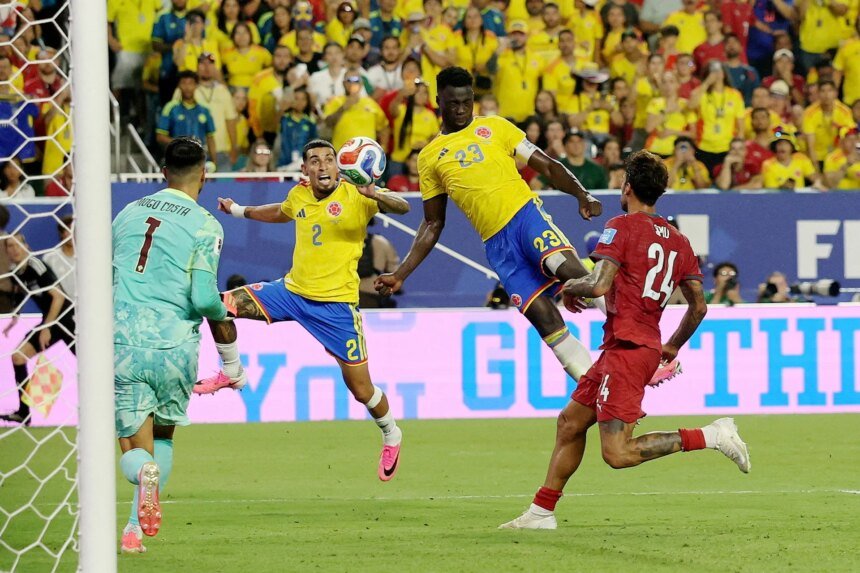
The decision to cancel Colombia’s fatal goal in stoppage time against Portugal caught the spotlight, after the Video Assistant Referee (VAR) technology and semi-automated offside detection technology intervened to cancel a goal that initially appeared to give the Colombians a valuable victory at the end of the group stage competitions of the 2026 World Cup.
After a review that took a few moments, the technology confirmed the presence of an offside case with a difference of no more than a few millimeters, so the match ended in a goalless draw (0-0), in a snapshot that brought back to the forefront the debate regarding offside decisions that are decided by differences that cannot be seen with the naked eye.
Colombia defender Davinson Sanchez scored the goal in the last moments, after he rose to a perfect cross inside the penalty area and headed it past Portuguese goalkeeper Diogo Costa, causing the stands of Miami Stadium to explode with celebrations from the Colombian fans, before the match was stopped awaiting review of the shot via video technology.
Why was Davinson Sanchez’s goal disallowed?
Read also
list of 2 itemsend of list
Initial replays showed that the Colombia defender was in an offside position when he rose to convert the cross coming from the left flank into the net, but the shot was inconclusive for viewers due to the limited television broadcast angles.
Later, the Video Assistant Referee (VAR) technology published drawings and snapshots of the semi-automated offside detection technology, which showed that Sanchez was ahead by a very small margin, represented by the front of his shoe (his toe), which was sufficient, according to the law of the game, to calculate the offside situation and cancel the goal.
Widespread controversy and mixed reactions
The decision to cancel Colombia’s goal sparked a wide wave of controversy across social media platforms and in sports circles, as it seemed to many that the goal was correct, especially since most angles of the television broadcast did not clearly show Sanchez’s foot position, which opened the door to questions about the validity of the decision.
Colombian fans expressed their dissatisfaction with the decision of Australian referee Ali Reza Faghani and his arbitration team, considering that the difference on which the semi-automatic offside technique was based was very small.
However, the technical footage published by the video assistant technology confirmed that Sanchez was ahead with the front of his shoe, which made canceling the goal consistent with the text of the offside law.
During the television broadcast, Fox sports analyst Stu Holden described the situation as “offside by a very small margin,” expressing his astonishment after showing the replay that showed the tip of Sanchez’s right shoe crossing the offside line, and said: “This is a size 10 instead of a size 9, wow!”
On the other hand, American sports commentator John Strong confirmed that the referees “made the correct decision” according to the text of the law, despite the small difference, stressing that the technology applied the law as it was.
The controversy extended to the “X” platform, where the “SPJ” account, which specializes in sports analysis, saw that the situation was considered offside from a legal standpoint, but it was not consistent with the spirit of the game, considering that video assistant technology was now deciding the results of matches with differences that did not give the attacker any real advantage, despite its importance in helping the referees.
As former American football player and sports analyst Taylor Twellman asked: “What do we do?”, referring to the recurring controversy raised by offside decisions calculated in millimeters.
While the “Khaldo” sports account saw that the goal was correct, attributing the error – from his point of view – to the timing of determining the moment the ball left the player’s foot.
Does the offside law need to be amended?
The debate was not limited to the validity of the decision, but rather extended to the offside law itself, as a number of bloggers and analysts saw that calculating offside due to a small part of the shoe or toe conflicts with the primary goal of the law, which is to prevent the attacker from gaining a clear advantage, not to punish him for differences that cannot be distinguished with the naked eye.
In this context, observers re-introduced what is known as “Wenger’s rule,” which gives the attacker a greater margin before calculating offside.
Supporters of this proposal believe that its application may reduce the cancellation of goals with millimeter differences, and achieve a better balance between technical accuracy and the spirit of the game, while its opponents assert that the existence of a dividing line between offside and proper play will remain in place no matter how the wording of the law changes.
Source: Al Jazeera + Agencies + social media sites