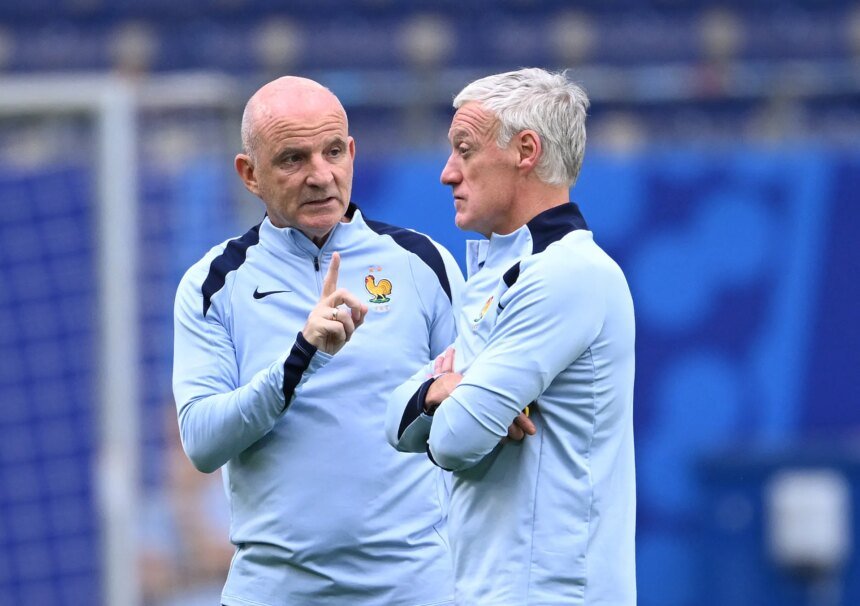
When the French national team plays any match, preparations begin with special rituals that only Didier Deschamps and his assistant Guy Stephan know about, details that reflect the depth of the relationship that has united the two men for nearly two decades.
On the day of the match, Deschamps enters his assistant’s room, carries the electric razor himself, and calmly shaves Stephane’s head, in a scene that has become a constant part of the team’s routine since 2014, and no one else is present.
Read also
list of 2 itemsend of list
The rituals do not stop there, as the duo is keen to adhere to fixed customs in every team gathering. At all meals, Stephane sits to the left of Deschamps, while he occupies the seat to his right during all trips, whether by bus or plane.
Stefan comments on these customs with a smile, saying that it is only about maintaining balance, and has no other connotations.
Although the official cooperation between Deschamps and Stephane began 17 years ago, the roots of the relationship go back to the year 2000, when Deschamps was captain of the French national team, while Stephane worked as assistant coach to Roger Lemerre, and the team then succeeded in winning the European Championship.
Years later, the duo began working side by side, as they spent three years with the Marseille club, before moving together to the French national team, and their cooperation continued for fourteen years within the Roosters’ technical staff.
Great successes and historical achievements
During their years together, Deschamps and Stephane have built one of the most stable partnerships in international football.
They won the league title with Marseille, then reached three final matches with the French national team in major tournaments, and the most notable achievement was winning the World Cup title in 2018 in Russia.
Despite some failures, such as the sudden exit to Switzerland in the round of sixteen of the European Championship in 2020, these negative results remained an exception in a career full of successes.

Stefan confirms that the team went through difficult periods, but was always able to overcome them, pointing out that the limited defeats did not affect the strength of the project led by the technical staff.
Guy Stephan believes that the secret of the success of the relationship with Deschamps lies not only in the long years of work, but also in the level of understanding that the two parties have reached.
Stefan told The Athletic newspaper: “We no longer need to talk during matches or training, as one look between us is enough to understand what needs to be changed or modified on the field.”
He explained that the discussions between them do not stop, and that they sometimes disagree, but once the decision is made, everyone becomes committed to implementing it, which has given the technical staff a great deal of stability over the past years.
An exceptional responsibility in a difficult humanitarian circumstance
Guy Stephan found himself facing a different task during the current World Cup, after Didier Deschamps was forced to leave the French national team camp and return to his country following the death of his mother.
Accordingly, Stephane takes over the leadership of the French national team temporarily during the third match in the group stage against the Norwegian national team, benefiting from the full confidence he enjoys from the first coach.
This is not the first position in which he has led the national team in the absence of Deschamps, as he previously took charge during a match against Denmark in 2022, when Deschamps was absent due to the death of his father.
But the current confrontation represents the first time he has led France during a major tournament, and he is sixty-nine years old.
Guy Stephan is among the most experienced coaches at major tournament level, currently competing in his fourth World Cup final alongside Deschamps.
He also previously participated in the European Championship in 2000 as part of Roger Lemerre’s coaching staff, before leaving his position after the 2002 World Cup.
His career did not stop with the French national team, as he also had coaching experience with the Senegal national team for several years, bringing his total participation in major tournaments to ten, a number that reflects the amount of experience he possesses in managing international competitions.
Make way for Zidane
The partnership between Guy Stephane and Didier Deschamps did not begin directly within the technical staff, although the two men worked together in the French national team that won the European Championship in 2000, when Deschamps was captain of the team, while Stephane held the position of assistant coach.
Stefan describes the nature of the relationship between them during that period as being a normal relationship between a player and a coach, before it developed years later.
The turning point came in 2007, when the two met again while working as analysts in a television studio, and there Deschamps offered Stephane to join his technical staff. Stefan recalls that moment simply by saying: “I agreed.”
Before the beginning of the long journey, there was a short attempt in 2008 to work together at Liverpool FC, but it was not completed, before the real partnership began in June 2009 with Marseille, from which they later moved to the French national team.

Guy Stephan believes that the current edition will be the last for him and Didier Deschamps with the French national team, in light of expectations that Zinedine Zidane is close to assuming leadership of the national team after the end of the current coach’s career.
Stephane believes that the value of what Deschamps provided will become clearer after his departure, stressing that the fans will realize the magnitude of the achievements achieved during fourteen years with the French national team. He explained that his speech did not contain any criticism of the next coach, but rather reflects the nature of football, where everyone tends to search for change and renew ideas, adding that the media, in turn, is always looking for new stories, considering that this is a natural part of life.
A different path to the world of football
Guy Stephane’s start in football was unconventional, as his father, who worked as a mechanic, was not convinced that the game could be a stable career.
Although physical education teacher Claude Berard encouraged his talent, Stephane enrolled in a teacher preparation course in response to his parents’ wishes, before he began to think seriously about his sporting future.
Stefan confirms that he does not feel any regrets about this decision, noting that his life might have gone in a different direction if he had played professional football early, but he cannot say for sure whether that would have been better or worse.
He also describes himself as a good player without reaching the level of stars, but he nevertheless succeeded in representing the French youth national team.
Between the ages of nineteen and twenty-three, Stefan lived a double life.
On weekdays, he was training to become a teacher in Dinard, Brittany, while weekends he spent traveling about an hour and a half to play for second-tier club Guingamp.
During that stage, a strong relationship developed between him and club president Noel Le Graet, who later became president of the French Football Federation for twelve years, between 2011 and 2023.
Although he has a qualification as a physical education teacher, Stefan has not practiced teaching.
In 1980, at the age of twenty-three, he made the decision to play professional football, joining Rennes, the city that also witnessed the birth of his eldest son, Julien, who is currently the club’s sporting director.
His career as a defense player witnessed the colors of several French clubs, most notably Rennes, Le Havre, Orléans, and Caen, before his sporting career took a decisive turn.
An accident changed the course of his life
On July 24, 1986, while returning home after a training session with Cain, Guy Stephan was involved in a serious car accident that nearly took his life.
The accident left him with fractures in his jaw, leg, and elbow, in addition to a severe head injury that put him in a coma.
He remembers that stage, saying that the experience taught him the necessity of getting up again, no matter how difficult the circumstances were, explaining that the pain is not limited to the injured person, but also extends to his family members and those close to him.
After long months of treatment and rehabilitation, Stefan returned to training, but quickly realized that his physical condition would not allow him to return to the level he was at before the accident.

When he was twenty-nine years old, he made the decision to retire, ending his career as a player, but at the same time it was the beginning of a new, more successful phase in the world of coaching.
His passion for education was an important factor in his transition to artistic work, as he benefited from his studies in the fields of psychology, physiology, and educational sciences to obtain his training qualifications.
He began his coaching career as assistant coach of the first team at Caen, alongside Pierre Mankowski, which was the first step towards a long career within the technical staff. Guy Stephan believes that the coaching profession has witnessed major changes since the beginning of his career in the 1980s.
Deschamps philosophy…the secret of success
Guy Stephan refuses to describe Didier Deschamps as an old-school coach, stressing that the secret of his success lies in his ability to develop and build strong relationships with the players. Speaking to The Athletic newspaper, he said: “The most important thing is to always be aware of what is going on on the field, and with the difference in generations, you must talk a lot with the players, and it is important for them to express themselves.”
He added: “The job of coaching today revolves around human relations and getting the best out of the player. It has evolved and become closer to the players than it was before.”

Stephane believes that the French team is experiencing a period of renewal after the departure of a number of stars from the previous generation, but he stressed that success does not depend on individual talent alone, explaining: “You need individual quality and collective quality together. Collective quality gives you continuity, but individual talent is what decides matches.”
He also stressed that the mission of the technical staff is to discover players capable of reaching the highest levels, noting that their evaluation requires accurate knowledge of their physical, technical and mental capabilities, and not just circulating impressions.
Stefan explained that his role is not limited to preparing training, but extends to monitoring the psychological state of the players, saying: “I try to talk to the players constantly, and I notice if one of them is sad or smiling, as mutual trust helps us maintain the stability of the group throughout the tournament.”
He also praised N’Golo Kante’s mentality, stressing: “He is a wonderful man, whether he plays as a starter or sits on the bench. He deals with the same morals, and few players possess these qualities.”
Stephane concluded his speech by emphasizing that the most prominent characteristic of Deschamps is his calmness under pressure, saying: “He brings reassurance to the team, and remains focused without tension. We talk a lot during matches, and he listens to opinions before making his decisions, and this is one of the most important reasons for his success.”
He added, in praise that reflects the long years of partnership between them: “I watched Didier develop. He was a really good coach, but I saw him improve year after year.”